DIY Your Design Cushion Covers – Photo & POD Printing
$1.50
DIY your design cushion covers: your photograph, quote, monogram or artwork printed full-bleed on the face you choose – linen, polyester peach skin, cotton linen or super velvet as charted, with embroidery, fringe and gold foil quoted as upgrades. This is the always-open lane with no seasonal gate: one artwork file, one digital mock-up returned free, a 3-5 day physical proof, then 7-15 days of bulk after artwork approval inside 1,000,000 pcs per month across our gift lines. The banner’s printed panel gives the photographed size floor plan – 45X45CM centre with 35, 40, 50 and 60CM rows flanking – so dimensions come from evidence, not assumption. Built for print-on-demand sellers testing a single design at 100 pcs per design, wedding and event favour runs counted per seat, and small brands printing their own mark between bigger product programs. Hidden back zip confirmed on proof; FBA labelling, ocean freight for stocked programs and air or courier (DHL / UPS / FedEx / TNT) for date-critical runs.
A blank cover is the cheapest custom product in the home-decor aisle: one flat print file, one sewn square, and a design that belongs to you alone. This page is the DIY your design lane – photo cushions, name prints, single-design programs for print-on-demand sellers, wedding favour runs, and any artwork a seasonal catalogue would never carry. No holiday calendar gates it: the line runs all year, one design at a time.
Your File In, A Printed Cover Out
The mechanic is a full-bleed print onto a sewn cover face. You send flat artwork – a photograph, a logo, a pattern tile, a hand-lettered quote – and we return a free digital mock-up showing it stretched on a filled square before anything is cut. From mock-up approval, a physical proof follows in 3-5 days so colour and scale sit in your hands, and bulk closes in 7-15 days after artwork approval. That is the whole loop, and it repeats for every design you launch.
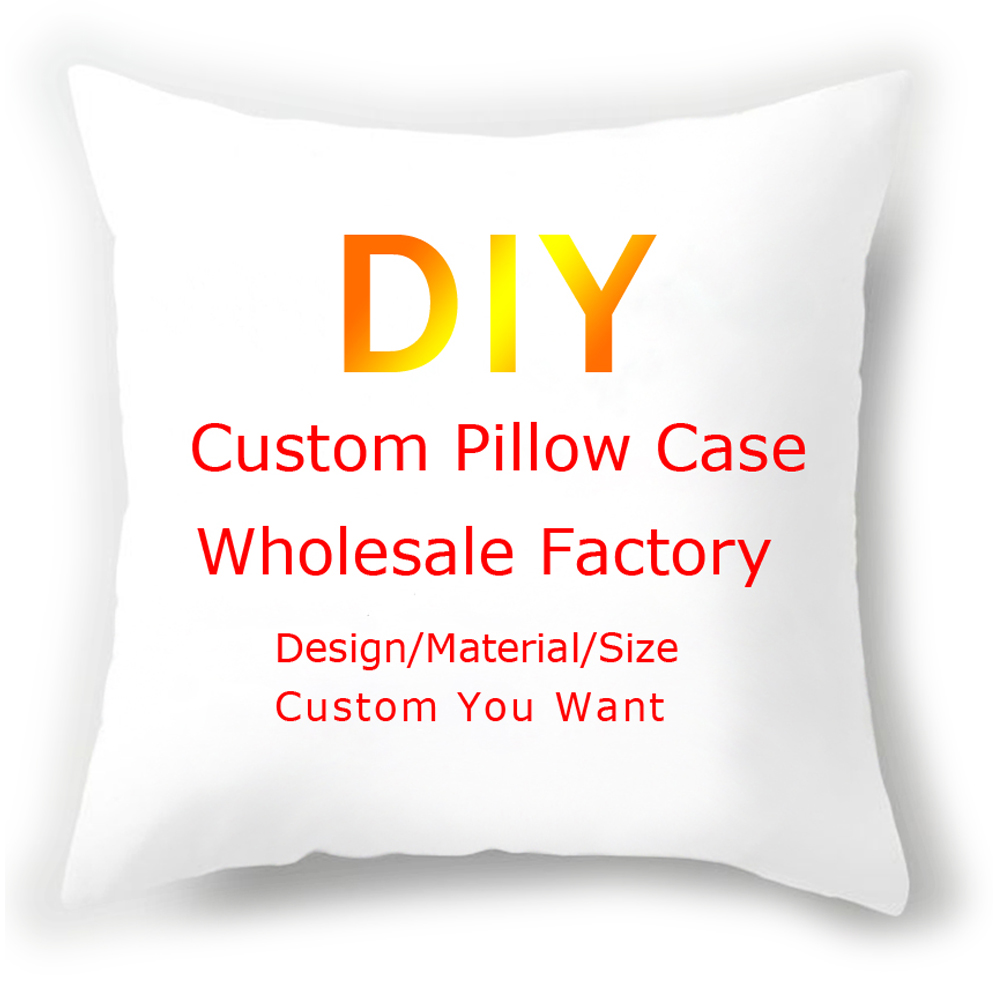
The photographed template makes the point literally: a plain white, print-ready face carrying only the line’s own spec pitch – DIY, custom pillow case, wholesale factory, your design / material / size. The face is smooth with no pile, the corners mitre to points, the perimeter is a plain sewn seam. That white square is the starting object for everything below; whatever your file contains, this is the body it lands on.
The Print Zones the Sample Panel Shows
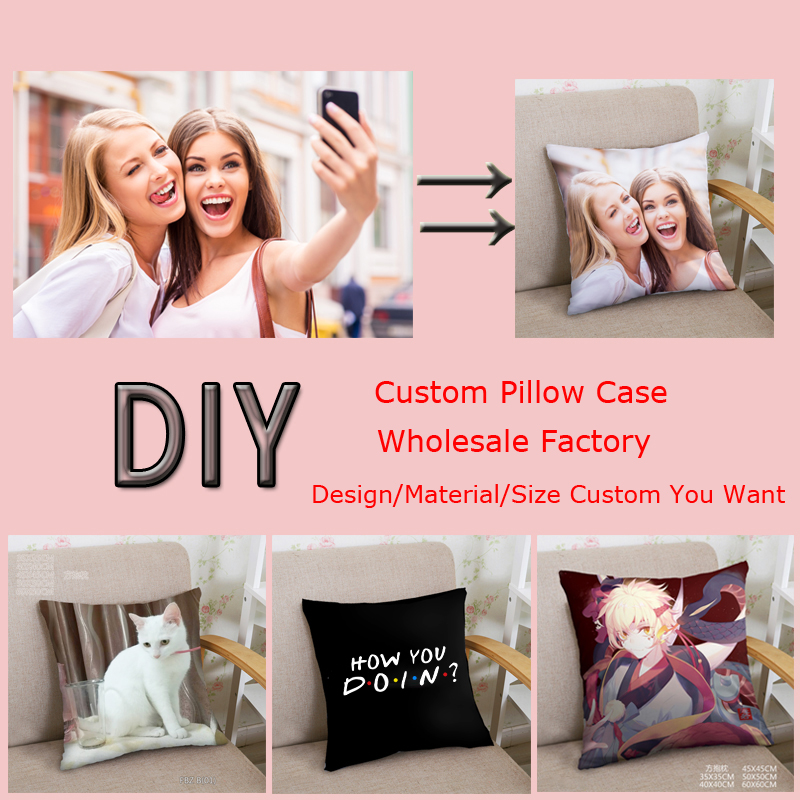
One banner photo maps the zones a DIY order can fill. Top band: a stock source photo of two women taking a smartphone selfie, black arrows pointing to the same image reproduced edge-to-edge on a cover – the picture-to-product move that drives personalised gifting. Bottom band: three more sample prints. A pet photograph on a light ground. A text-led novelty print on solid black, hand-lettered capitals punctuated with coloured dots. An illustration-zone print in a red-and-dark palette with a small square seal mark at the artwork’s edge.
Those samples are stock demonstration art, and the honest rule of this lane is rights: the selfie, the pet photo, the quote and the illustration are all customer content zones, printed on your files and your permissions. Recognisable characters, logos and TV wording need licensing from whoever owns them; family photos, original artwork, business marks and made-up quotes do not. We press what you own – and the mock-up stage is where an artwork either earns its place on fabric or gets sent back for a fix before you commit quantity.
Choose the Fabric From the Option Chart
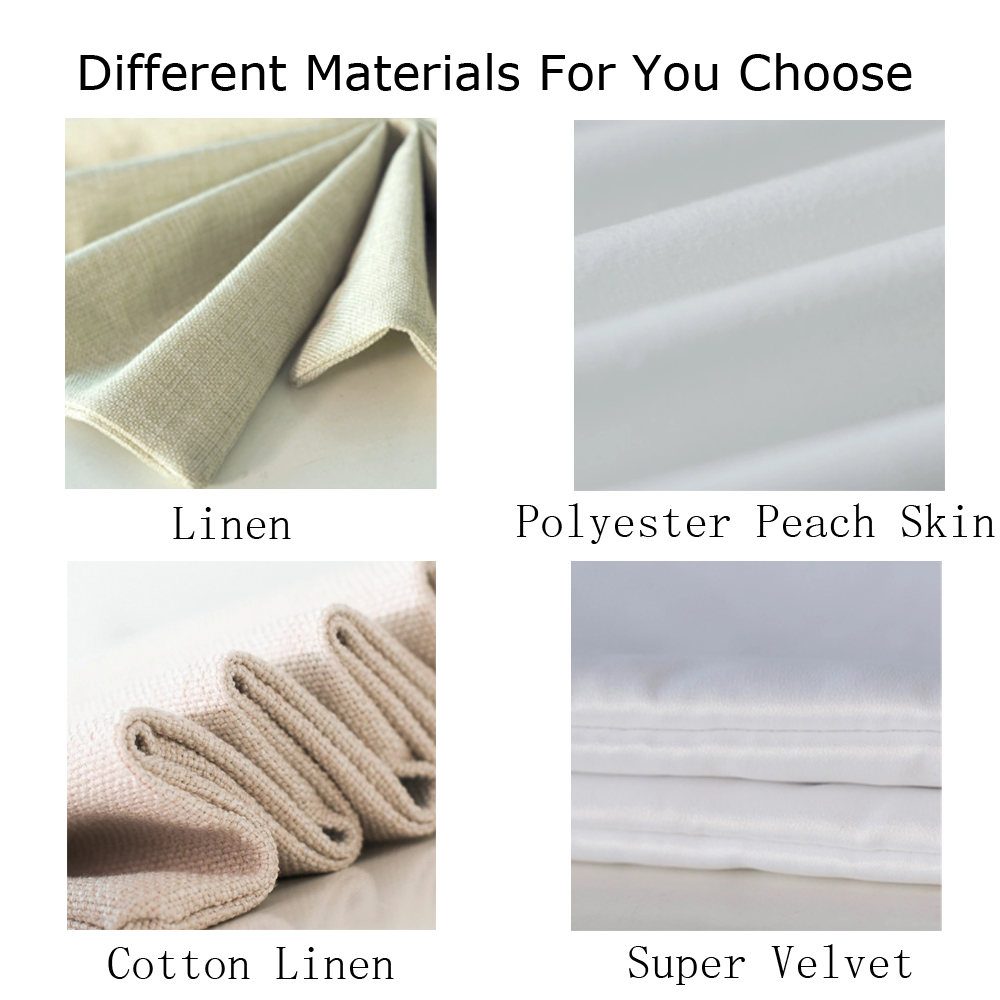
A second graphic lays out the material menu, photographed as four draped swatches under a choose-your-material headline. Linen: a matte, coarse slubby plain weave in oatmeal, fanned into accordion folds. Polyester peach skin: a near-white cloth with a faint sheen and a very short brushed nap, folded in broad soft rolls. Cotton linen: a chunky open basketweave in dusty pink, rolled into loose cylinders. Super velvet: a white short-pile stack with a soft low sheen and one stitched line across the fold.
These are fabric options quoted per order, not the four swatches themselves – raw cut edges, no construction. Face weight moves with your quote: the peach-skin and velvet builds read soft against the hand, the woven linen and cotton-linen faces hold print lines crisp and matte. No printed grammage appears on the chart, so gsm figures come back with your quote rather than being guessed on the page. For photo prints specifically, the tight smooth faces (peach skin, print-ready woven) reproduce gradients and skin tones far cleaner than the open basketweave, which suits graphic and typographic art better than photographs.
Choose the Decoration Method Too
A third chart splits four finishing routes, each photographed in a styled bedroom or living-room panel. Digital print: black geometric motifs on white grounds, including lumbar shapes finished with pom-pom tassels at the ends. Embroidery: raised white animal figures standing off flat colourways in yellow, grey, teal and pink. Tassels: full-colour safari scenes on green foliage grounds, edged all round with a gold fringe trim. Gold print: metallic foil crowns, palm fronds, flamingos and triangles on smooth grounds, mixed with a long-pile faux fur cushion and a tufted round. The chart labels are functional – print, stitch, fringe, foil – and the panel text carries one typo (“Embroldery”) we have corrected here.
For a DIY program, the digital/sublimation column is the workhorse: it takes photographic files at full bleed with no screen count or colour separation penalty, which is what single-design sellers need. Embroidery, tassels and foil are merchandising upgrades – quoted per design once your brand moves from test batch to shelf presence, same factory, different tooling conversation.
The Size Panel, As Photographed
Unlike the seasonal capsules on this site – where no size is printed on any sample face – this page’s banner carries an actual printed specification block on one sample cover. The panel reads, under a CJK square-cushion label: 45X45CM as the centre reference, with 35X35CM and 40X40CM in one column and 50X50CM and 60X60CM in the other. So 45x45CM is quoted here as photographed spec, not assumption, and the flanking rows are the photographed size range; anything outside that panel is cut to order and confirmed on the quote.
One construction note held to the same evidence rule: every shot on this page is face-on, so no zipper or backing panel is anywhere in frame. This family is normally finished with an invisible fastener set into the rear seam; the tape, pull and gap length get walked down on your proof sample before quantity runs, never promised off a photograph.
That evidence discipline is also what keeps one-design catalogues honest between restocks. A POD seller reordering a winner in month six gets the same sewn square as the launch batch because the approved physical proof – not a mood board – is the factory reference. File revisions run through the same gate: swap your artwork, take a fresh free digital mock-up, re-approve, and the 7-15 day bulk clock restarts on the new file while the old spec stays archived. A bride adding a monogram variant for the rehearsal dinner and a brand tweaking a logo kerning before its second drop are queueing into the same controlled process, and neither one is shipped a surprise.
Who Runs a Single-Design Lane
Three buyer types, three different maths. Print-on-demand sellers: your catalogue is artwork, not inventory – the 100 pcs per design MOQ is the lowest floor a custom cover line can quote without hand-made pricing, sized for a launch of one design, and the mock-up image comes back usable for your storefront listing while the physical stock is still in production. Wedding and event buyers: matching favour runs carry a date, monogram or venue quote across the face – one design, counted per seat, and the covers live on as the takeaway nobody throws away, which is why the proof stage matters more than speed here. Small brands and cafés: staff-lounge décor, a retail add-on or a launch gift carrying your own mark, ordered between bigger product runs on the same account.
What all three buy is the same structural thing: a product where the design – not the textile – is the value. The blank is commodity; your file is the moat. That is also why this lane never appears in the seasonal capsules’ pricing conversation. A Halloween set competes against five other shops running near-identical spooky art at the same endcap; a photo cushion or a monogram favour competes against nothing, because the artwork exists once and lives with whoever commissioned it. If your program is instead a pre-designed holiday look, the September-order gothic Halloween capsule and the October-cut-off Christmas cover line own that calendar – same sewing floor, different decision.
The lane’s real argument is portfolio economics: a seasonal capsule owner buys pre-designed art twice a year and competes on price; a DIY program owner owns the artwork and competes on things nobody can reorder from the same factory. Production capacity – 1,000,000 pcs per month across our gift lines – means a POD seller’s Christmas spike and a bride’s spring date queue into the same sewing floor without either one waiting out the other.
The fabric chart above is doing double duty for that argument. Four named faces – oatmeal linen with a coarse slubby plain weave, near-white peach skin with a faint sheen and a whisper of brushed nap, dusty-pink cotton linen rolled into loose cylinders, and white super velvet stacked in soft horizontal folds with a low sheen – are not four products but four positions on a hand-feel spectrum, photographed as raw draped swatches with no construction at all. A graphic or typographic file looks deliberate on the open weaves; a photograph looks deliberate on the smooth faces. Choosing the face is choosing which of your products photographs truest on a listing page, which for a single-design seller is a revenue decision dressed up as a textile decision.
Because the swatches carry no printed weight figures, gsm comes back per selection on the quote rather than being guessed here – the same evidence rule that lets us print 45X45CM on this page (it is on the photo) and refuses to print any number that is not. Ask for swatch cards with your proof if your program needs to feel the four faces side by side before committing a run; the cards ride in the same courier envelope, and the fabric decision stops being a screenshot argument between you and your customer.
Freight behaviour follows the face you pick. The smooth print-ready builds pack flattest and photograph cleanest, which suits sellers running one SKU across a marketplace listing with tight image requirements. The velvet and peach-skin options read softer in hand but show compression lines out of a poly bag, so they earn a card interleaf between folded units – a packing note that costs cents per unit and saves a review thread about creases. Tell us the fabric and the sales channel in the same enquiry and the carton spec comes back already matched to both: retail-bound cartons get unit barcodes and shelf-ready counts, marketplace-bound stock arrives presorted to the inbound requirements your listing has to satisfy before the warehouse crew even cracks the master seal.
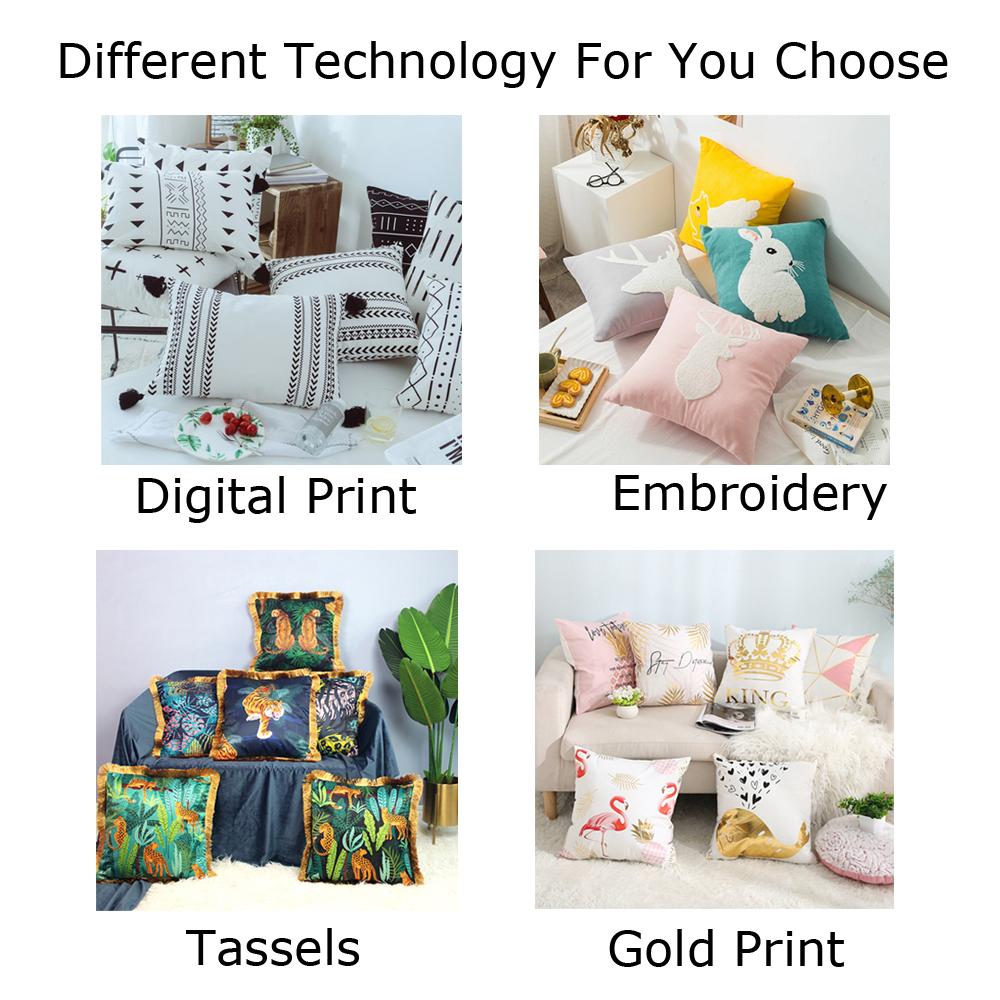
Worth reading the panels as a ladder rather than four equal doors. Every DIY file starts in the digital-print column, where any artwork – photo or vector – prints full-bleed with no tooling. From there, a programme graduates: a repeating mascot stitched in raised pile for a boutique line, a gold crown foiled over a monogram for wedding runs, a fringe trim added to a best-seller for a gift-shop launch. Each rung changes the quote and the proof conversation, and none of them require a new factory – the chart exists so buyers can plan the upgrade path instead of discovering it at reorder time.
Specifications
| Item | DIY Your Design Cushion Covers – photo & POD custom printing lane |
| Print zones | Full-bleed photo, text or illustration from your flat artwork file, reproduced edge to edge |
| Fabric options (as charted) | Linen, polyester peach skin, cotton linen, super velvet; gsm quoted per selection |
| Decoration routes | Digital / sublimation print standard; embroidery, fringe trim and gold foil quoted per design |
| Photographed size panel | 45X45CM centre reference; 35X35 / 40X40 / 50X50 / 60X60CM flanking as printed; other sizes on request |
| Closure | Hidden back-panel zip (line-typical); not shown in front-only photos – confirmed on proof |
| Design service | Free digital mock-up of your file on a filled-square view before cutting |
| MOQ | 100 pcs per design |
| Sample time | 3-5 days |
| Lead time | 7-15 days after artwork approval |
| Capacity | 1,000,000 pcs per month across our gift lines |
Seasonal Sisters, Same Sewing Floor
If your program is a pre-designed holiday look rather than your own artwork, the two capsule pages split that demand: the September-order gothic Halloween cover set and the October-cut-off Christmas cover line are printed on the same construction and freight lanes described here – they own the calendar, this page owns your file. Everything cushions-related lives in the cushion covers category inside the wider home textiles line; POD sellers building gift sets commonly pull printed throws from the blanket category and wall art from the tapestry section off one artwork file.
Packing and Delivery for Custom Runs
Finished covers fold flat, ride one to a poly sleeve, get counted into inner cases and load into export masters. FBA labelling is handled on the same line, which matters most to the POD sellers shipping into marketplace warehouses. Freight quotes split by urgency the way custom orders demand it: ocean for a stocked design program, air or express (DHL / UPS / FedEx / TNT) for a wedding date or a seller restock that cannot slip.

DIY Cover Questions, Answered
Can I print a single custom design, and what does it cost to start?
What artwork files do you take for photo cushions?
Which sizes exist – and where does 45x45CM come from?
Can I choose the fabric and the finish, not just the print?
Do you print characters, logos or TV quotes customers send in?
How fast does a custom order ship?
Send Your File, Get the Mock-Up Back
Attach your artwork, the fabric and size you want, and the quantity through the form below – or push the spec onto the quote request list if the cover rides together with throws or tapestries from one file. The free digital mock-up comes back before any cutting starts. WhatsApp / Tel: +86-15967739086 | Email: [email protected]