Custom Heavy Duty Non-Woven Grocery Bags
$0.30
Checkout-aisle carriers for chains and grocers: custom non woven grocery bags heavy duty, built from spun-bond polypropylene with sewn side gussets, a flat bottom that stands empty for counter display, and shoulder-length loops anchored by box-and-X reinforcement stitching. Choose the grammage tier – featherweight promotion, mid shelf-side carrier, or board-like weekly shopper – against swatches in a 3-5 day sample; print flat one-colour, reverse knockout or laminated full-colour faces across front, back and gussets. MOQ 100 pcs per design, free digital mock-up, bulk 7-15 days after artwork approval, 1,000,000 pcs per month across our gift lines, colour-coded carton breaks, FBA prep. Quote grammage and panel sizes at [email protected] or +86-15967739086.
Checkout Aisle Capital: Custom Non-Woven Grocery Bags, Heavy-Duty Build
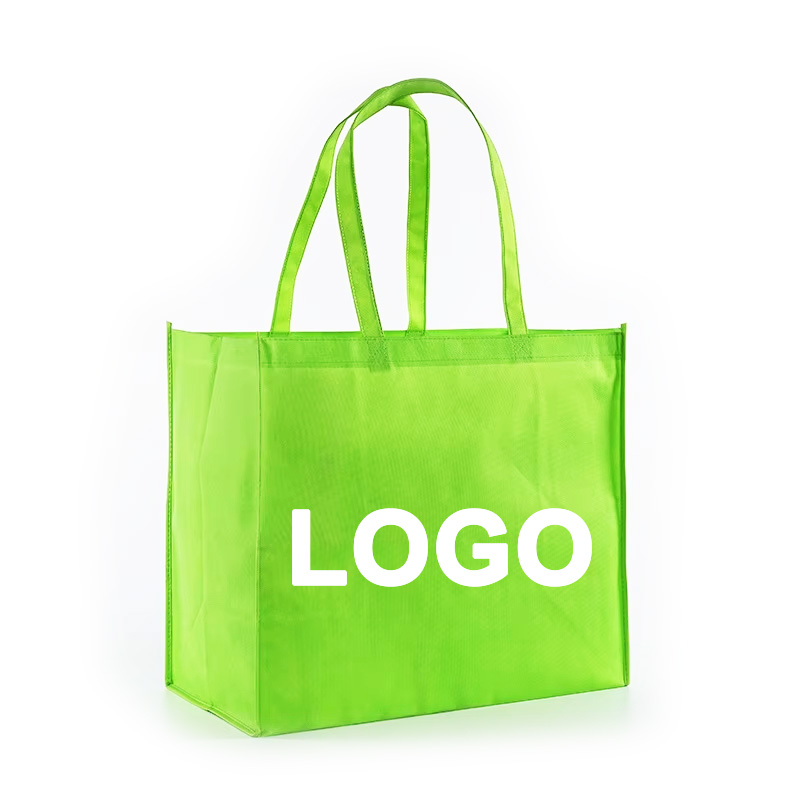
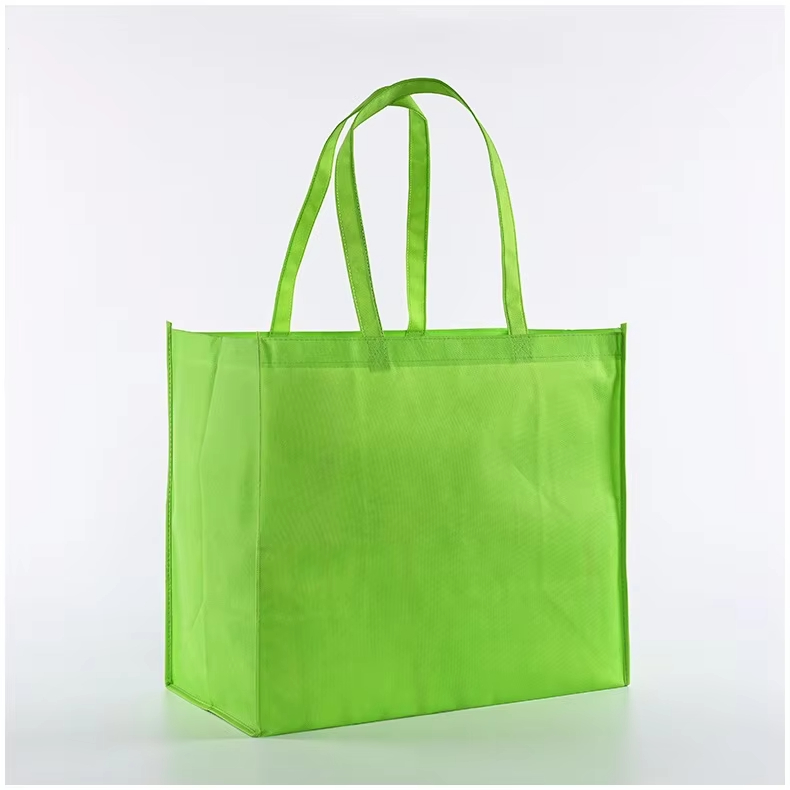
Custom non woven grocery bags heavy duty are bought by retail operators for one reason: a shopper who carries twelve items in your tote is advertising your brand past every rival shop on the walk to the car park. The photographed line is the classic open-top spun-bond polypropylene shopper – body in a saturated chartreuse, two same-colour loop handles, a sewn side gusset and a flat bottom fold that lets an empty bag stand upright on a counter, which is exactly how it merchandises at a checkout island before it ever reaches a home.
What the images prove and what we quote are kept apart on purpose. The shell shows the fine pressed cross-hatch texture of bonded fibre sheet rather than woven cloth; the handles show ribbed webbing with lengthwise stitch lines; and every handle foot is anchored under load with a rectangular box-and-cross reinforcement patch – all directly visible facts. Panel height, width, gusset depth and fabric grammage are printed nowhere on these photographs, so they are quoted against the roll, die and store requirement you select, not guessed here, and any supplier who prints numbers those photos do not show is selling you a datasheet, not a bag.
Procurement frame: this is a consumable that must survive repeat trolley runs, which is why the spec conversation starts at grammage, moves to stitch, and ends in carton-count maths. Production runs at MOQ 100 pcs per design, samples land in 3-5 days, bulk closes in 7-15 days after artwork approval, and monthly capacity of 1,000,000 pcs across our gift lines covers a chain-wide swap-out without splitting the order between suppliers or re-timing a launch.
Two more facts the camera settles before a buyer sends money. The mouth of the photographed bag is a turned-over hem stitched all the way round – no binding tape, no contrast piping – which is the cheapest clean edge and the reason these totes land in one flat colour head to toe: body, gusset, hem and loops all come off the same roll. And the walls are visibly unsupported: the upright posture in the studio shots comes from the folded box bottom plus gusset geometry, not from any board, base insert or corner stiffener. A retailer who wants a truly rigid display carrier is buying a different construction, and we will say that on the quote rather than let a soft shell fail a hard shelf.
Grammage Is the Whole Conversation: a gsm-to-Stiffness Ladder
On a non-woven shopper, thickness per square metre decides everything the shopper notices: how the panel drapes, whether the bag stands, and how many trolley transfers it survives before the fold lines fatigue. Read the ladder against the photographs rather than against a datasheet. The standing-bag sheets show gentle crinkle folds in empty walls – that is light spun-bond behaviour, the featherweight end of the range where the tote costs almost nothing per unit to freight but reads as disposable in a careful shopper’s hands within a week.
The practical build path we quote runs in three tiers. Entry: thin bonded sheet that palm-folds into a keyring pouch – right for a one-week promotion, wrong for a checkout staple. Mid: the panel holds its rectangle when stood up, creases soften, and print sits flatter on the face – the tier most regional chains pick for a shelf-side carrier that has to look intentional. Heavy: board-like walls, crisp gusset lines, visible body stiffness even when empty – what you want where the tote doubles as the weekly shop and a street-level sign for months at a time. Exact grammage figures per tier are set at quotation against physical swatches, because the photographs carry no printed gsm numbers and we will not invent one to talk you into the middle tier.
Handle material follows the same ladder. The photographed handles are folded self-coloured webbing rather than cut from the body panel – a load-path upgrade that costs one tooling line and buys years of shoulder carries. When you specify heavy-duty here you are buying two decisions: a stiffer sheet and a stitched-in strap. Anything weaker is a different product with a different reorder cycle and a different claim ceiling, and our quotation sheet separates the three tiers rather than blending them into one vague premium line that lets the buyer guess which compromise was made.
One more ladder rung worth pricing consciously: laminate. A bonded film over the spun-bond body adds stiffness without adding sheet weight, gives the print a gloss base, and turns the tote into a wipeable surface for the reuse cycle a chain actually tracks. The heavy non-laminated tier bends and recovers; the laminated mid tier stays crisp and shiny but costs a second lamination pass on top. Retailers chasing a board-like hand at the lowest freight often land on laminated-mid rather than raw-heavy, and the gsm ladder should be quoted with both branches side by side, so nobody discovers the cheaper-feeling choice at store level after the launch.
Handle Stitch Is Where a Grocery Bag Lives or Dies
Look closely at any of the three studio shots and the handle attachment tells the quality story. Each strap foot terminates under the top hem inside a boxed square of stitching crossed by a diagonal – the box-and-X patch that spreads a loaded bag’s pull across several square centimetres of bonded sheet instead of a single seam line. Bags that fail at a checkout counter fail at exactly that patch: either the stitch count is trimmed to save seconds on the line, or the box sits too close to the hem fold and tears out on the first shoulder lift with a full load. Ours are anchored at the rim with the reinforcement box visible on both faces, the same treatment the photographs show, and the webbing feet are edge-stitched along their length rather than cut-raw.
Strap length is the second load decision. The loop shown is shoulder-length, not a hand-carry grip: a shopper with a full tote transfers it to the shoulder to free the other hand for keys, a phone or a second bag, and a strap that forces hand-carry gets abandoned after one trip. Shoulder loops also carry your artwork at eye level instead of swinging at knee height, which changes the impression value of every unit on the chain floor. Load ratings are printed nowhere on the photographed product, so we do not invent kilograms on this page; instead, any retailer spec gets validated by pulling the sample we ship in 3-5 days and loading it against your own store-test protocol, which is how the heavy-duty tier earns its name with your quality team rather than ours.
Extended strap tabs that drop below the hem into the body panel, double-stitched feet and edge-binding tape are all quotable upgrades on the same die – the photographed sample shows the single-ply hem and standard box patch, so the upgrade path is a line item, not a retool. For stores handing out at self-checkout where staff load bags fast, the tab-stitch variant is the one that survives the year; for counter give-aways the standard patch is honest economics, and we will happily sell you the cheaper tier if that is what the program actually needs.
Thread choice is the unglamorous half of the stitch decision. Spun polyester topstitch on a bonded sheet fatigues at the needle holes after repeated wash-and-reuse cycles, while a bonded filament thread keeps the same patch holding through the tote’s second and third life at the market stall. It costs pence per bag, moves nobody’s visible spec, and decides whether your chain’s carrier survives long enough to keep advertising after the promotion ends – the honest test of whether a loyalty tote is an asset or a one-week expense with your logo on it. Ask for the stitch to be checked on the sample with three fingers and a full supermarket load before the sign-off box gets ticked.
Print Zone, Reverse Knockout, and Aisle Visibility
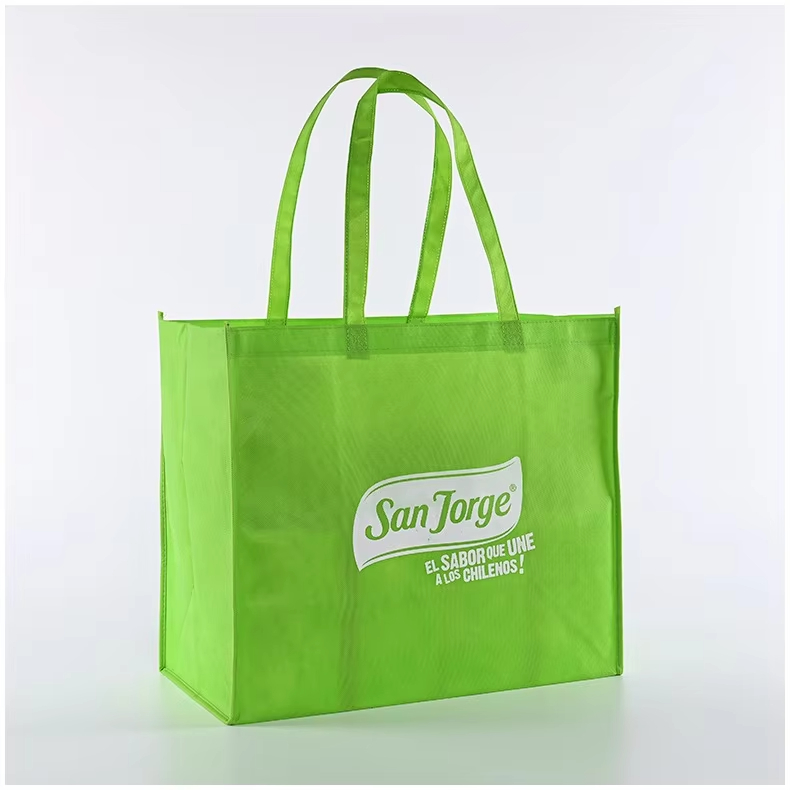
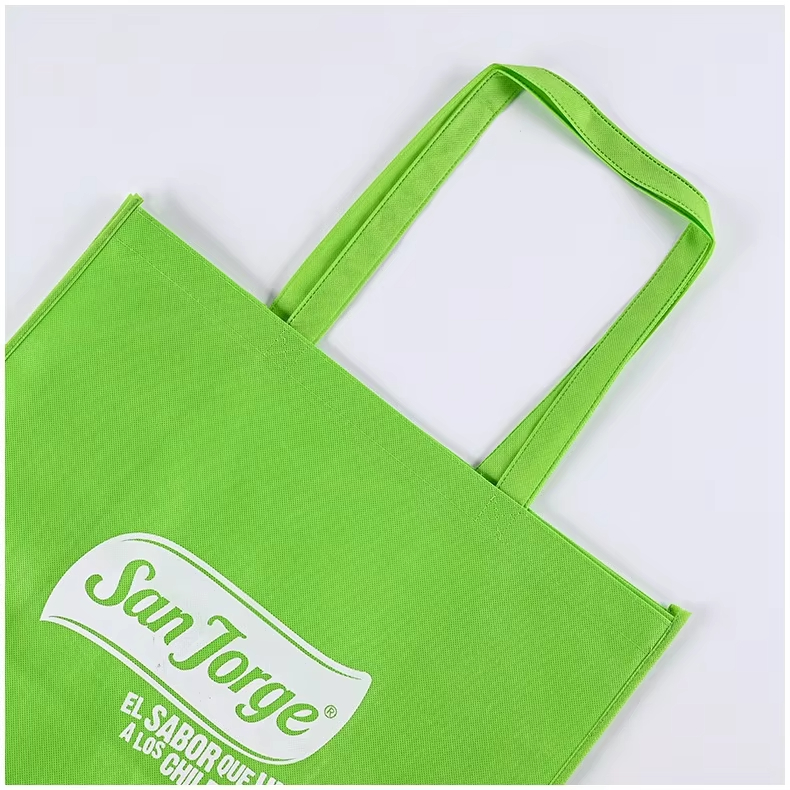
The front panel is one flat rectangle, and the photographs show how a retail program uses it. Two sheets carry a single centred print in flat matte white – no foil, no metallic element, no gradient – including a reverse-knockout treatment where the bag’s own colour shows through the lettering inside a white banner shape. That is the economical default for a store carrier: one colour, one screen, one pass, legible from a metre away, cheap to reprint when a promo cycle refreshes the message. Multi-colour laminated faces that carry photography are quoted as a separate process for chains that want the tote to look like packaging design; the panel geometry does not change, the print budget does.
Artwork hygiene matters more than technique on a long-lived carrier. Most chains run one master lockup for years, so we set minimum line weights per print colour on the bonded-sheet texture and confirm them on the physical sample before the first bulk pass – a knockout that reads perfectly on a screen layout can bridge shut once it lands on cross-hatch spun-bond. Where the photographed sheets show sample artwork belonging to another company’s campaign, read it strictly as a position demo: those designs belong to their owners, production reproduces only artwork your business holds the rights to, and the placement, panel zone and colour count in your file are what gets quoted.
The side gussets are your second and third face. They are commonly used for store locators, delivery-app marks, opening hours or a repeated logo for shelf-edge visibility when the totes are stacked for display. The photographed samples leave gussets solid, which protects the one-colour price point; adding gusset faces moves the quote into extra screen passes rather than new tooling, so it is a mid-program decision you can make at next reorder without restarting the sampling clock.
White ink coverage is the trap on saturated bodies. The photographed lime shells demonstrate why: a white banner or knockout reads brilliantly against chartreuse, but the same file printed white-on-white or over a pale shell loses all separation and the lettering has to be rebuilt as a solid knock-out instead. One-colour artwork should therefore be tested against your darkest and lightest planned colourways at mock-up stage, not just the flagship lime – chains that skip this step discover it eight thousand units late, when the pale seasonal run lands looking blank.
Formats, Flat Bottoms and the Size Conversation
The body construction visible in all three upright shots is a gusseted square-bottom shopper: side panels sewn in at vertical seams, a folded base that squares off when loaded, and a turned hem at the mouth. That silhouette stacks flat for export, pops open in one shake at a checkout island, and stands empty on a counter for display – the three physical behaviours a retail buyer actually tests before signing. Dimensions are a quotation field on this line, not a photograph field: none of the samples carry printed centimetres, so width, height and gusset depth are set against your trolley-fit requirement and the panel economy of your artwork, then locked in the mock-up.
A useful planning rule: choose a base that lets a standing one-litre bottle and a bread loaf occupy it together, because checkout totes get judged by the shop they visibly fail to carry. Taller, narrower bodies print cheaper per unit area and merchandise worse on an endcap; squat wide bodies do the reverse. Send the store-layout problem with the RFQ and we price both panel cuts in one quotation, so the decision is arithmetic rather than taste – and both variants still share one screen tool if the print zone stays in the same vertical band.
Customisable Items on the Grocery Line
- Spun-bond grammage tier – entry, mid or heavy, swatch-approved at sampling
- Body colour from the standard spun-bond colour card; the photographed line runs saturated lime and chartreuse tones
- Handle style: same-material folded loops as shown, upgraded webbing, or extended tab stitching
- Print: one-colour flat, reverse knockout, or laminated full-colour on front, back and gusset faces
- Panel dimensions per store fit; flat-bottom gusset depth chosen at quotation
- Optional mouth closure – snap or hook-and-loop strip, quoted as a separate tooling line
- Packing: bulk cartons, retailer-specific poly-bag counts, FBA prep and labelling available
| Field | Quotation basis for this tote |
|---|---|
| Fabric | Spun-bond non-woven polypropylene; grammage tier approved on swatch before the price is fixed |
| Construction | Open-top shopper, sewn side gussets, folded flat bottom, turned top hem |
| Handles | Shoulder-length same-material loops with box-and-X stitched feet |
| Closure | None on the standard shell; snap or hook-and-loop strip at quote |
| Print faces | Front panel standard; back and gusset faces add screens, not new tooling |
| Sizes | Width, height and depth set per store requirement – no dimensions appear on the photographs |
| Minimum | MOQ 100 pcs per design |
| Sample | 3-5 days from file and fabric lock |
| Bulk | 7-15 days after artwork approval |
| Monthly output | 1,000,000 pcs per month across our gift lines |
Chain rollouts get planned backwards from the shelf date: mock-up free of charge, sample for the store-test protocol, then a production window of 7-15 days – which means a weekend promotional swap approved on a Wednesday still lands without air-freight panic pricing eating the margin you saved on grammage.
Carton Counts, Pallet Fills and Freight
A grocery tote earns its keep in freight maths. These bags nest in flat stacks, so one export carton swallows a large unit count and a pallet fill planned against your store count usually lands the chain-wide swap in a single container rather than three mixed part-load jobs with three sets of customs paperwork. We pack to retailer carton-labelling rules, print unit counts and size on the outside, and keep colour or size breaks on carton boundaries so the receiving dock never opens a mixed case at 6 am. Store-level drops can be pre-built as shelf-ready cartons – one carton per aisle position – when your logistics team prefers pushing full cases to the floor instead of counting at the back.
Freight moves by sea, air, DHL, UPS, FedEx or TNT; courier runs make sense for a sample-plus-pilot-store test, sea freight for the full swap, and the two are often run in parallel on one artwork file so the pilot opens two weeks ahead of the container. FBA prep and labelling apply when the tote ships through a third-party marketplace channel instead of a store dock, including bundle prep for multipacks sold as checkout add-ons. The packing chart below is the same reference attached to every quotation for this line, so carton dimensions and pallet-count assumptions enter your planning sheet on day one rather than arriving as a surprise on the booking note.

Which grammage should a supermarket carrier use?
Do you publish a load rating in kilograms?
Can one order mix sizes and print colours?
Is the logo printed on the handles too?
How fast can a full-store swap happen after approval?
Adjacent Non-Woven and Carry Lines
This page specs the checkout-aisle workhorse; the lighter campaign handout is a different conversation with a different buyer and lives on its own page – custom non-woven promotional tote bags. Event kits that pair a carrier with personal carry usually add the belt-pack line and the bulk cinch-bag program to the same order sheet. Browse the wider bag catalogue or the printed-items range, and send store counts plus shelf dates through the request-a-quote page.
Order Against Shelf Dates, Not Slogans
Carton counts, grammage tiers and print passes come back together in one sheet – mail your store program to [email protected] or reach us on ring / WhatsApp +86-15967739086. Free digital mock-up, sample in 3-5 days, 7-15 days after artwork approval, MOQ 100 pcs per design.