

Custom Kids School Bags with Logo | Backpack Bulk Orders
$3.25
One backpack silhouette, nine solid colourways, and a clean front panel that takes a school crest the way a procurement calendar needs it: proofed on a free digital mock-up, felt on a 3-5 day sample, produced in 7-15 days after artwork approval. Photographs show the double-zip main compartment with cord grip pulls, a padded zip front pocket sized for diaries and permission slips, black-edged padded shoulder straps, bar-tacked strap anchors and a black elastic side loop that holds a bottle through the bike-rack commute. 100 pcs per design entry with colourways sharing one artwork file; crest embroidery, junior sizing and reflective trim are not shown in the photos and get quoted on request against the physical sample. Built for year-group colour policies, house splits and term-start replacement runs.
Custom kids school bags logo work starts with a question a uniform supplier asks every August: how many children, in which colours, and who checks the crest placement before nine hundred bags ship? This backpack answers the first two from the photographs – one silhouette, nine solid colourways, a plain front panel built to take a mark – and answers the third with mock-up artwork rendered free of charge, a couriered reference bag inside a working week, and 100 pcs per design as the entry line, so a single form group is already a real order. Bulk runs inside 7-15 days after artwork approval, on 1,000,000 pcs per month across our gift lines, which is what a term-start deadline actually needs behind it.
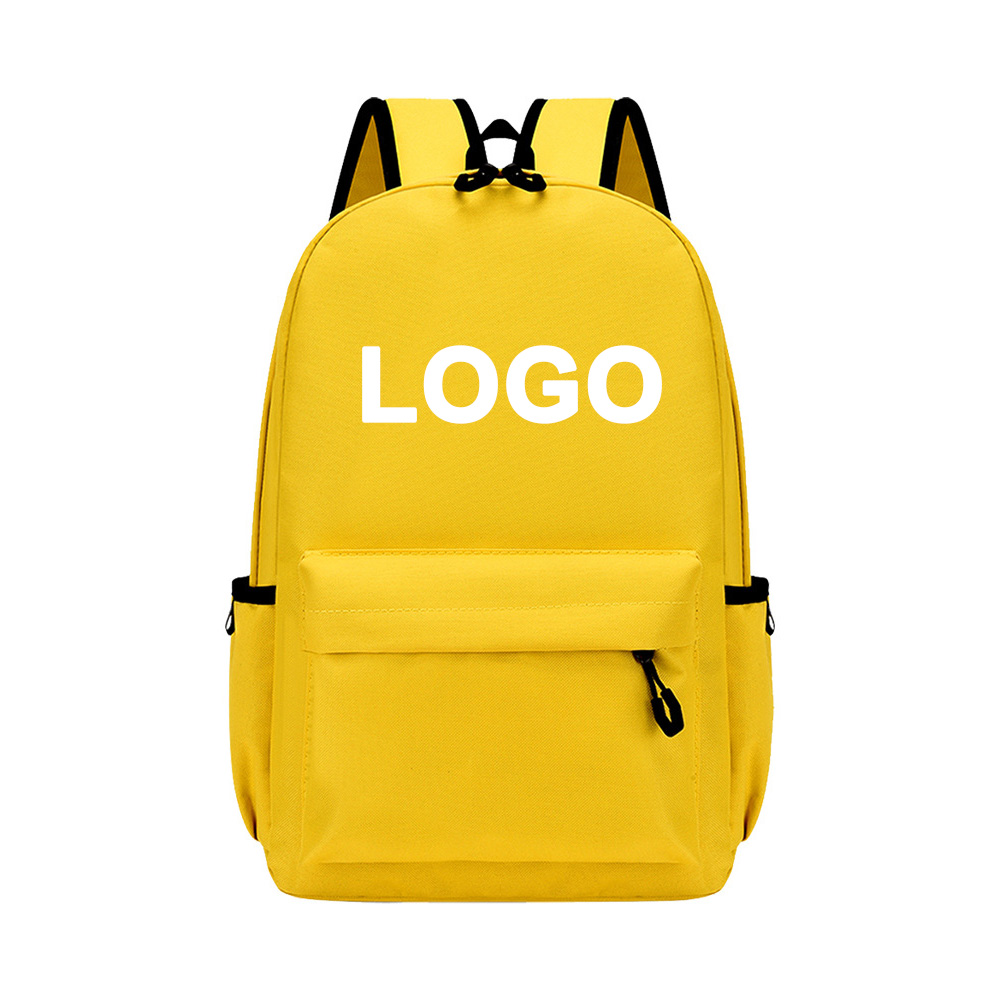
The Front Panel Is the Whole Conversation – and How It Gets Priced
Every school order is decided on the face of the bag, and the mock-up photograph shows it exactly: a clean yellow panel, black trim, and one flat-print zone centre-high where the crest or programme mark sits. No pre-existing graphics compete with it, no seams cut it in half, no zipper runs through where a shield shape would read best. Placement follows what is printed rather than what is promised – the zone above the front pocket zip, centred between the strap anchors, is where marks stay visible when the bag hangs on a hook behind a classroom door, which is where a school bag actually lives eight hours a day. Scale matters next: a crest that reads at arm’s length can disappear at two metres, and the free mock-up renders it on the panel photo so the head office sign-off is a yes-or-no over a picture of the real bag, not a box around a vector file. One honest flag before you spec the thread: the photographed artwork zone is a flat print. Embroidered crests are a real option in this category but they are not shown in any image on this page, so stitch density, backing and cost land as quoted on request against a physical sample rather than as a picture-backed claim. Designs count separately, and school programmes need that rule explained plainly. The same yellow bag carrying the primary crest is one design; the same bag carrying the sports-house mark instead is a second design with its own 100 pcs per design floor. Four houses on one year group is therefore four design lines, not one big order – unless the houses share one master artwork with a small swapped element, which is the usual way procurement keeps a multi-house order inside one proof round. Colourway is not a design break when the artwork file is identical; nine colourways from the photographed grid run on one approval. A PTA fundraising run works the opposite way: one crest, one colour, and quantity as the only variable. Send the crest file with the year-group counts and the quote returns mapped to these cases, mock-up included, so nobody discovers the design-split arithmetic at invoice stage. Budget holders should also note what happens at the edges of the rule: a programme that adds a second crest mid-year does not reopen the first line’s pricing, because the original run already signed and shipped; and a house that renames its badge from next September gets a fresh file, a fresh mock-up pass, and a fresh floor of its own, which is precisely why the desk asks “how many marks, not how many bags” on the first call.
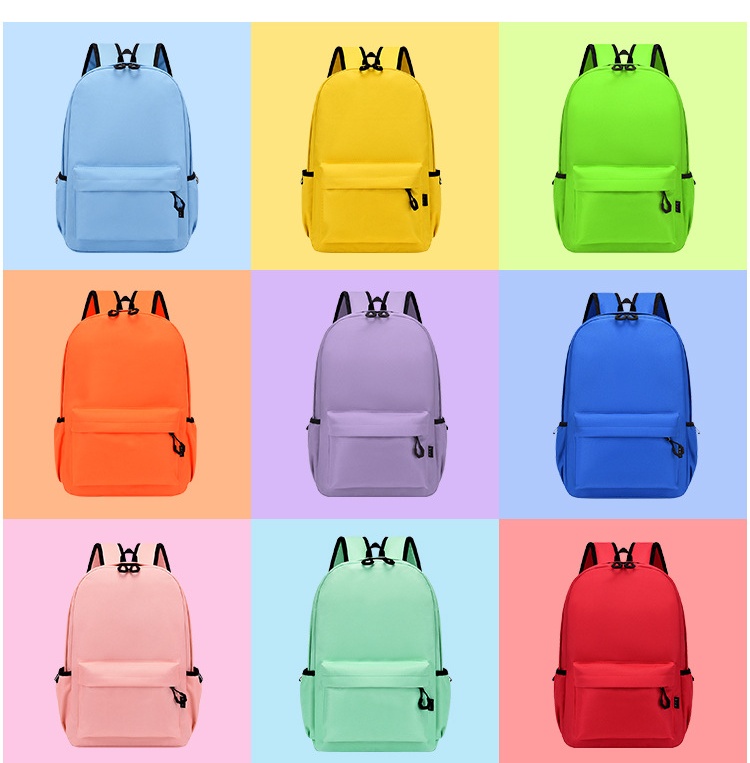
Nine Colours, One Pattern, Zero Guesswork
The colour grid is the ordering sheet: nine solid bodies under identical construction, each photographed against a matching pastel cell so buyers compare body colours instead of lighting tricks. Sky, yellow, lime, orange, lilac, cobalt, pink, mint and red – and the hardware family stays constant across all nine: black-edged padded shoulder straps, black top grab loop, black zipper tape and cord pulls, black-trimmed side pockets. That consistency is a procurement fact, not a stylistic one: an infanta’s red bag and a sixth-former’s navy bag read as the same school product, so a colour-choice policy per year group keeps the programme unified while letting the children feel they chose something. Year-group colour splits are free on this shape because one design file prints across nine shells – the split is packing math, not artwork math. If your uniform supplier works from a swatch card that names colours differently, send the reference; the mock-up is built to the named colour, and the 3-5 day sample is where the whole panel gets compared under classroom lighting rather than a studio white.
What the Photographs Prove About Fit and Carry
The strap system is the visible part of comfort, and every shot shows the same answer: two padded shoulder straps with black piped edges rising from behind the top of the bag, plus a small grab loop between them for the hook-behind-the-door life a school bag leads. Padding reads as a foam layer under the body-coloured cloth – visible in the grid and mock-up as soft rounded sectioning rather than flat webbing – which is the difference between a bag a child wears to school and a bag a child carries by one strap while it knocks their heels. No carrying harness, no chest clip, no lumbar curve appears in any photograph, so none is claimed here; strap adjusters and back-panel ventilation are asks for the sample stage, quoted on request. The open-top side pockets flank the body on every shot, sized for the flat water bottle a classroom allows rather than a thermos. Height guidance for year groups cannot come from this listing because no photograph prints a dimension: the exact shell size is quoted on request, and if your programme needs a junior cut and a senior cut, ask for both against the physical sample before artwork locks. A quick classroom test beats any paragraph here: fill the sample with the books the youngest group actually carries, adjust the straps to the smallest child who will wear one, and check that the bag’s base clears their lower back instead of dragging between shoulder blades – the fit answer schools need is that geometry, not an adjective. The strap ends deserve the same hands-on pass: threaded adjusters that a child can slide with one hand decide whether the bag rides high or knocks heels, and the photographed black-trimmed tails show the adjuster position clearly enough to spec a shorter webbing tail if your procurement dislikes loose ends flapping on the playground run.
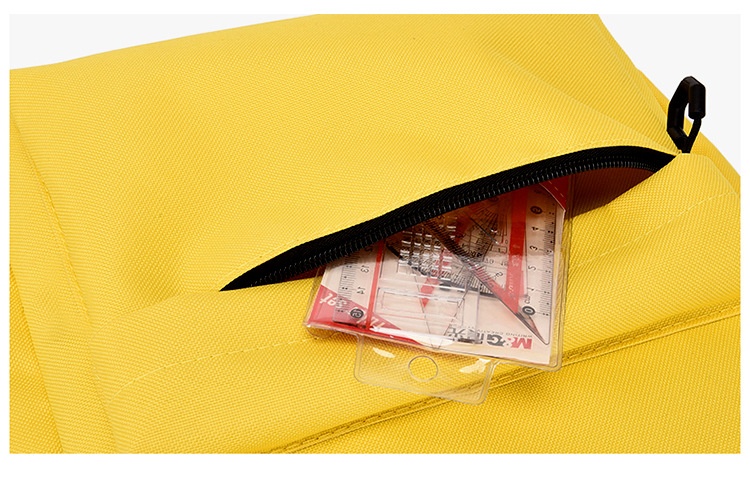
The Small Zip Pocket Is Where School Admin Happens
Parents of infants buy this bag for the lunch box; schools issue it for the reading-diary loop, and the photographed front pocket settles the argument. It is a black coil-zip pocket across a quilted, padded panel, and the detail shot puts a flat card sleeve inside it on purpose: permission slips, library cards, a timetable strip, a contact card for the lost-property pile – flat objects that live loose at the bottom of a main compartment until they end up shredded through a lunch pot. The double row of top-stitching tracing the pocket outline says the panel is padded rather than limp, which protects exactly the thin rigid things schoolbags carry badly. One clarification the photograph requires honesty about: the branded ruler-calendar card used as the size reference in that shot is a styling prop. It is not bundled, not blank stock, and its label is its owner’s – ask for the actual pocket depth on the sample, because nothing on the bag itself prints a measurement.
Two more classroom realities live in that same pocket. The first is the lost-property problem: a schoolbag with no exterior flat pocket returns to the pile as an anonymous lump, while the marked zip pocket carrying a printed name card sorts itself in seconds – which is why programmes that issue bags year one should also issue the artwork decision that puts a name panel inside that zone. The second is the spare-key-and-card routine infants’ teachers build their day around; a zip track keeps a plastic-card sleeve from migrating out of an open slip during the coat-rack shuffle, and the photographed coil zip, half-open with its black plastic pull tab, is the closure doing that quietly all term. Neither point needs a spec sheet – both are visible in the crop, which is exactly the kind of evidence this listing insists on before it sells anything.
Hardware Details, Shot Close Enough to Audit
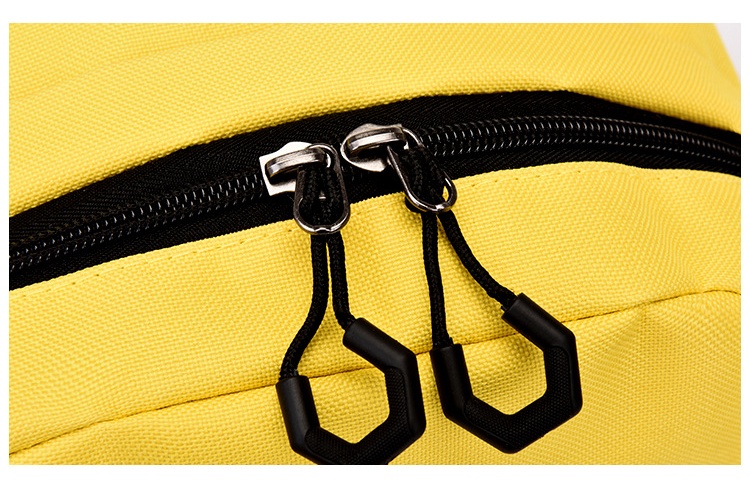
Sourcing teams should read the macro photographs like a QC checklist, because they were shot that way. The main closure is a two-way zip: black tape, two silver-toned metal carriages side by side, each carrying a black cord loop that ends in a moulded geometric pull tab – the kind a child can grip with cold fingers or bite-free hands, and the kind that doubles the loading strategy: open from either end and the compartment yawns flat. The weave visible in the same frame is a fine tight cross-hatch, the oxford-look synthetic cloth this category is built from; denier and fibre content are quoted on request rather than guessed off a close-up, because a listing paragraph cannot feel a fabric’s thread count. The pulls themselves are aftermarket-swappable components in this price class – colour-matched cord is a common programme upgrade – so flag the hardware spec while proofing artwork instead of discovering the mismatch at reorder.
Why the Strap Anchors Are the Stress Question
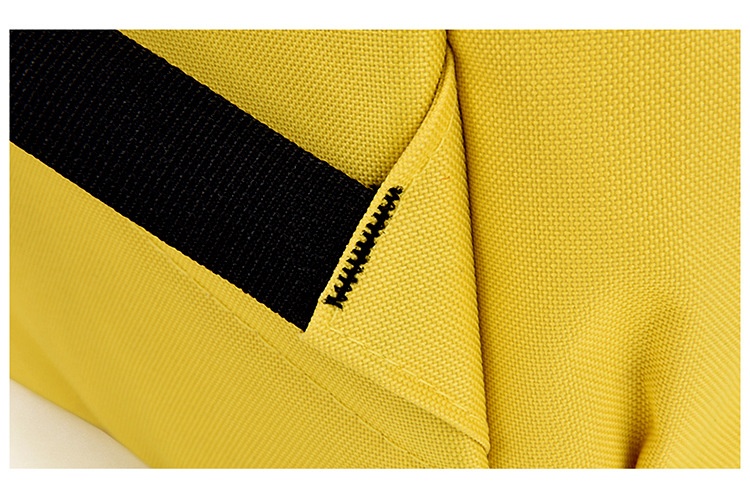
School bags do not fail at the fabric; they fail where the strap meets the shell, once a child swings the bag by one shoulder or hangs from a cloakroom rail with a full maths textbook inside. The anchor close-up shows the answer the construction takes: a black ribbed webbing strap fed into a sleeve on the body panel, with the joint locked down by a diagonal line of bar-tack zig-zag stitching through the fold. Bar-tacking is the machine-sewn reinforcement pattern this stress point is supposed to carry, and it shows in the frame rather than resting on assumption – exactly the detail a purchasing officer should demand to see before a bulk signature, because the difference between a programme that survives two terms and one that returns in September as a repair bin lives in that stitching row. The same frame shows the two weave directions of the cloth – a tight grid on the body panel, a finer diagonal on the folded flap – which reads as panel-by-panel fabric choice rather than one blanket material spec; request the actual cloth reference with the sample. When a programme writes its acceptance criteria, that anchor zone is the row worth spending money on: bar-tack thread count, stitch length and a bartack at each corner of the sleeve insertion are all visible on a flipped sample in ten seconds, long before a year of cloakroom abuse finds them. Purchasing officers who standardise on this one inspection – anchor first, fabric second – consistently report fewer September repair bins than committees that check the zip pull colour first, because the failure that strands a bag is rarely the one that photographs prettiest. The same logic extends to the top grab loop, anchored through the body panel between the straps; it is the single point a bag is lifted by at assemblies, and on a cloakroom rail it carries the whole week’s books for one second at a time while the child’s shoulder rests. One more anchor worth inspecting on the same flipped sample: the strap exits the sleeve at a slight outward angle rather than straight down, which is how a bag keeps its load against the back instead of pulling the seam outward on every step – visible in the macro shot’s geometry, and the reason a purchasing officer should request the same crop from any competing supplier’s sample before comparing prices. Programmes running two-term contracts should photograph their own anchors monthly: thread fraying at a bartack corner is a repairable observation in October and a replacement budget in March, and a bag line that survives its first winter of cloakroom abuse is worth more to a bursar’s ledger than one that photographs prettier in the brochure.
The Elastic Side Loop, Explained Without the Prop
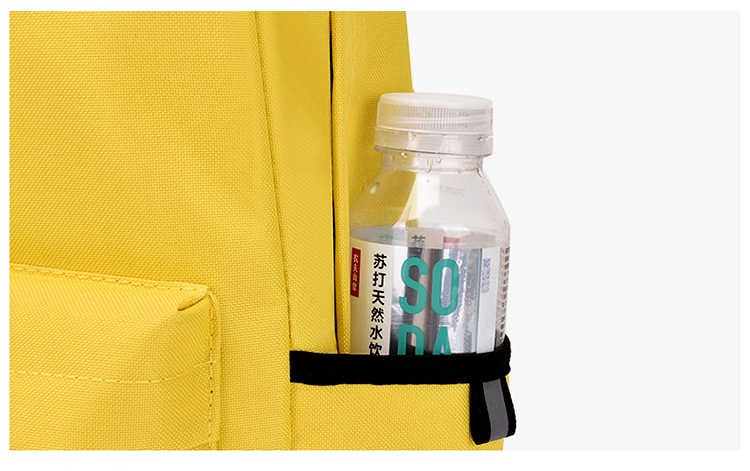
The bottle-pocket photograph deserves careful reading because it is the one image on this page carrying somebody else’s branding inside the frame. What belongs to the bag: a black elastic band stretched across the flank panel, finished with a small grey webbing tab, gripping a bottle against the side so it cannot fall out mid-stride; a patch pocket stitched in parallel rows under the band, visible in the same crop. What does not belong to the bag: the plastic bottle itself – a styling prop with its own printed label, reproduced nowhere on this page, and never a bundled item. The product fact is the retention system: elastic instead of an open slip pocket means a water bottle survives a bike basket, a run to the bus and a bag dropped on its side. Where the programme wants the other behaviour – a bottle pocket with a drain, an elastic band in body colour rather than black – those are sample-stage asks against the physical build, quoted on request. The panel weave in the frame is the same tight cross-hatch as the main shots: consistent cloth, honest description, and no printed claim about fibres beyond what the lens settles. Parents who buy by photograph should zoom this crop deliberately: the elastic runs full-height across the pocket zone rather than pinching the bottle at one point, which is why a half-empty bottle stays upright instead of tipping the bag sideways on a classroom floor. Ask for the band’s stretch spec on the sample sheet if the programme issues metal bottles – heavier containers load that band differently than the plastic prop in frame, and the honest answer comes from the desk with the sample in hand, not from this page’s caption. Two practical notes for the procurement file, because the elastic loop is the detail parents ask about first at an issue-evening display. The band crosses the panel horizontally at mid-height, which suits a flat classroom bottle rather than a tall gym litre – worth knowing before a programme writes “fits any bottle” into its own letter home, since the loop’s behaviour depends on the container, not the bag’s goodwill. And the grey webbing tab at the band’s end is a finishing detail, not a handle or a clip point: nothing should be hung from it, and a programme that briefs children on that single sentence will see the loop outlast its first two terms intact rather than torn at the anchor by a bag hung from a hook by its strap tab. Everything above that – band stretch rate, loop height options, pocket depth – belongs on the same quoted-on-request list as the shell dimensions, settled with the sample between your hands.
Term Cadence and the Numbers a Bursar Can Repeat
A school-supply order is a calendar contract. Uniform programmes set issue day first and count backwards: artwork with the crest placed needs a signed proof roughly a month out; the 3-5 day reference sample sits inside that month, not after it, because committees need a physical bag for a parents’ evening display before the order is even placed. Production itself is 7-15 days after artwork approval – the quiet window most programmes waste by treating approval as a formality rather than a date. The August rush repeats three times per hemisphere per year, and 1,000,000 pcs per month across our gift lines exists precisely so a September program and a January program can both be locked without fighting each other for the slot. Reorder discipline is the other half: late joiners and replacements come best from reserved artwork, top-up runs on the signed proof, packed per year group so the front office hands out bags without opening everything. Against that calendar, the commercial floor stays simple: entry is 100 pcs per design; a single form group of thirty students does not meet it alone, which is why school orders consolidate by programme, not by class. Mixed colourways ride inside one design when the artwork file is identical – nine-body grids exist for exactly that reason. Mixed crests do not: each crest variant is a design of its own with its own floor. Price tiers read as an approximate unit at the 100-piece entry band, quoted to your quantity rather than printed here, and every number on this page is one a buyer can repeat to a bursar without footnotes.
| Line | This listing’s commitment |
|---|---|
| Shell | One backpack silhouette, front print zone above a padded zip pocket, twin open side pockets, double-zip main |
| Colourways | Nine solid bodies photographed; black-trimmed padded straps on all |
| Crest handling | Flat print proven by photo; embroidery and its backing quoted on request |
| Size, denier, age fit | Nothing printed on photographed bags – quoted on request against the sample |
| Design floors | 100 pcs per design; colourways share a design, crests do not |
| Sample and bulk | Reference sample 3-5 days; production 7-15 days after artwork approval |
| Programme ceiling | 1,000,000 pcs per month across our gift lines keeps term windows clear |
Proofing, Freight and the Nine Hundred Bags Behind Them
Three sign-offs happen before bulk, and none of them needs a meeting. First, the digital mock-up on the photographed panel: crest scale and centring checked by whoever owns the badge, free, before tooling. Second, the reference sample, 3-5 days out, which is where three unphotographable questions settle – pocket depth for the actual diary the school uses, strap padding against the actual lunch box plus reading-book load, and colour match under the hall’s lighting rather than a screen’s. Third, the packed carton check if bags issue per class: poly count, name-list labels, colour split per box. Each proof step has a cost if skipped: a reprinted crest, a September of repair bin, a pallet that unpacks as chaos. The desk that runs these steps reads artwork files in the usual formats and answers the paperwork questions by email: [email protected]. Freight follows the same calendar: backpacks nest, so a carton carries a real quantity rather than a suggestion; the reference chart below shows the standard build for this category – individual polybag, carton count, pallet stack – and your freight option is the one variable that a term deadline actually moves. Sea freight for programmes locked by the previous term, air or express when an order arrives late, courier samples either way within the 3-5 day window. Split consignments across campus and warehouse addresses if the programme ships to two sites; marketplace sellers get FBA prep, pick, pack and labelling straight off the production batch so the school-shop listing opens on time. Reach the freight and packing desk at +86-15967739086 when the issue date is already on a poster.

The Questions Parents’ Councils Forward to Us
Can the school crest be embroidered instead of printed?
How many bags minimum, and does one colour split the order?
Is there a smaller size for the youngest year group?
Does the bag have reflective trim for winter mornings?
Can replacements for lost bags be reordered mid-year?
What file quality does the crest artwork need?
Where This Backpack Sits Beside Its Programme Siblings
The household that issues this bag issues three more from the same desk. Siblings walking to the same gate with squad kits need the team cinch sack, the beach day that survives after-school lives on the lined cooler tote listing, and the teacher carrying it all home has the adult travel shell. Campaign folders pull the whole catalogue from the textile-bags branch, the printed-bags branch or the printed-items root, and the desk that quotes crest embroidery, junior sizing and reflective tape is reachable at the quote page.
If the year-group counts, the colour policy and the issue date are known, the order is already specified: a free mock-up on the photographed panel, a 3-5 day sample on the real cloth, and 7-15 days of bulk after the proof is signed. Send the crest and the calendar.


