Custom Wire-Bound Ruled Notebook, Large Format Bulk
$0.68
School and office tender stock: a wire-bound 3-subject pad photographed at 8.5×11 inch (21.5×27.9 cm) with 150 sheets, college rule at 9/32 inch (0.71 cm) with a red margin line, a 3-hole binder column, a perforated tear that leaves a clean edge, an inside pocket and a moisture-resistant cover – every feature shown in the listing’s own spec frames. A4, A5 and other trims, sheet counts and gsm are quoted on request against your standard. Programs open at 100 pcs per design, samples leave in 3-5 days, approved reorders run 7-15 days after artwork approval, and cartons ship palletised or FBA-prepped for direct-to-campus drops.
School and office purchasing departments do not buy notebooks one cover at a time. They buy a size decision, a paper decision and a restock rhythm, and they need one vendor who holds all three steady across a tender year. This custom A4 A5 spiral notebook bulk line exists for exactly that conversation, and our photographs put the US-format end of it on the table first: a red wire-bound, 3-subject college-ruled pad at 8.5×11 inch (21.5×27.9 cm) with 150 sheets printed on the stock cover, 3-hole punched, perforated, pocketed inside. The larger-format question – A4, A5, B5, B6 – is answered at quotation against your district or office standard, because those formats run on the same coil line with a different trim. What the photos do prove is the engineering that tender sheets actually specify: 9/32 inch line spacing, a single red margin rule, three binder holes, a tear line that leaves a clean edge, and a cover that resists a cup of coffee. District buyers comparing this page against a supply schedule should read it as a specification argument, not artwork talk: here the size family, gsm tier and sheet count are the product, and the school-year calendar is the clock. The displayed figure anchors the 100-piece tier; MOQ 100 pcs per design; samples in 3-5 days; production 7-15 days after artwork approval. One million pieces a month of capacity sits behind the whole gift-line family, so a mid-year term replenishment never queues.
What the front cover states in print
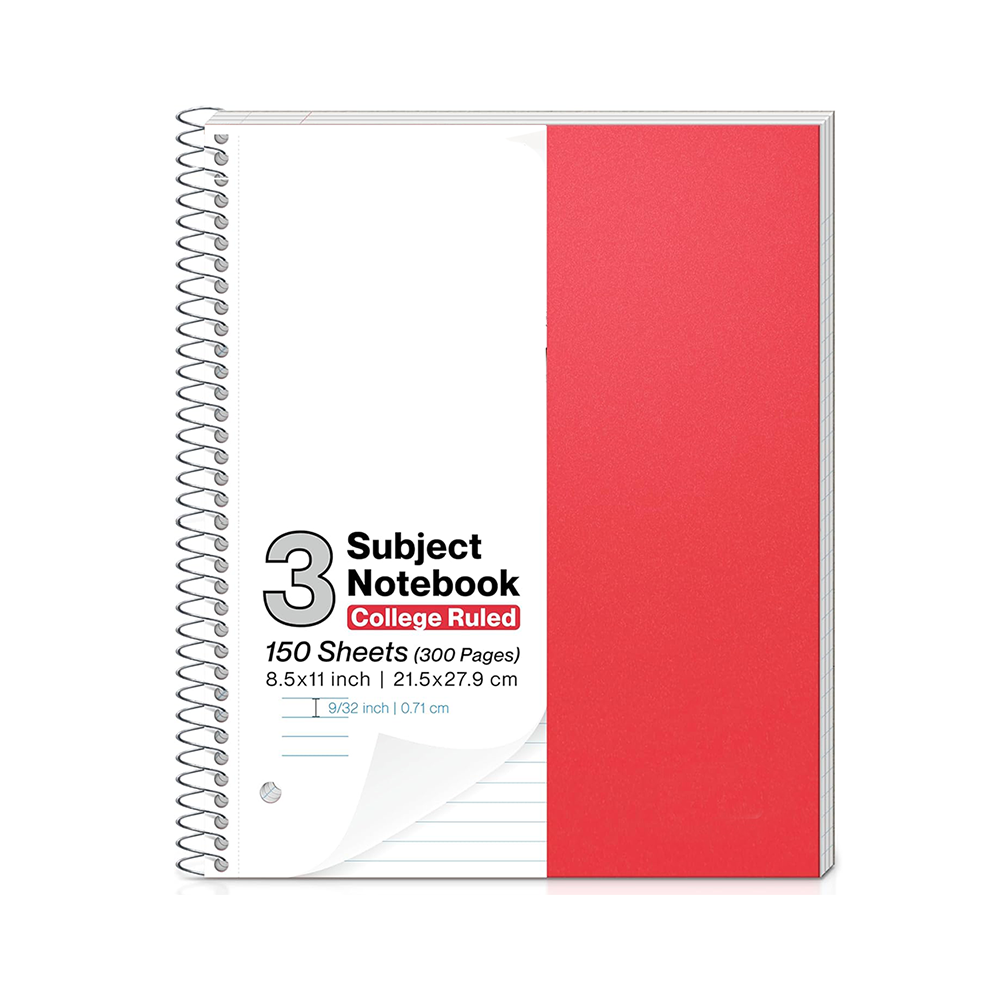
The listing’s main image is a spec sheet pretending to be a cover. White and red fields split the face, a curled-corner graphic shows blue ruling under the lift, and the printed text block at lower left states the configuration outright: a large numeral 3 for Subject Notebook, College Ruled in a red pill, 150 Sheets (300 Pages), 8.5×11 inch | 21.5×27.9 cm, and 9/32 inch | 0.71 cm beside a small two-line spacing diagram. A thin printed band at the side edge carries a square-grid pattern.
We quote these numbers as photographed text of the shown configuration, and the sample you receive carries exactly the specification you approve. The 9/32 inch rule is the standard college spacing US classrooms expect; 150 sheets across three subjects is the semester-carrying count; and that 8.5×11 inch field is the letter-size answer for schools on imperial paper. Districts on metric standards specify A4 or A5 instead; both trim on this coil family at quotation, and one tender can mix formats as separate designs under the shared program.
The stock cover’s graphic language is a placeholder by design. The red-and-white field, the curled-corner illustration and the subject numeral are our listing’s artwork – your district logo, office identity or reseller brand replaces them at the mock-up stage while the spec text positions stay available if you want them. A purchasing officer can keep 9/32 inch and 3-subject fixed, swap only the artwork, and compare supplier quotes on identical engineering. That is the whole reason this photograph exists on a tender page: it shows what is constant and what is yours to set.
Ruling, perforation and punch: the three callouts
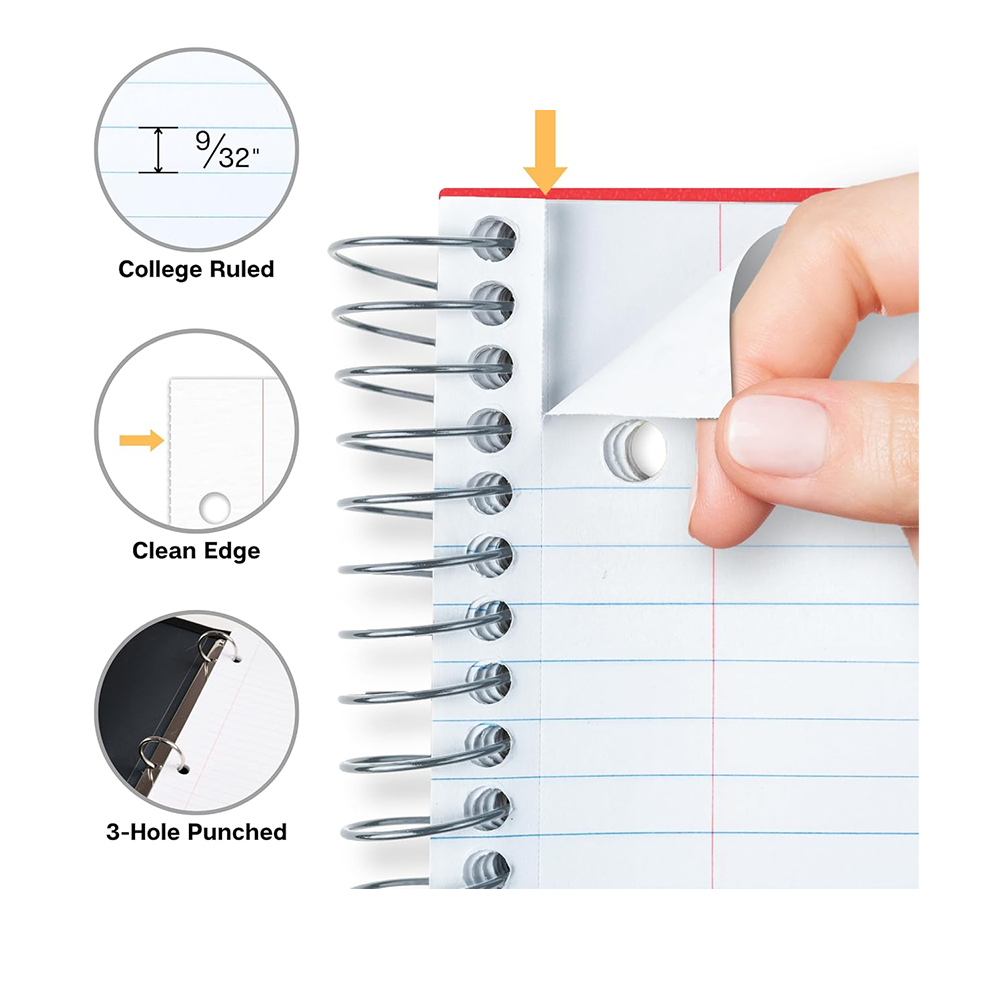
The second photograph is an engineering drawing in product-photo clothing. On the right, a hand pulls a sheet away from the pad along its tear line, the flap curling to show the blank reverse; the coil, blue rules and red margin all stay in frame. Down the left, three magnified circles state the case: the 9/32 inch spacing measured across one line gap, captioned College Ruled; a torn sheet edge with no ragged stub, captioned Clean Edge; and a sheet seated on two binder rings under the caption 3-Hole Punched.
Read together, those three circles are a school-supply requisition written in one image. College ruling is the district default; a clean tear means submitted pages have no confetti edge to jam the copier; binder compatibility means the same sheet moves from spiral to ring folder without a hole-punch queue in a classroom of thirty. The coil holes and the three-hole column coexist on the same sheet because the punch geometry is a plate decision at order stage – if your program wants two-hole, four-hole or no extra punching, specify it before the proof rather than accepting a default nobody asked for.
Perforation quality is the feature nobody thanks until it fails. A well-cut tear line separates under one confident pull; a shallow one leaves a hinged strip that rips the next page on the following pull, and by October the pad is shedding sheets in the wrong places. The photograph freezes the good outcome on purpose – the flap peels away whole, the margin column stays intact. The paper’s grain direction relative to the coil decides whether a tear runs straight across the rule or wanders diagonally through it, which is why sheet orientation is fixed at the layout stage and never left to a random carton.
There is a filing argument folded into that punch geometry. Office managers who buy these pads for meeting notes want the torn sheet to live longer than the spiral: pages move into a departmental ring file, and the sheet that arrives flat, square-edged and aligned on its holes is the sheet that does not get re-typed. All three callout circles describe that downstream moment – ruling for readability, edge for the copier tray, punch for the ring file. It is why the requisition language on this page leans on paper geometry rather than cover adjectives. Geometry is also what the tear line protects: a cleanly perforated sheet keeps its punch column aligned with the margin rule, so the filed page reads as designed even after it leaves the pad.
Pocket and moisture: the durability callouts
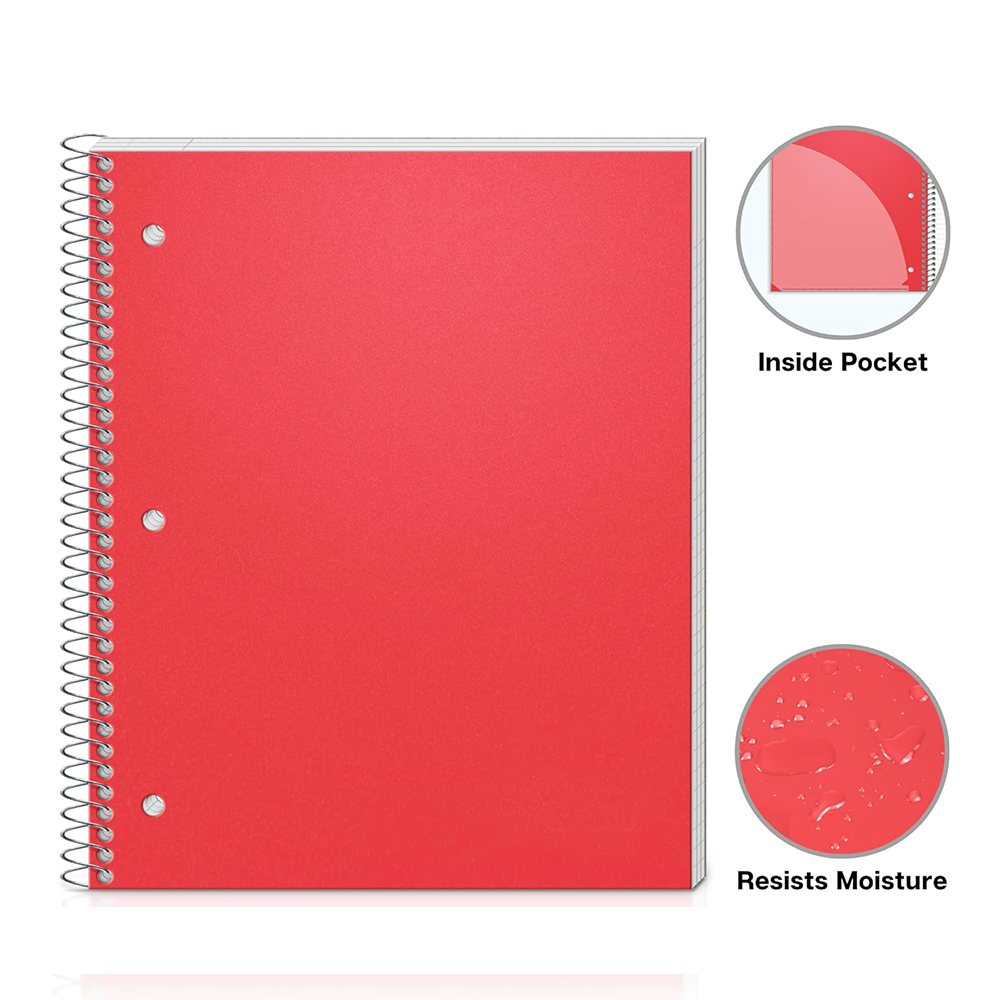
The third frame closes the loop on how a school pad dies. The red book stands closed, three white punched holes visible in a column beside the coil, and two magnified circles on the right: a translucent flap inside the back cover, captioned Inside Pocket; and water droplets sitting in beads on the cover face, captioned Resists Moisture. The closed-book pose is deliberate: the holes are visible beside the coil, the coated face is visible under the droplets, and the pad’s silhouette reads the way it will sit in a supply catalogue line picture for the next three school years.
Both features answer named failure modes. The inside pocket is where permission slips, worksheet single-sides and quiz returns live between home and class – a one-piece difference between a notebook a student keeps and one replaced in October. The beaded drops are the cover surface standing up to the desk spill that ends a paper-cover notebook’s term in week two. The photographed pad’s cover reads as a coated stock consistent with these claims; we write them as the listing’s feature callouts and your 3-5 day sample is where your facilities committee verifies both.
Durability economics for a district: a pad that dies at week ten costs two-thirds of its price in quiet re-buy from family budgets, and the parent remembers whose name was on the cover. A pad that finishes the term earns the next September without a marketing conversation. That is the argument to put in a tender file beside the price column – pocket, coated face and a coil that neither snags on a strap nor flattens at the bottom of a backpack; every one of those choices is decided at specification and repeated faithfully on every carton after, because the tooling does not drift between orders.
The pocket callout carries a subtle procurement point most catalogue photos hide. That translucent flap lives inside the back cover, so a school ordering the pocket variant is buying an assembly step, not a printing one – the film is mounted before coiling, which is exactly why pocket-on and pocket-off configurations change the carton weight, the unit price band and nothing else about the pad’s external identity. Specify it once on the proof and every September after repeats the same silhouette from the outside, which is what a district wants from a recognised supply line.
Water beading, likewise, is a cover-stock decision. The droplets sit on the coated face rather than soaking its edge, and the frame is there to answer the facilities question: a desk spill wipes off instead of warping the board. A paper-laminate cover fails the same test in week three; the coated face passes it for a term. Neither claim needs a laboratory certificate when a photograph of the behaviour is on the page, and your sample proves the same thing on your own desk before the tender closes. Specify both options in writing at quotation – pocket in or out, coated face or plain – and the proof sheet becomes the contract: what the callout promises, the build repeats on every carton, and a district reordering the following August is reordering the same object, not a substitution.
The two-pad frame: cover outside, ruling inside
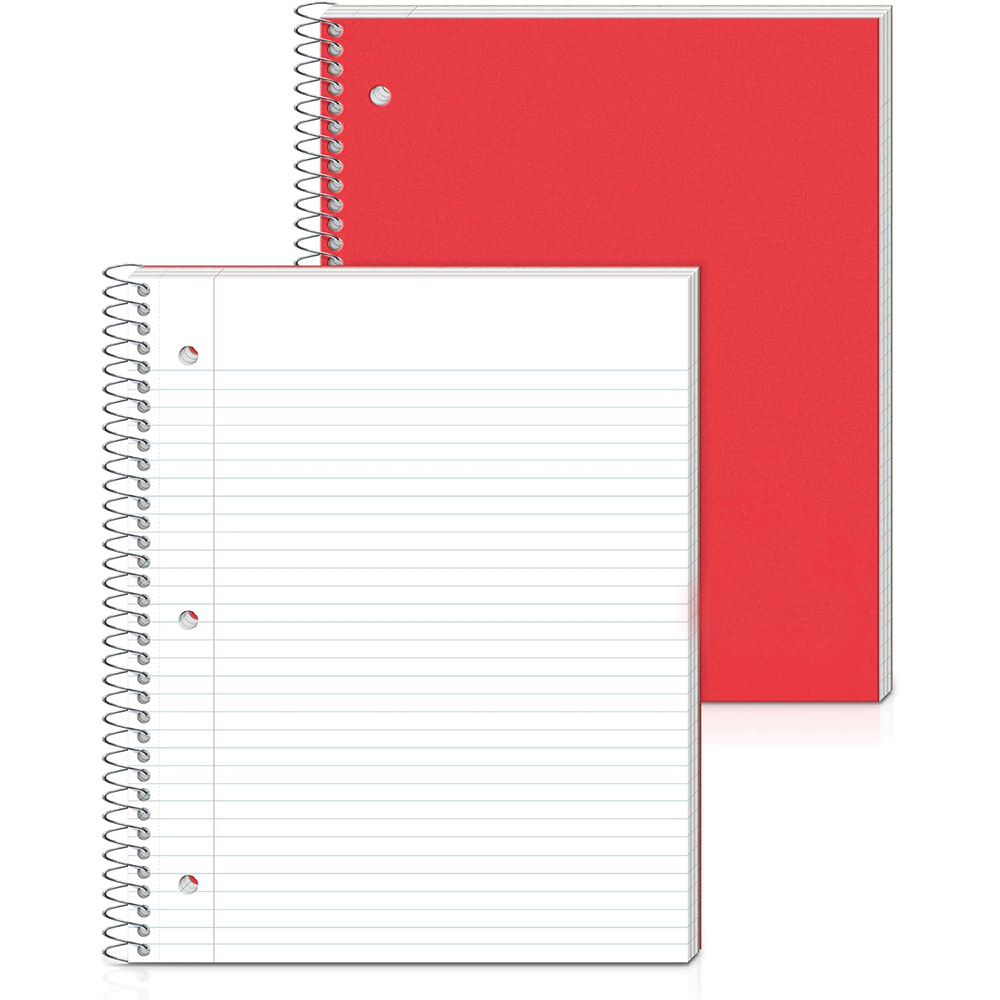
The paired frame shows the same book twice – closed and open – which is how a purchasing officer reads a catalogue line anyway. Behind, the red cover stands with a silver twin-loop coil down its left edge and the white page block showing along the fore-edge. In front, the same format lies open to a working sheet: bright paper with evenly spaced light-blue rules and one vertical red margin line, three round punch holes in the left margin with the red cover visible through them.
Every element a teacher checks in the first thirty seconds is in that frame: rule spacing even enough for a handwriting-impaired ninth grader, a margin line that keeps notes off the binder side, and a coil that lets the sheet fold back while the student writes one-handed. The punched column matters commercially too – pages leave the spiral for the folder without scissors, which is the entire homework workflow in one design feature.
Sizes beyond the photographed 8.5×11 inch pad are set at order stage against your format requirement, and the construction argument above holds at every trim: same coil family, same punch logic, same ruling geometry scaled to the page. Whether your requisition sheet says A4 for the office, letter for the classroom, or a B5 compromise for study halls, the decision is a dimension line on a quotation rather than a different product page. Ask for the trim you actually stock and the sample comes cut to it. That sentence is the whole size-matrix policy: the photographed pad proves the construction, your requisition proves the dimension, and neither one guesses at the other.
One detail in the open pad earns its paragraph: the rule field and margin line are printed on each sheet rather than ruled into the block, so a page torn for the ring file keeps its margin and spacing intact – the office equivalent of the classroom workflow above. The red cover visible through the punched margin also proves the stock is consistent front to back: a sheet that shows its parent cover colour at the hole column is a sheet that was laid and punched in register, carton after carton, without the drift that separates a first term from a second term on the same line item. That consistency is what a purchasing office tests when it buys a second year without re-checking samples: the pad should be interchangeable with the one already on the shelf. It also protects the requisition’s boring arithmetic: a district that standardises on three-subject letter pads this year should be able to restock in five years without re-measuring desks, folders or filing cabinets, because the trim, coil pitch and margin rule never drift between orders.
Set at order stage for your tender
- Format: photographed 8.5×11 inch letter-size pad; A4, A5 and other trims quoted on request against your standard
- Layout: 3-subject divider style as photographed; single-subject and 2-subject interiors quoted on request
- Ruling: college 9/32 inch as printed on the sample cover; wide rule and grid interiors quoted on request
- Sheets: 150-sheet configuration as photographed; other counts priced per trim and target
- Punching: coil holes plus 3-hole binder column as shown; alternative punch patterns at specification
- Cover: printed field colours with your school, district or office mark in place of the stock graphics
- Paper weight: gsm not stated in the photographs – quoted on request and verified on sample
Specification table
| Item | Custom wire-bound ruled notebook, large-format school and office pad |
| Size | 8.5×11 in (21.5×27.9 cm) as photographed; A4/A5 and other formats quoted on request |
| Paper & Ruling | College ruled 9/32 in with red margin as printed on the sample cover; 150 sheets (300 pages) shown; gsm quoted on request |
| Cover | Printed cover fields with subject/spacing spec text; custom school or office artwork replaces stock graphics |
| Binding | Silver double-loop wire-o coil; punched holes plus 3-hole binder column as photographed |
| Logo & Finish | Cover print zone with free digital mock-up; moisture-resistant coated cover face and inside pocket per the photographed callouts |
| Packing | Export cartons, palletised or loose; FBA labelling and prep supported |
| MOQ | 100 pcs per design |
| Sample time | 3-5 days |
| Lead time | 7-15 days after artwork approval |
| Capacity | 1,000,000 pcs per month across our gift lines |
Reorder calendar and the sample gate
Term supply is a backwards-planning exercise. Lock the size and ruling decision with a sample – 3-5 days out of the plant – then approve artwork, then let the 7-15 day production window do its work under whatever freight lane your dock accepts. A district that specs in spring and signs proofs in July receives August cartons by sea without a single expedite fee; one that wakes up two weeks before term gets the honest express-lane number instead of a promise we cannot keep. Reorders of an approved design skip re-proofing entirely: the file stays on record, and mid-year restocks enter production the week you raise the repeat PO. Capacity of 1,000,000 pcs per month across the gift lines covers the size family, the ruling variants and the pocket spec in one program.
Cartons, freight and FBA prep
Bulk pads pack in export cartons at counts chosen for your receiving – classroom cases, library cartons, or one pallet per school in a district drop. Freight runs sea, air, DHL, UPS, FedEx or TNT against the tender calendar, and marketplace resellers get FBA labelling and prep done at our dock before the first-mile booking. Carton dimensions and weights come with the quote, because procurement compares landed cost, not unit cost. The photograph below shows the load standard: square-stacked cartons banded to pallets, corner protection on tall loads, shipping marks matching the drop list so deliveries split across several campuses without a recount in your mailroom.

Tender-desk questions
Does this line really cover A4 and A5, or only the letter-size pad in the photos?
Can one order mix 3-subject and single-subject interiors for different grades?
Is the inside pocket and the water-beading cover standard on every unit?
What line spacing do the ruled pages use?
How should a district budget the first year of a notebook program?
Can we get cartons labelled per school for a direct-to-campus drop?
Related formats worth putting in the same requisition
Where the same buyer also stocks smaller desk formats, the B5/A5 clear-cover coil notebook is the compact sibling on the same coil line, and the stave music notebook answers the band-room line item. Faith-group class sets belong on the study-journal page with its sermon-note form; the notebook category holds the full family, printed collateral from the printed-items range ships in the same carton, and tender sheets go to the quote desk. District supply officers who run a mixed requisition – letter pads for classrooms, A5 composition books for lockers, pocket pads for the front office – keep all three on one PO, on one coil line, in one freight booking.
Put the format decision in writing
Send the size standard, ruling, sheet expectation and first-term quantity; we return a mock-up and a tiered quote the same week, with the sample in your next mail run. Email [email protected], call +86-15967739086, or fill the form below – 100 pcs per design opens the line, and the calendar decides the rest.