Custom Stave Paper Music Notebook with Logo
$0.95
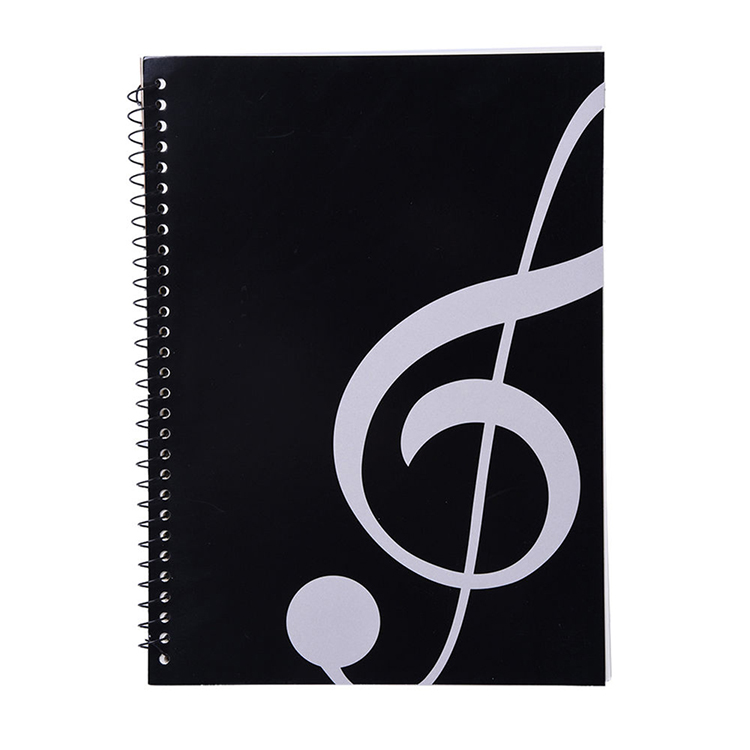
Manuscript pads for band rooms, conservatoire lessons and solo-exam prep: five-line staves stacked in open systems, printed on a wire-bound book that folds flat on a music stand instead of fighting the clip. The photographed black cover carries an oversized treble clef – keep it, or replace the artwork with your school crest, festival mark or private-studio logo on a free digital mock-up. Sheet count and paper weight are quoted against your target and verified on a physical sample in 3-5 days. One design opens at 100 pcs; stave plus plain-page SKUs are two designs, one program. Production lands 7-15 days after artwork approval, timed backwards from audition week or the September roster.
A band director does not shop for notebooks the way a stationery buyer does. The purchase is measured in first-term enrolment, solo-exam dates, section chairs who write in the same book all year, and a music stand on which a pad that fights back is useless. That is the brief this custom stave paper music notebook answers. The interior, proven by our photographs, is manuscript paper: groups of five closely spaced staff lines stacked down each leaf, roughly eight or nine staves per page, with air between the systems so bar lines and bowing marks stay readable. The binding is a metal wire coil, not a glued spine, because a wire-bound book opens flat and folds back on itself – the one posture that behaves on a stand. The cover is a black printed face with an oversized treble clef cropped hard against the edges, a design that says music department before anyone reads a word, and it is the space where your school, studio, festival or shop mark goes instead. Sizes, sheet counts and paper weight are set at quotation because the photos show construction, not calipers. If your September roster drives the buy, the terms below drive the calendar: samples in 3-5 days, production 7-15 days after artwork approval, 100 pieces per design as the entry quantity. This page is the notation-paper argument in full, written only from what the studio frames prove.
The cover is your department’s front door
Closed, the book is a black card face with one graphic that reads across a riser: a large treble clef in a light tone, drawn bigger than the cover can fully hold, its curl and stem cropped at the edges, balanced lower-left by a single solid disc that reads like a stylised note-head. The binding edge carries a punched column and a coil, silver in this studio sample, which makes the whole object legible as a music book before any logo is added.
That stock artwork is a starting point, not a straitjacket. Programme buyers typically do one of three things with this face: keep a notation graphic and place the school crest or band name beneath it, replace the clef entirely with their own mark printed at the same scale, or run a plain black field with a single spot-colour logo for a private-studio order. Because the clef occupies the right two-thirds, a horizontal wordmark along the top or a small crest low-left both fit without colliding – we prove exactly that on a free digital mock-up before you approve anything. Music-department identity sells renewal orders: students who outgrew last year’s stave book still want the black cover with the right crest on it.
One construction note on that closed cover. The card is a printed face, not a laminated showpiece, and the photographed stock sample shows why that is a feature rather than a compromise: there is no gloss reflection fighting the stage lights of an auditorium program table, and a mark printed into the grain of the card does not peel at the corners the way a foil laminate does after a year inside an instrument case lid. Coil colour on this line is an order-stage choice – the closed-cover photograph shows silver wire while the detail frames later on this page show black – so your run states it once and never negotiates it again. That single line on your proof also covers punch colour, card thickness and the matte or low-sheen print finish, because the mock-up is the contract: what it shows is what every carton repeats.
What a working stave page has to survive
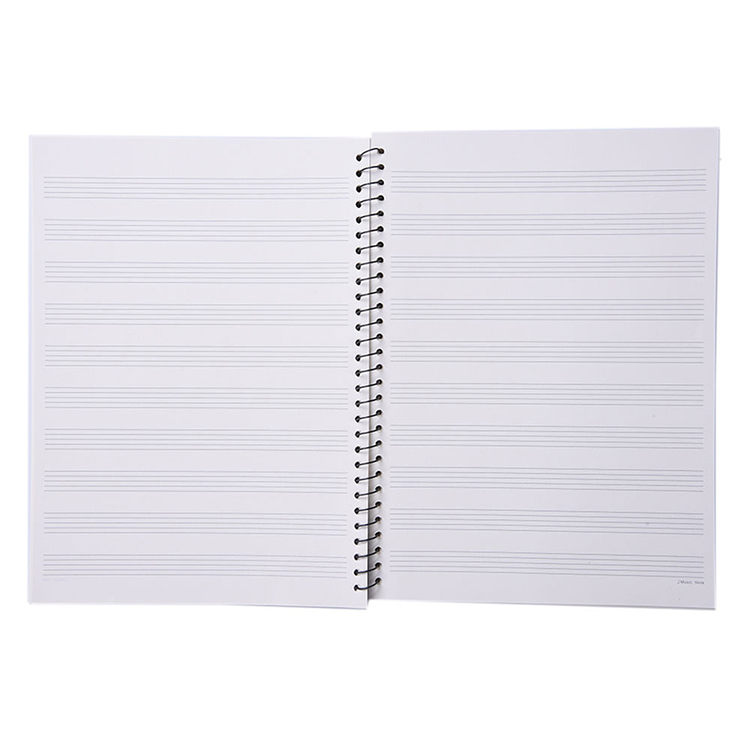
The open spread is the most important photograph here. Two white leaves lie flat around a black twin-loop coil running down the gutter, and every line on the page is doing notation duty: five hairlines per staff, tight within the system, clearly separated between systems, eight or nine systems deep with an unruled breathing margin top and bottom. A student drafting eight bars needs the inter-system gap big enough for lyrics under the staff or fingerings over it; an arranger crossing out bars needs lines that stay grey after an eraser. That gap architecture is the difference between manuscript paper and ordinary ruled stock printed five-at-a-time, and it is what we reproduce when you order a stave book.
The coil at the centre of that spread is doing the second job. A glued spine springs open on a stand clip; a saddle stitch never opens truly flat. A double-loop wire lets the book fold back through itself so a page stays under the stand light without being pinned, and the loops pass through punched holes rather than being threaded through slots, which is why pages tear out clean at the end of the year when a student files them. Line spacing, system depth and the coil’s lay-flat behaviour are the three things band people touch first.
All three are repeatable at volume, because a stave ruling is a print-plate decision, not a new machine. That distinction matters when a district asks for a trial order plus a term order: the trial books and the restock come off the same plate set, so system depth and staff spacing match page for page. We have shipped the same music-ruling programme across lesson studios with four students and school systems with four hundred; the artwork and quantity change, the notation geometry does not.
One geometry detail settles itself in the open spread: systems stop short of the outer edge, leaving a white gutter past the last staff line. That is where a student writes bar numbers, a conductor scribbles rehearsal marks, or a copyist notes the instrument the part was drafted for. Manuscript pages that run lines edge-to-edge waste that gutter, and the photographs show the short-staff layout chosen deliberately. When you approve a stave proof with us, spacing between system and page edge is part of what you sign, not a surprise that arrives at bulk.
There is a purchasing angle here too. Manuscript pads are bought by people who also buy reams of staff paper for the same classroom, and a coil notebook that matches the loose-leaf ruling exactly – same five-line group, same system gap – stops the awkward mix of half-staffed books on a stand. Order the stave book and the matching loose-leaf count at quotation, and both leave on one pallet with one ruling plate behind them. Band directors who restock this way report the same classroom result every September without re-explaining which book goes with which folder.
Paper you can hear bending
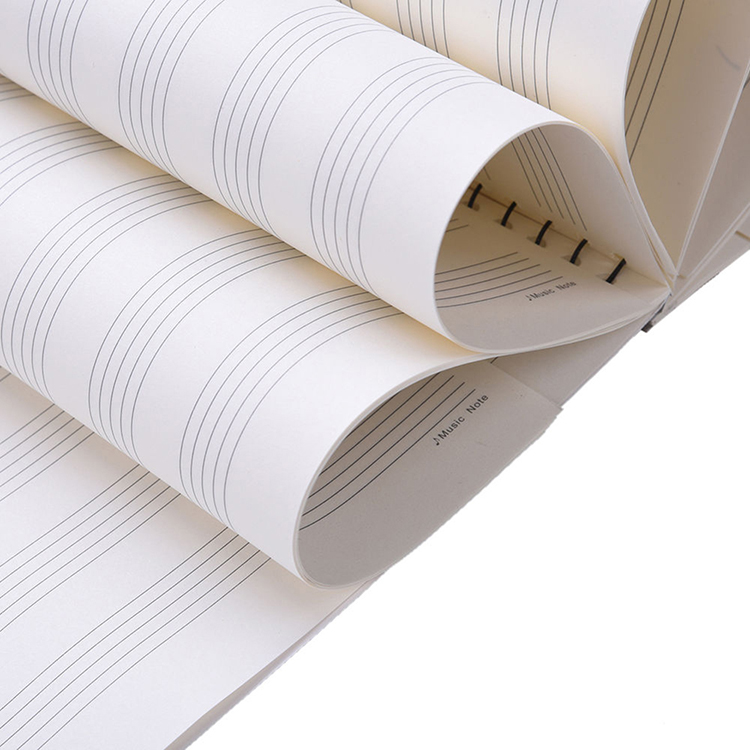
The third frame is a materials test disguised as a product photo. Several manuscript leaves are rolled into soft tubes and fanned diagonally, the staves bending into concentric arcs, the black wire loops peeking through the punched column at the spine, a small printed note-mark sitting in the page footer. A sheet that rolls without cracking, then holds that curve, is a sheet with body: it survives a trumpet bell pressing it against a stand, a backpack with no case, and a year of being opened at the same spread. The curl also shows the ruling surviving flex – lines that crack or flake when bent are a coating problem, and you can see here that this is matte, uncoated writing paper taking the deformation cleanly.
One thing we deliberately do not claim from this frame: the photograph carries no paper-weight stamp. That is why gsm and sheet count live in your quotation, not in this paragraph. Ask for a 70, 80 or 100 gsm interior against your price target and we send a physical sample in 3-5 days so the section’s own piano can reject whatever bleeds through. The footer mark printed on these sample sheets is generic stock decoration; on your run, that footer can carry your department name, stay silent, or take a rehearsal-mark box – all layout decisions at proof stage. Engravers and theory teachers routinely ask for a bar-number gutter or a title box above the first system; both are plate edits on the same ruling, quoted together with the stave SKU rather than surprise-added at bulk.
Why does bleed-through matter more on manuscript paper than on ruled stock? Because notation is written twice – pencil first, then pen when a part is finalised – and erased repeatedly between rehearsals. A thin sheet that ghosts the next system makes a student rewrite the page instead of refining it, and rewritten pages are the hidden tax on every theory class. That is the paragraph your department head actually wants from a supplier: not a poetry about paper, but the engineering reason the ruling and the weight get specified together at quotation.
The same curl photograph shows the black twin-loop coil threading the punched column at the spine, and that pairing is the durability story in one image: a sheet with body and a binding that flexes with it, not against it. Stave books live in folders, cases and stand clips; every flex cycle is a stress test on the punch column. Round holes plus a double-loop wire survive those cycles, which is what the flat open spread earlier on this page already demonstrated – the leaf block opens, closes and folds back without the cover tearing at the holes.
The corner detail: coil, holes and ink edge
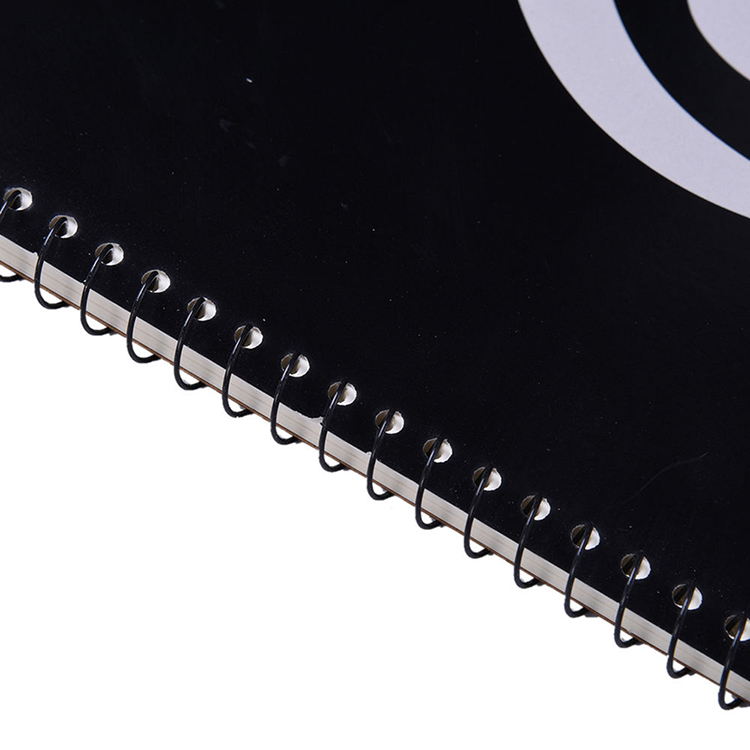
A macro crop settles the build questions before they become email threads. The black card lies against white, cropped at an angle so you see the binding edge-on: black-coated twin loops passing through clean round punches, roughly twenty visible along this stretch of spine, the white page block compressed behind them, and the corner of the cover’s ring artwork printed flat – no emboss, no foil edge lifting in the light. That punch quality is the difference between a coil book that loosens by winter break and one that still feels tight in June. Round, evenly positioned holes keep the sheet rotating on a full loop instead of tearing at slot edges.
Zoom on the ink: the white graphic sits on black card with no halo, no misregistration sliver, no edge of a foil patch. Single-colour printing on dark stock is the most forgiving decoration method on this line – one pass, one plate, identical on every unit in the carton – and it is why school programmes reorder the same file for years without paying for re-tooling. State your coil colour against the black or silver photographed here; everything else in the build carries forward unchanged.
The photographed coil in this detail frame is black; the closed-cover frame above shows silver. We treat coil colour as an order-stage selection against your brand or department colours, not a surprise that arrives with the carton. State it on the quote request and it is locked on the mock-up.
Read the macro one more level in, because buyers ask what the cover corner does after a term. The ring artwork sits flat on the card with no embossed edge to catch bag lining and peel, and the coil loops turn freely in their punches rather than sawing at them – the failure mode of oversize wire in undersize holes. Nothing here needs a datasheet; the crop exists so a facilities buyer can see loop gauge, punch clearance and print registration in one frame and stop guessing what arrives in September. Your crest, wordmark or festival title then simply replaces the ring artwork on the same black card, same plate family, same one-pass print – while the coil colour line on the proof stays next to the hole-count note, so a single signature locks every mechanical detail of the build before any paper moves. Band suppliers who order blind, without the corner crop in front of them, eventually email about loop gauge; suppliers who read this frame first do not, which is the entire service a detail photo is supposed to provide on a product page that carries no datasheet.
Points you set before the plate is made
- Interior ruling: five-line staves as photographed; system depth and staff spacing adjusted for junior or engraver layouts at proof
- Alternate ruling inside the same programme: plain, lined or lyric-style pages quoted alongside the stave SKU
- Cover artwork: keep the clef design, substitute your mark, or go plain field with a spot-colour logo
- Coil colour: black or silver as photographed; other coil colours quoted on request
- Sheet count and paper weight: quoted on request against target price
- Book format: pad dimensions set at quotation; the photographs show spread detail rather than measured size
- Logo method: printed on the card cover, proofed on a free digital mock-up
Specification summary
| Item | Custom stave paper music notebook, wire-bound manuscript pad |
| Size | Format fixed at quotation; photographs show open-spread and cover detail rather than measured dimensions |
| Paper & Ruling | Five-line music staves, systems stacked down the page as photographed; gsm and sheet count quoted on request |
| Cover | Black card with printed treble-clef artwork or your substitute design; matte print surface |
| Binding | Metal twin-loop wire coil through punched holes, black or silver as selected |
| Logo & Finish | Cover print zone for crest, band name or studio mark; free digital mock-up before production |
| Packing | Export cartons, palletised or loose; FBA labelling and prep supported |
| MOQ | 100 pcs per design |
| Sample time | 3-5 days |
| Lead time | 7-15 days after artwork approval |
| Capacity | 1,000,000 pcs per month across our gift lines |
Buying to a school calendar, not to a product page
Music programmes buy against fixed dates: audition week, festival entry deadlines, the concert where soloists need fresh manuscript books in hand. Work backwards. Send the crest and ruling spec in time to hold a mock-up, take the 3-5 day physical sample as the term’s last rehearsal gift to yourself, approve artwork, and the order finishes in 7-15 days – comfortably inside the gap between approval and almost any September if you move during summer break. The displayed figure anchors the 100-piece tier for one design; a design is one cover, ruling and format combination, so a treble-stave SKU and a plain-leaves SKU are two designs at two hundred pieces together, not a broken order.
Colour-matched, logoed covers on a shared plate reorder without re-proofing while the mark stays current. When the school rebrands, the plate changes and everything else in the specification holds. Our gift lines run 1,000,000 pieces a month across notebook, pad and journal formats, so a district-wide manuscript order is capacity math, not a favour – and because the ruling geometry lives in a print plate rather than special tooling, a programme that starts with one hundred books for honours band and grows to four hundred for the full roster is just a bigger PO on the same file. The one thing that does change between a hundred-book trial and a four-hundred-book term is the freight plan, not the product – which is exactly what a department chair needs to hear when comparing two terms of spending.
Packing, freight and fulfilment
Cartons ship to school docks, conservatoire reception desks or Amazon shelves with equal instructions. We band books by format so a term’s stave restock and its theory-journal restock pull from the same facing, apply FBA barcodes at our dock when you forward the plan, and book freight by sea, air, DHL, UPS, FedEx or TNT against your deadline rather than our convenience. Partial-carton splits between two campus addresses are quoted as their own line, and carton weights and dimensions travel with the quote so your freight forwarder prices landed cost instead of guessing. The photograph below shows how bulk notebook orders ship: books banded in inner lots, cartons stacked true inside the box walls, pallets sized to the container floor and marked to the delivery plan you send with the PO.

Tender-desk questions from music departments
Will these stave books actually lie flat on an orchestral music stand?
Can we mix stave pages and plain composing pages under one order?
Can the clef artwork be replaced with our school crest?
What is the realistic timeline before a September audition week?
Why doesn’t this page state a paper weight or page count?
Does the listing price include the school crest printing?
Related pages worth reading before you spec
If the same purchase order feeds a general notebook need, the clear-cover coil journal carries the lined-to-dot ruling menu for theory and ear-training notes, and the large-format ruled pad suits section rehearsals on letter-size paper. Browse the full notebook range or pair the set with printed collateral from the printed items catalogue. Send the crest file through the quote desk and we will mock it up on the stave book.
Start the manuscript run
One mock-up costs nothing and answers more than any paragraph here. Email your mark to [email protected] or call +86-15967739086, state the format, ruling and quantity tier you need, and approve artwork in time for the 7-15 day window. The form below routes straight to the same desk.