Custom Wire Spiral Notebook with Logo (B5 & A5)
$0.95
White twin-loop coil pads in B5 (7.3×10 in) and A5 (5.7×8.3 in), each with a clear plastic cover sleeve that turns your printed insert into the shelf face – swap a season or a school roster without changing the book. Interiors run lined, grid, dotted or blank to your spec; the photographed dot-grid and plain covers are open print zones for your logo. Built for stationery shops, campus stores and journal labels that reorder by term. MOQ is 100 pcs per design, physical samples leave in 3-5 days, bulk finishes 7-15 days after artwork approval, and the price displayed on the page anchors the 100-piece tier. FBA labelling and prep supported, freight by sea, air or express.
Stationery shelves turn over in sets, not singles. A shop that sells one coil pad restocks half a dozen SKUs at once, a campus store reorders every term start, and a bullet-journal label refreshes cover art twice a year without touching the book underneath. That buying habit shaped this custom wire spiral notebook with logo. The unit is a white paper pad on a silver twin-loop Wire-O coil, sized B5 (7.3×10 in) or A5 (5.7×8.3 in) as labelled in our studio photos, finished with a transparent plastic cover slipped over the front like a sleeve. The sleeve is the quiet workhorse: it protects a printed paper insert, so a retailer swaps a seasonal face or a school swaps a roster card by changing what rides under the clear layer, not by re-making the notebook. Interior ruling is specified at order stage – lined, grid, dotted or blank – and the plain faces of the photographed samples are exactly what they look like: print zones waiting for your mark. Cover face, sleeve option, coil finish, format and sheet count are locked at quotation; nothing here is a fixed configuration you must accept. The displayed figure anchors the 100-piece tier, the MOQ holds at 100 pieces per design, and a digital mock-up costs nothing, so a small shop can test one SKU before it commits a shelf. If you are assembling a wire-o programme for a stationery chain, a school store or your own label, the rest of this page gives you the construction facts the photos prove and the commercial terms sitting around them.
Why a twin-loop coil, and what the tent shot proves
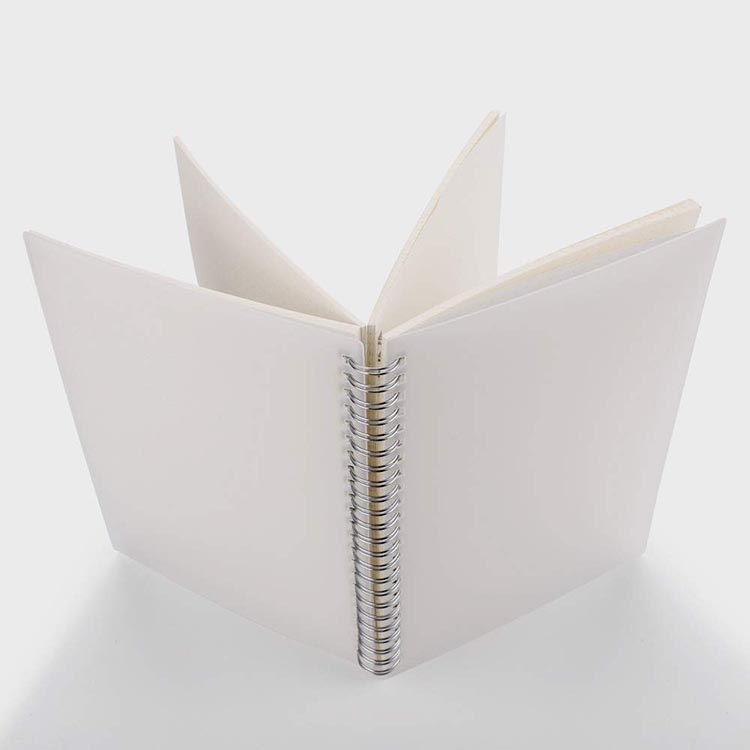
The coil decides whether a journal survives its first month on a desk, and our studio pose makes that visible. One blank notebook stands on its lower edge, both covers splayed open to left and right like the legs of a tent, inner leaves fanned into three soft peaks, the silver coil running down the central spine and holding the whole shape upright. Page edges show the warm cream tint typical of uncoated writing stock. A binding that keeps that pose without springing shut is the practical reason bullet journalers, sketchers and note-taking students keep asking for wire-o instead of a plastic comb.
A double-loop Wire-O threads through round punched holes and keeps its round profile under a writing hand. It lays flat on a desk, folds back through itself for half-page spreads, and does not lift the sheet the way a comb spine does when you press near the gutter. For the school-supply reorder culture that matters commercially: a pad that survives a term inside a backpack, with no kinked spine to hand the shelf a returns story, gets reordered the following term without a new line review. That is the quiet difference between a notebook that sells once and a SKU that earns a permanent bay.
The same coil spec carries across the full interior menu – lined, grid, dotted, blank – with no tooling change, because the coil threads whatever sheet block you specify. Only insert count and paper choice move the quote, and we hold both open until your target landed cost is known. Coil colour follows the photographs as silver; alternative wire tones are quoted on request. Punch quality matters as much as the wire itself: clean round holes, evenly spaced, keep each sheet rotating on its loop instead of tearing at the edge by June, which is why our coil pads read as the durable answer on a planogram rather than the cheap one.
The clear cover is your shelf identity layer
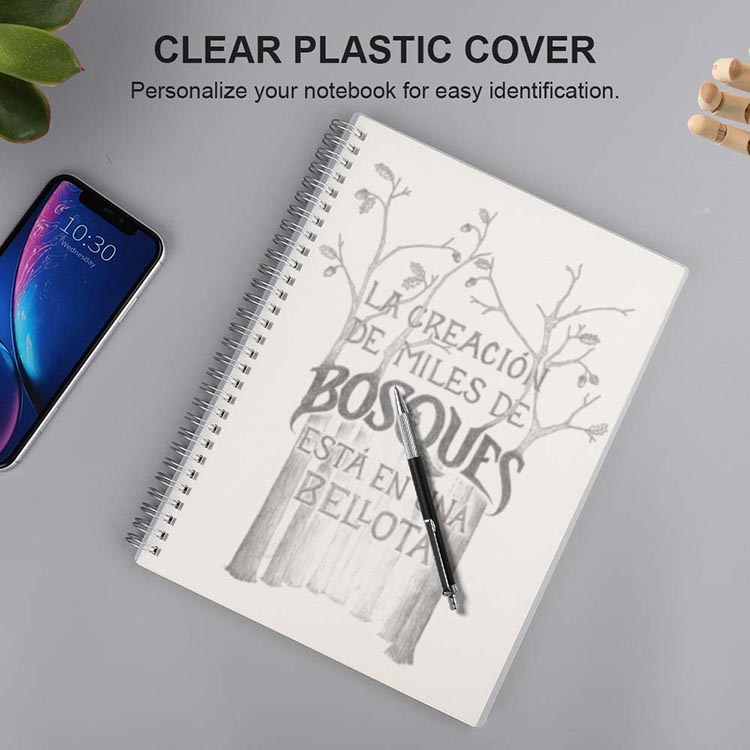
The lifestyle shot shows the transparent cover doing the job it exists for. It slips over a front sheet carrying a pencil-style drawing, coil to the left, the sleeve lifting a small highlight along its edge so you can see it is a separate layer, not a laminate. The photo’s own headline above the frame reads CLEAR PLASTIC COVER, and the line under it states the sentence every retail merchandise planner cares about: personalise your notebook for easy identification. A spiral notebook with logo under a clear sleeve is recognised by its face at arm’s length, and that face can change while the hardware SKU stays put.
Because the printed sheet rides under the cover rather than taking ink head-on, a shop can run one construction all year and change only what the customer sees. Back-to-school gets a subject grid. January gets a planning cover. Graduation season gets a commemorative sheet. Each is an insert decision, not a tooling decision, and reorder lead time stays inside the 7-15 days we quote after artwork approval. Schools and clubs use the same layer for ownership: a name or class card tucked under the clear front answers the lost-and-found problem without a second print run.
Two honesty notes about that photograph. The smartphone and the pen in the frame are styling props for scale and mood – they are not in your carton, and we will never write them into a packing list. The artwork printed on the sample insert belongs to that sample only; when you order, your own file occupies the same space. If your programme wants a coordinated desk gift around the pad – pen, flash drive, boxed set – that is built on our notebook, pen and flash-drive gift set line and quoted separately, in the same conversation, from the same dock.
There is a second economic argument for the sleeve that buyers discover after their first restock. Ink on a clear film scuffs at the corners first, because the sleeve edges take the abrasion of a bag or a shelf rail; ink on the paper underneath never rubs against anything but the sheet it faces. Keeping artwork under the overlay therefore protects print legibility across the life of the product, which is exactly what a school wants when a pad has to survive a term and a shop wants the front of the display to still look crisp in week six. Replace a scuffed clear sleeve? Not a decision a customer makes – sleeves are fixed at our factory stage – but choosing the sleeve-on configuration at order time is a durability decision disguised as a cosmetic one.
Dot-grid faces, plain faces, and the four-way ruling menu
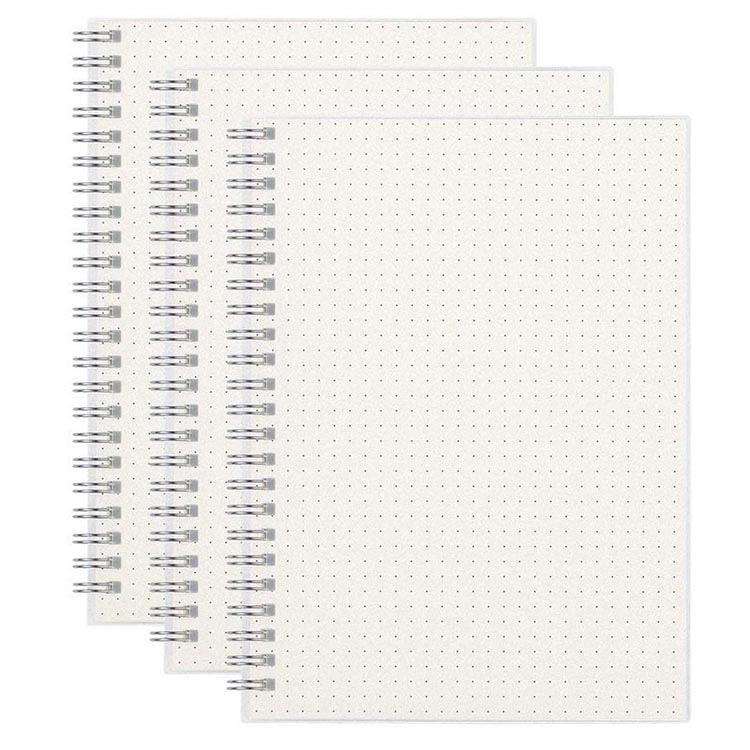
The studio three-pack gives you the decorated option. Three cream notebooks are staggered on white so all three coil edges read at once, each cover printed head to toe with a fine grey dot lattice. A dotted cover face is a deliberate retail cue: before a bullet-journal buyer opens the book, the grid already tells them the inside was built for dot-to-dot layout, habit trackers and sketch-note spacing. Plain white, printed dot grid, or a full-colour custom cover with your artwork are three ways to face the same construction, and one programme can mix them across shelf positions.
Inside, ruling is your call. Lined suits meeting notes and school dictionaries. Grid carries sketch-noteing, maths and engineering pads. Dotted is the bullet-journal default and the planner crowd’s first grab. Blank serves colour-in, free layout and kids’ packs. The photographed samples keep their interior sheets closed, so no specific gsm or sheet count is claimed on this page: those are set at quotation against your sample request, and the paper we mail in 3-5 days is the paper you approve for bulk.
The two sizes split a shelf logically once the ruling menu is fixed. A5 slides into a handbag, a planner pocket, a conference delegate pack or a kids’ school-kit polybag; B5 gives journalers wider spreads and gives meeting-note users more lines between reams. Same coil, same sleeve, same interior options across both, so one artwork system covers the size pair and only the pad format changes between the two facing lines of your planogram.
There is a shelf-mechanics argument for the printed dot face as well. A dot-grid cover reads as a category before it reads as a brand, so a shop can place this SKU in the planner and journaling bay rather than fight for position in generic school supply. The fine grey lattice also photographs consistently across cartons, which matters when your online store and your social grid do half the selling: a dot cover looks intentional in a flat-lay in a way a plain white pad looks unfinished. Plain white stays the right choice for corporate artwork programmes; the dot face stays the right choice for retail journal labels; both run on one construction, one plate family, one reorder clock.
Whichever face and ruling you choose, artwork gets one decision loop: send the file, receive the digital mock-up on real pad dimensions, approve, and the plate is set. That single approval gates every variant in the programme, which is what keeps a five-SKU shelf honest across reorders without five separate negotiations.
Reading the size labels before you spec a planogram
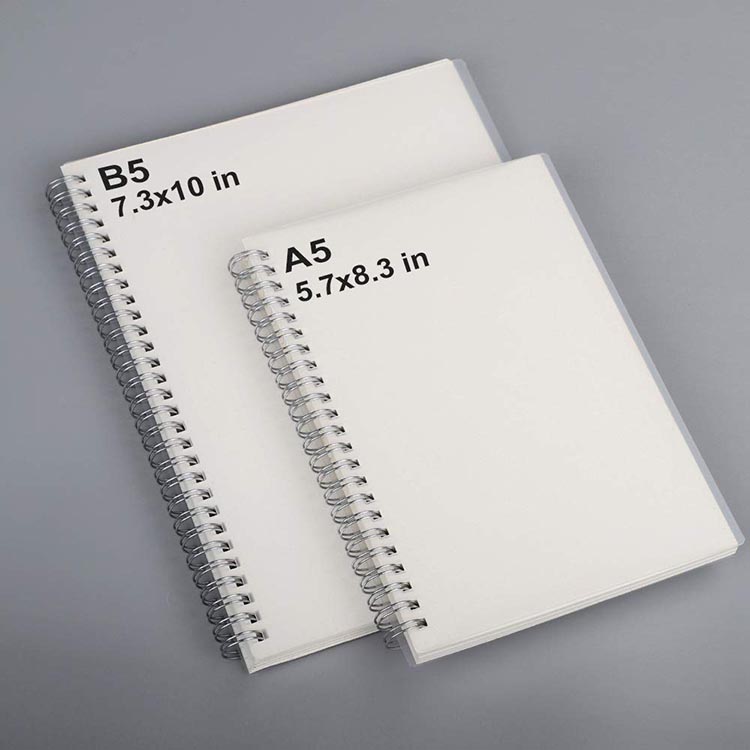
The size-overlap frame settles the first question every retail buyer asks us. Two white pads lie on a grey ground, each wrapped in a clear plastic cover that shows as a thin translucent rim along the top and right edges; a silver double-loop coil runs down the left side of both. The larger pad carries the printed label B5, 7.3×10 in and the smaller one reads A5, 5.7×8.3 in. Those figures are our studio spec text laid onto the covers, quoted here as photographed – the physical sample you approve before bulk is where the measuring happens.
Nothing else appears on those two faces: no logo, no barcode, no shrink-wrap, no hang tag. That blankness is the product spec. Both covers are unclaimed print zones, photographed bare so you can judge how much room your mark gets – the full front panel below the size text, uninterrupted by stock graphics. When we print a client’s notebook with logo for a store programme, the mark sits in that field, scale and placement decided on the mock-up you approve before anything runs. And when your brand manager wants the mark above the coil line and the label desk wants it centred, both versions are the same construction with different artwork positions; only the proof changes, not the pad.
Size choice is really a price-band choice dressed as a design choice. B5 carries more paper per unit and reads as the premium journal on a shelf where customers compare formats by hand; A5 lands cheaper per carton, fits impulse positions at the till, and is the format most school-kit bundles quietly standardise on because a case of A5 pads weighs less on the freight invoice. Most of our retail clients end up running both: one size for the display, one for the bundle, identical artwork plate across the pair so the programme stays one file set. Set your size mix from sell-through data rather than catalogue habits – the tooling is shared, so the only variable between formats is the sheet count you decide at quotation.
Two practical notes from the same frame. Both pads sit under their clear sleeves even at B5 and A5 – the sleeve is specified on each format, not an option that only the larger book gets. And both faces stay bare apart from the spec lettering, because the studio shot deliberately shows the maximum blank margin around any logo print. When artwork arrives later, the mock-up places the mark on these exact pad dimensions, not on a generic template, so what was proofed at A5 actually fits at A5 in bulk. That is also why this frame doubles as the pack shot your merchandising team can crop for internal planograms: size, sleeve and blank face in one picture, no measuring notes required, no calipers borrowed from the mailroom.
What you can set at order stage
- Cover face: plain white, printed dot-grid, or your full artwork in one spot colour or process colour
- Clear plastic cover sleeve: specified on or off per line
- Format: B5 and A5 as photographed; other pad sizes quoted on request
- Interior ruling: lined, grid, dotted or blank; each ruling is treated as one design for MOQ
- Sheet count and paper weight: quoted on request against your target landed cost
- Coil finish: silver as photographed; alternative coil colours quoted on request
- Logo placement: front panel print zone, sized and proofed on a free digital mock-up
Spec table at a glance
| Item | Custom wire spiral notebook with logo, twin-loop Wire-O pad with clear plastic cover option |
| Size | B5 (7.3×10 in) and A5 (5.7×8.3 in) as photographed; other formats quoted on request |
| Paper & Ruling | Lined, grid, dotted or blank interior at order stage; sheet count and gsm quoted on request |
| Cover | Plain white card or printed dot-grid face; full custom artwork available; clear plastic sleeve over the front |
| Binding | Silver double-loop wire-o coil, punched through cover and sheets |
| Logo & Finish | Single-colour or full print-zone artwork on the cover; free digital mock-up before tooling |
| Packing | Export cartons, palletised or loose; FBA labelling and prep supported |
| MOQ | 100 pcs per design |
| Sample time | 3-5 days |
| Lead time | 7-15 days after artwork approval |
| Capacity | 1,000,000 pcs per month across our gift lines |
Samples, artwork approval and the hundred-piece door
Order flow on this line is short because the construction is standard. You send the logo file plus the format, ruling and sleeve decision; we return a digital mock-up free of charge on the actual pad dimensions, so the artwork is proofed where it will print. Approve the mock-up and a physical sample leaves in 3-5 days – run it, hand it to the store manager or the journaling lead whose opinion you actually need. Bulk runs 7-15 days after artwork approval, and because every coil pad on this page shares one tooling family, reorder waves between seasons stay inside the same window.
The MOQ is 100 pieces per design, and a design here means one cover-face, ruling and format combination. A shop that wants dotted B5 and lined A5 is two designs, two hundred pieces, one conversation. The number displayed on this page anchors the 100-piece tier; quantity breaks are quoted against your forecast, and nothing on this page is a fixed unit price. Capacity of 1,000,000 pieces per month across our gift lines means a mid-year planogram win does not turn into a stockout story, and an approved file stays on record so identical restocks skip the proof stage entirely.
Questions shop buyers ask before they commit
Does every notebook ship with the clear plastic cover, or is it an add-on?
Are the pen and smartphone in the styling photo part of the order?
How do we split the MOQ across the dotted, lined, grid and blank versions?
Which format should a planogram hold, B5 or A5?
Is the listing figure a quote for my quantity?
Can we restock the same cover mid-season without a re-proof?
Packing and shipping, shelf-ready or FBA-ready
Notebook packing follows the programme. Retail buyers take units in plain cartons with inner sleeves as specified; campus stores often want a facing count per carton that divides cleanly into shelf sets; Amazon resellers send the same pads straight to fulfilment centres with FBA barcodes applied at our dock and carton weights declared before booking. Freight moves by sea, air, DHL, UPS, FedEx or TNT against your incoterm, and we plan the booking backwards from your in-store date, not forwards from our production calendar. The packing photograph below shows the carton discipline a coil pad ships under – inner packs squared to the box wall, palletised when the order reaches container size, marked to the plan you send with the PO. Ask for carton dimensions and per-carton counts at quotation; both are printed on the quote sheet before you book anything.

Neighbouring lines worth comparing before you lock a programme
Coil is not the only honest answer on a stationery shelf, and this page should be read next to its neighbours. The kraft-cover spiral notebook is the low-unit-cost giveaway tier that pairs with this premium face on one purchase order. The large-format wire-bound pad answers tender sheets where letter-size ruled stock is the requirement. The full range lives in the custom notebook category, print collateral for the same launch ships from the printed items line, and pricing a two-format shelf programme starts at the request-a-quote desk.
Order the mock-up, not the guess
A shelf decision should be made holding the actual pad, not a rendering. Send us the logo, tell us B5 or A5, lined or dotted, sleeve on or off, and we return a free digital mock-up the day the file lands; physical samples follow in 3-5 days. The quote desk is the fastest door, or reach the team at [email protected] or +86-15967739086. Use the form below and we will put your artwork on the coil pad your shelf is missing.