Custom Bible Study Journal Notebook for Groups
$0.68
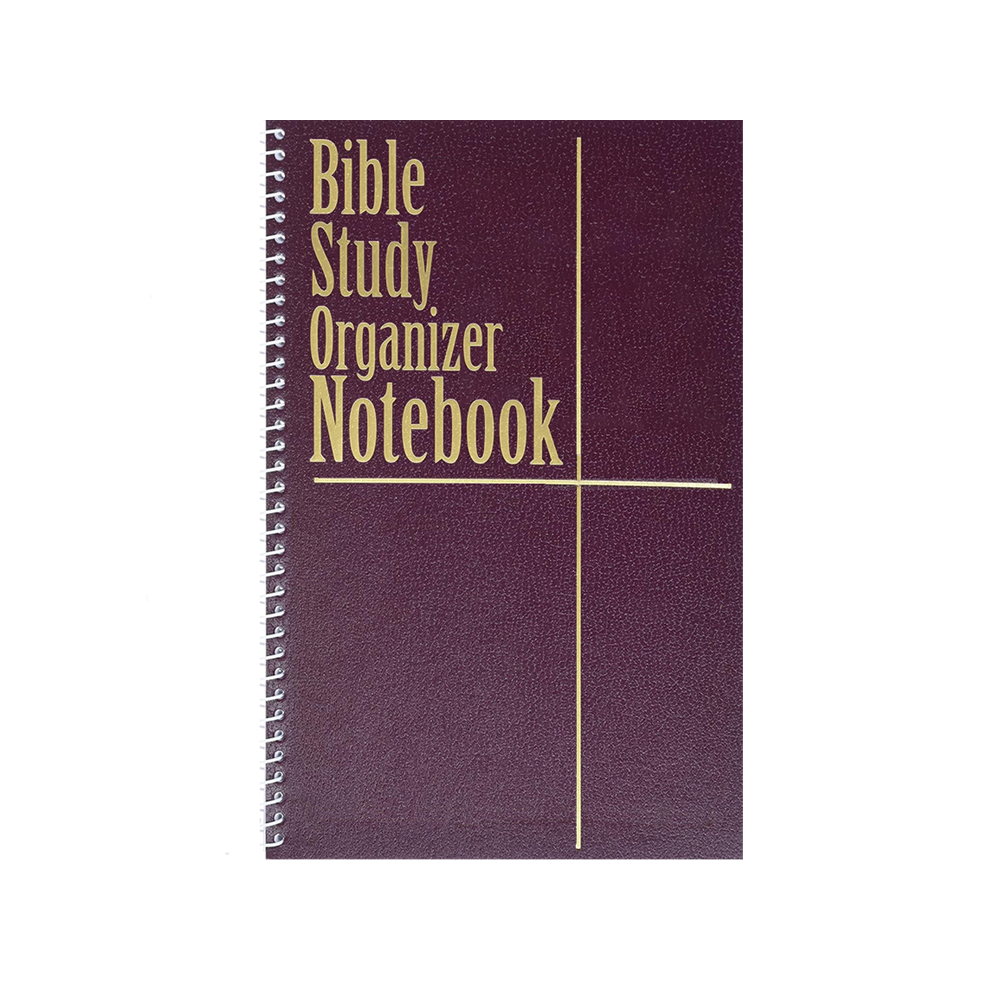
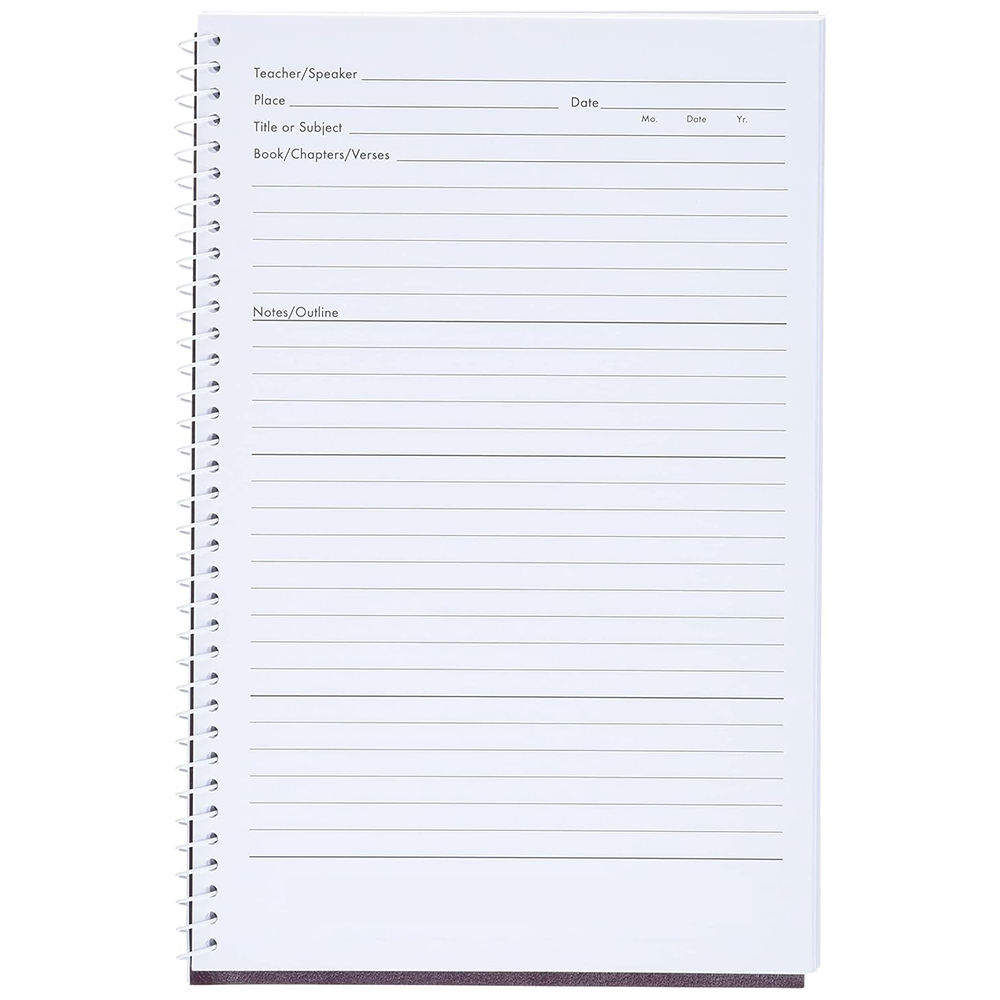
A faith-group journal built the way study classes actually write: a deep red leather-grain cover with gold-foil title and cross – or the same grain blank for your church, retreat or society mark – over pages that carry printed Teacher/Speaker, Place, Date, Title or Subject and Book/Chapters/Verses fields above wide ruled notes. 80GSM paper is quoted from the photographed spec callout and verified on your 3-5 day sample. Welcome Sundays, men’s and women’s class sets, Easter and Christmas programs all price from the 100-piece tier at 100 pcs per design, with production 7-15 days after artwork approval and per-class names printed across one run.
A church orders differently from a store. A bookstore buys what sells; a parish, a diocesan gift committee or a women’s-movement coordinator buys what a class receives together – forty matching journals at a welcome Sunday, five hundred at a Christmas program, the same cover carrying the group’s name so a returning member recognizes hers on a shelf. That is what this custom bible study journal notebook is specified for. The photographed book is a deep red, leather-grained cover with a slim metal coil at the spine and a four-line gold title reading Bible Study Organizer Notebook under a fine gold cross: a face that states its purpose across a fellowship hall. Open it and the argument gets better. One photographed page is a plain wide-ruled sheet under a printed 80GSM callout; the other is a sermon-note form with fields for Teacher/Speaker, Place, Date, Title or Subject and Book/Chapters/Verses over ruled lines – structure the way a study class actually writes. Cover foil, heading text, class name or society crest are yours at artwork stage; group names per class are a data-driven print run, not a handwritten afterthought. The displayed price anchors the 100-piece tier, samples leave in 3-5 days, and production closes 7-15 days after artwork approval – tight enough to serve an Easter program ordered after Lent begins, generous enough that nothing ships without a signed proof.
The sermon-note page: form over function
Study journals fail when the page fights the way notes are taken. The photographed interior form solves it with labeled fields at the head of the sheet, each sitting on its own fill-in rule: Teacher/Speaker, Place, Date with small month/day/year subdivisions, Title or Subject, and Book/Chapters/Verses for the passage. Mid-page, a Notes/Outline header opens a block of wide horizontal rules with no margin line – room for the point you underline later, not just the quote you copy now.
This layout does real catechetical work. Six months later a member finds the note because the speaker and date are on the page, not in a phone. A class that reads through Isaiah in sequence can index its own volumes by the scripture field. A small-group leader who lends out printed study guides can stop printing them, because the takeaway each week is already written down in a book that belongs to the attendee.
And because the header labels are print, they change per program at no structural cost: a men’s Bible study may want the scripture field first; a women’s circle may want a memory-verse line; a new-members class may want name and membership date. Header text is editable at artwork stage on every order of this line, proofed on paper before the plate is committed. If your class follows a published curriculum with its own field names, send them – relabeling a header row is a layout edit, not a new product. The same rule covers language: header rows print in English as photographed, and Spanish, Portuguese or Korean field labels are laid out on request when a bilingual class needs both columns on the sheet. No translation surcharge is built into the tooling, because the header band is just type on a plate; what you sign on the proof is what every carton repeats.
Paper, as photographed and as quoted
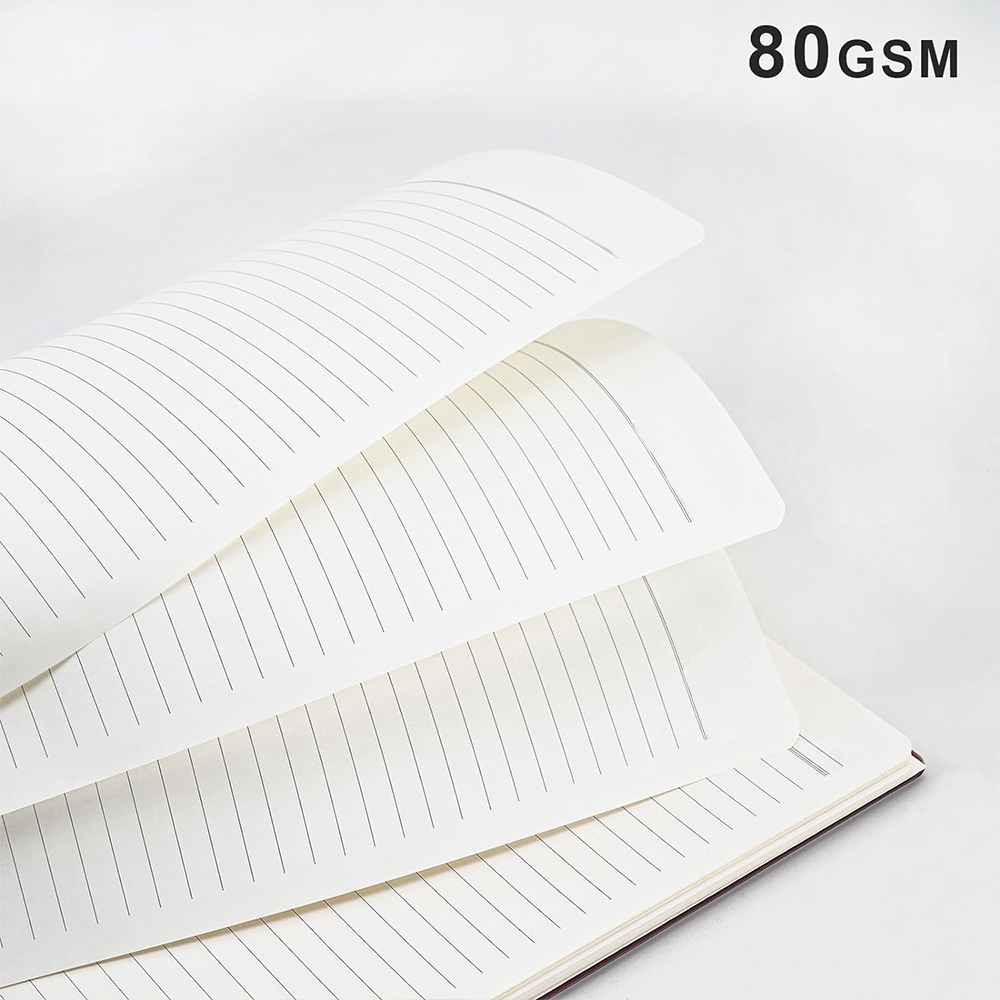
The second frame is a paper-body demonstration. Four cream leaf layers fan upward into nested arches over a deep red cover edge, holding their curl instead of flopping – sheets with enough substance to stand up to fountain pens and gel rollers without a ghosted second page. Across each leaf run single horizontal gray rules with a right-hand stop, the writing area kept clean of edge crowding, and a black 80GSM callout printed into the photo’s corner.
We treat that number the way an honest factory treats photo spec text: 80GSM is quoted as printed in our listing image, and the sample we mail in 3-5 days is where you verify it – hold a page to a window, write on it with your class’s worst pen. Other weights are quoted on request against target price; nothing here claims a certificate, a test report or a chemistry.
Why the curl matters for a journal rather than a legal pad: study members keep these books for years, wedged between hardback commentaries on a shelf or loose in a tote. A sheet that holds an arch today is a sheet that will not dog-ear into confetti by the third study cycle, and cream-toned paper takes pencil graphite and ballpoint alike without the shine of a coated sheet fighting the ink. The photographed wide rule with its right-hand line stop is the other quiet kindness – no note crowds the cut edge, no marginalia runs off the page during a fast sermon transcription. The nested-arch presentation is also how committees judge opacity in a single look: four lifted layers let you count how much of the rule beneath bleeds through the sheet above, the same window-test you will run on the mailed sample before the vote. Weight choices for other budgets – lighter stock for a large membership drive, heavier for officer gifts – are quoted the same way, with a physical sheet in the committee’s hands before the tier is signed.
Sheet count and trim dimensions are not legible in the frames either, so they are quotation-table items you set, not paragraphs we invent. Committees that measure against existing resources – hymnals, commentaries, the class’s current dog-eared spiral – should send those dimensions with the quote request, because a journal that shares a shelf with a study Bible needs to match its depth or it lists in the row. Neither the photographs nor this page commit a fixed trim; send your shelf or tote measurement with the quote request and the build follows it.
For committee budgeting there is a practical consequence: a study journal lives on the same shelf or in the same tote as the class’s printed curriculum, and dimension alignment is what makes a gift feel chosen rather than bulk-bought. Measure the resource the class already uses, send that number with the quote request, and the sample arrives cut to match. No frame on this page prints a page count, so sheet depth is a quotation item you set and then verify by hand before the 7-15 day production clock starts – the one step that separates a committee that reorders annually from one that quietly switches vendors after the first term.
The cover, read as a gift committee reads it
Closed, the book fills the frame: burgundy-red panels with a fine pebbled grain that catches light along the peaks the way leatherette does, low sheen rather than gloss, and a bright metal coil running down one edge. Two frames of the same cover matter to buyers for opposite reasons. The listing’s opening image is the fully decorated stock face – gold foil type stacked left of a long, thin cross – and it tells you the program voice the page serves, Bible Study Organizer Notebook in four lines of condensed serif.
Committee buyers sort that cover into a question they can answer from the photo alone: does it look like a gift, or like a supply item? A foil title on pebbled red grain reads as a gift – the visual vocabulary of a confirmation or anniversary presentation – which is why these books land well at welcome Sundays and memorial programs alike, where a plain notebook would feel thoughtless. The grain also does real work in a tote bag: scuffs and corner wear that would show on smooth coated board read as texture on a leatherette face, so a year of weekly study circles ages the book without damaging it.
Layout of the stock title block earns its keep for the same reason. Four stacked lines sit upper-left, a slim cross runs vertically along the right and crosses at mid-height, and the two elements frame each other without touching. Any church name, society crest or retreat theme that replaces that block can inherit the same composition – short text stack left, symbol right – and the balance holds; the mock-up proves it before plate. If a committee wants the cross centred, moved, or dropped entirely for an ecumenical class, that is a layout edit at proof stage while the grain, foil tone and coil stay unchanged.
Colour is the decision committees revisit most, and the frames defend themselves here. Deep burgundy reads as solemn without tipping into black, which is why it carries both Easter lilies and Christmas reds without matching a seasonal theme by accident; plum and lighter reds sit in the same leatherette family at quotation if a denominational office wants a palette for different ministries. Whichever tone is picked, the pebbled grain stays the same spec, so the tactile signature – the one people check before they read the foil – is identical across the ministry lineup. A retreat house that orders plum for the spring week and burgundy for the winter week gets two shelf identities from one book. The photograph keeps the committee’s palette argument honest by showing one tone at true saturation, not a gradient of screen-bright reds, so what the elders approve on screen is what they unwrap. Committees that order a single tone across five years of class sets report one last practical benefit: the photo above becomes the reference swatch, pinned to the finance folder so nobody re-litigates the colour at each renewal.
Committees read that decoration as permission: if the factory can foil a cross and four lines of title, it can foil your church name, your retreat theme or your society crest at the same standard. Foil colour, text size and placement are locked on a free digital mock-up, and per-group variations – Class A, Class B, men’s circle, women’s circle – are handled as named print data across one run rather than handwritten afterthoughts on a folding table. Gold on deep red stays the default because it photographs well in a Sunday-shelf announcement; silver foil and blind-deboss alternatives are quoted on request. A named-foil selection, once chosen, is a plate setting: every carton in the run and every reorder after carries the same metallic tone, so a committee that approves a mock-up in March receives what it approved, not a close approximation.
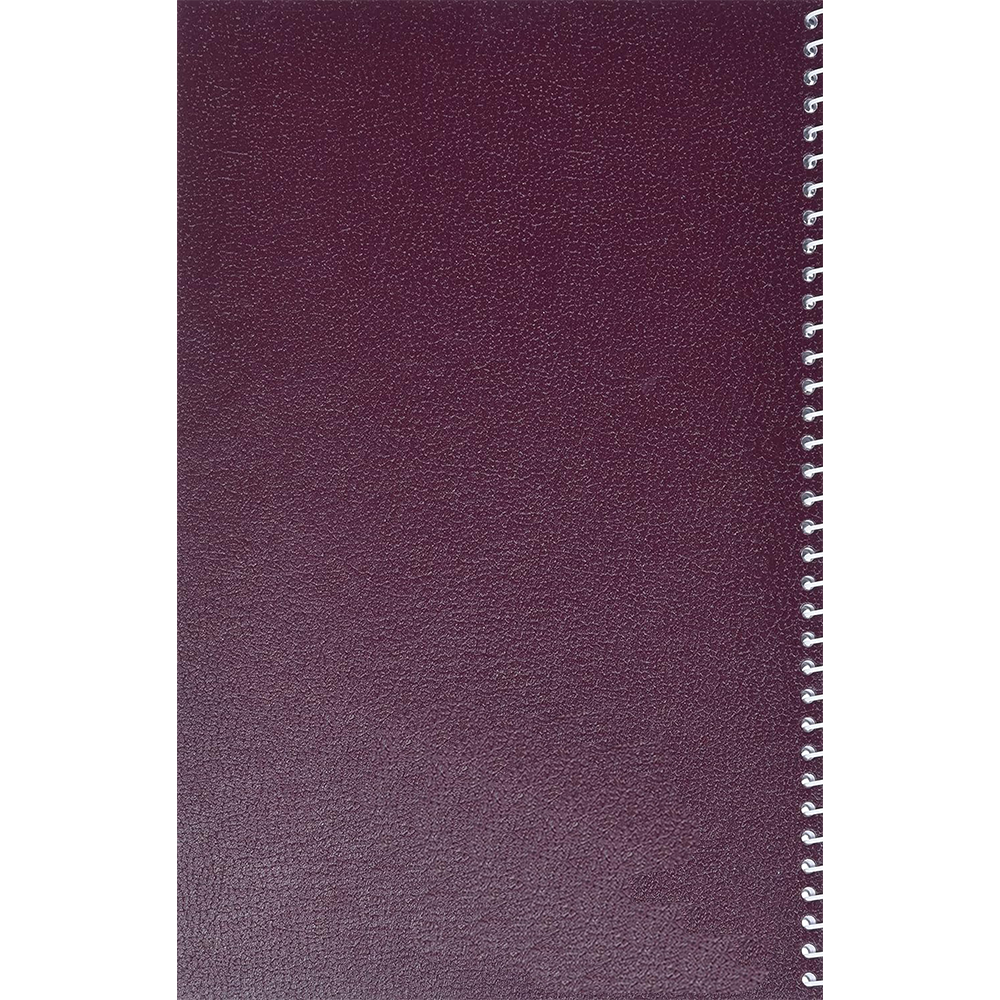
The second cover frame shows the identical grain and coil with no print at all: the honest version of what you receive before artwork – no pre-printed logo you have to design around, no publisher mark to license. The whole panel is a print zone, and the pebbled surface takes foil cleanly without the gloss reflection that makes an embossed logo unreadable under hall lighting. A committee reviewing two mock-ups – decorated stock face versus plain grain with their crest – decides in one meeting instead of one semester, because both versions are the same book and the same price tier; only the print file moves. The coil tone visible along the spine in both frames is the finished edge you receive: a bright metal wire-o, not a plastic comb, which is what lets the journal lie open on a table while a member writes standing at a lectern. Interior options beyond the photographed pages – paper tones, pocket builds, closure styles – stay quotation items listed in the configuration section rather than promises hidden in a paragraph. The blank-grain frame also answers the question gift committees actually argue about: whether the cover will look like the sample on the day. A debossed or foiled church name on pebbled burgundy reads the same across an entire run because the grain hides press-to-press variation in foil bite – something smooth coated board broadcasts instead. Print depth on leatherette is forgiving in a way that cheap notebook covers never are, and the frame is the proof. For coordinators assembling welcome-gift trays – journal, pen, printed welcome card – the blank face is also the practical one: it pairs with any diocesan colour system without clashing against pre-printed artwork nobody chose, which is why the unprinted grain photograph sits on this page at all rather than a fifth decorated angle.
What can carry your group’s identity
- Cover print: church name, society crest, retreat theme or class year, in foil or ink on the photographed grain face
- Header fields: Teacher/Speaker, Place, Date, Title or Subject, Book/Chapters/Verses text edited per program
- Ruling: wide ruled as photographed; blank, dotted or lined-plus-margin interiors quoted on request
- Interior extras: inner pockets, ribbon marker or elastic closure are not shown in the photographed frames – available as quoted-on-request build options
- Coil: bright metal wire-o as photographed; alternative coil tones quoted on request
- Per-group names: Class A/B, circle or member names printed across one production run as data
Specification table
| Item | Custom bible study journal notebook, faux-leather organizer with study-form pages |
| Size | Trim set at quotation; the photographs show cover and page detail rather than measured dimensions |
| Paper & Ruling | 80GSM quoted from the photographed spec callout and verified on sample; wide-ruled and sermon-note form layouts as photographed; other ruling quoted on request; sheet count at quotation |
| Cover | Deep red / maroon leather-grain (leatherette finish) with gold-foil title and cross as the stock face, or blank print-ready grain |
| Binding | Light metal wire-o coil along the spine edge as photographed |
| Logo & Finish | Gold foil default on dark grain; ink, alternative foil tones and per-group names quoted; digital proof free before production |
| Packing | Export cartons, palletised or loose; FBA labelling and prep supported |
| MOQ | 100 pcs per design |
| Sample time | 3-5 days |
| Lead time | 7-15 days after artwork approval |
| Capacity | 1,000,000 pcs per month across our gift lines |
Planning a class set against the church calendar
Faith-group gifting runs on dates that do not move. Easter, Christmas, convention week, the Sunday the new-members class is commissioned. Work backwards from the date with our real numbers, not a wish: artwork signed off, production 7-15 days after approval, then freight at the speed the calendar allows – express couriers for a rescue window, sea for planned volumes. A forty-journal class set sits at one end of the range and a five-hundred-program run comfortably inside monthly capacity of 1,000,000 pcs across our gift lines, so a denominational order never displaces your own. The sample stage is where committees get confidence: a physical book in the pastor’s hands settles cover tone and page layout arguments faster than any email chain, and it leaves in 3-5 days.
Price honesty for finance committees: the figure a buyer sees on this listing anchors the 100-piece tier for one design, not your program cost. Foil colours, header-text changes and interior options adjust the quote; the per-design floor of 100 pcs does not, which is why two classes with two different cover names are quoted as two designs of 100 each rather than one order of two hundred with a surcharge. The mock-up costs nothing and the file stays on record for next season’s restock, where the identical design skips re-proofing and goes straight into the production window.
Packing and delivery to parishes and distributors
Cartons arrive addressed to church offices, diocesan stores or retreat centers, with counts set so a class list divides evenly into box quantities. FBA preparation is standard when a Christian-bookstore seller ships the same journal into marketplace fulfilment – labeling and prep happen at our dock, not in your storeroom. Freight options cover the realistic range: sea for planned program stock, air for late decisions, and DHL, UPS, FedEx or TNT for small top-ups before the Sunday. The photograph below shows how finished journals leave: inner-count cartons squared to the box wall, pallets banded and marked to the drop list you send with the PO, so a multi-campus delivery unpacks without a sorting table.

Committee questions before ordering
Can two different study classes print on one order?
Does the journal ship with a pocket, ribbon or elastic band?
How far ahead of Easter or Christmas must the order land?
Is the 80GSM paper weight guaranteed?
Can the page fields change for our program?
What does the listed price cover for a 500-journal program?
Pages nearby in the notebook catalogue
Where a church office also buys classroom stock, the coil journal with clear cover serves Sunday-school kids’ rooms and bulletin-board planners, and the large-format ruled pad covers choir and committee meeting minutes. Welcome-bag inserts pair with collateral from the printed items range, the whole journal family sits in the notebook category, and committee quotes start at the quote desk.
Send the class list and the date
The quickest path from committee decision to signed carton is the mock-up: send the cover name, header wording and program date, and a proof returns the day the file lands. Sales can be reached at [email protected] or +86-15967739086. Put the details in the form below and we will price the tier your program actually needs.