Custom Automatic Open Straight Umbrellas With Logo
$2.00
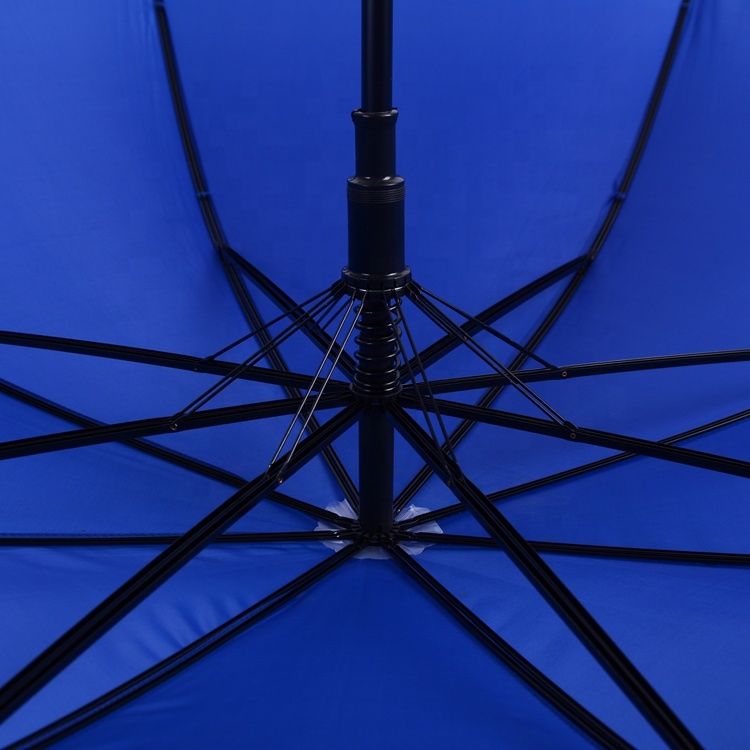
Spring-loaded stick umbrella with a full walking canopy, photographed open and inside out: eight-panel blue canopy, black ribs and stretchers, runner and coil spring riding the shaft, straight matte black grip. Logo zones map panel by panel onto the wedge geometry, with a free digital mock-up prepared before artwork approval. MOQ 100 pcs per design, samples in 3-5 days, production 7-15 days after approval, sea, air or courier freight with FBA labelling and bagging prep included. The displayed figure anchors the 100-piece tier, not a fixed unit price. Operating mechanism variant, open width and fabric weights are named on your quotation rather than guessed in a listing.
A custom automatic open umbrella is bought for one precise moment: hands are full, the sky lets go, and whoever thumbs the shaft and keeps walking looks organised. This straight-stick model pairs a spring-loaded shaft with a full walking canopy — the silhouette hotels, golf clubs, property desks and conference organisers hand out because it reads as equipment rather than giveaway clutter. Everything described below is visible in the photographs on this page: canopy, frame, spring, runner, grip. What you approve matches what lands in the carton, and what the photos do not prove, this listing does not claim.
Start With the Canopy: Eight Plain Panels
The first photo is a top-down study of one open canopy in solid royal blue. Eight wedge panels radiate away from a matte black top ferrule with a pale grey end cap, and the stitch seams run straight over the hidden ribs. No panel carries artwork, no watermark crosses the fabric, and nothing in the frame tells you a brand except the one you will supply. For a procurement team, that blankness is the entire point: your mark gets mapped onto chosen panels instead of competing with a pre-printed pattern, and colour-to-colour consistency across a long production run is far easier to hold when the base canopy is a single stock-dyed fabric rather than a painted graphic field.
Panel count matters commercially, not just visually. Eight wedges give you eight placement options and, because each wedge tapers from rim to apex, the same logo file has to be re-keyed to the curve before it screens cleanly — a step most buyers never see and every printer charges for if it is discovered late. We do the re-keying at mock-up stage, free, so the artwork you sign off is already corrected for the geometry it will land on. The black ferrule at the centre of the blue canopy is a second, quieter brand surface: programmes that want a close-range mark without touching the print budget can deboss or pad-print the tip, a configuration requested in the quotation.
Fabric weight, coating detail and open measurements are not readable from a photograph, so they are not asserted here either — the model spec sheet travels with your quote and carries those figures in the units your market uses, and your sample arrives against that same document rather than against adjectives. Stock-dyed canopy colours hold saturation across reorders better than hand-painted batches, which is the quiet reason institutional buyers keep the same two or three colours on their approved list for years: the blue that went out last spring is provably the blue that goes out next spring, lot after lot, with no conversation about drift.
Inside the Frame: Ribs, Runner and the Spring on the Shaft
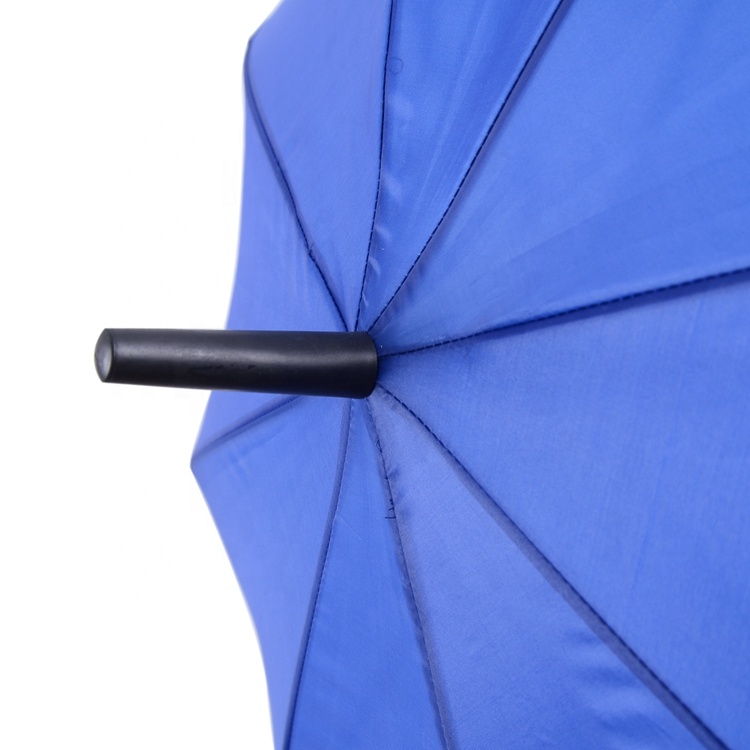
Flip the umbrella inside out and the engineering becomes the sales pitch. The second photo looks straight up the pole: black ribs and their supporting stretchers fan out symmetrically under the blue fabric, a moulded runner rides the shaft, and a coiled steel spring sits wrapped around the pole immediately below that runner. That spring is the muscle behind the opening action — it loads energy as the canopy seats and releases it when the catch gives way, turning a two-handed fumble into a single motion. The scissor pattern of rib and stretcher, visible in crisp detail against the backlit fabric, is what holds the dome shape in wind; a cheap canopy collapses because its hinge geometry is sloppy, and this one photographs like geometry that has been done properly.
Two honest notes from the photography. First, the rib pattern in this underside view matches the eight-panel layout seen from above — the two photos describe one frame, not two products. Second, our straight-stick family ships in both push-up and button-release builds. The spring-and-runner assembly shown here is common to the family; the exact release mechanism depends on the variant you order, and your quotation names it. We will not pretend a listing photograph proves a button exists on every unit, and we will not let your sample arrive as a different action from the one your team demonstrated at the office. Confirm the mechanism when you request the mock-up, and the sample follows that answer.
Why Institutions Standardise on the Stick Profile
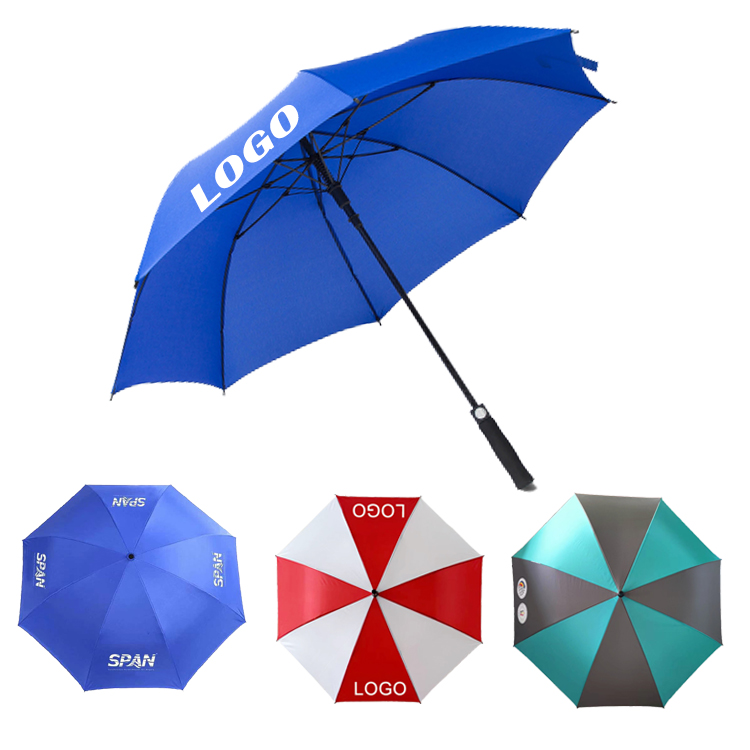
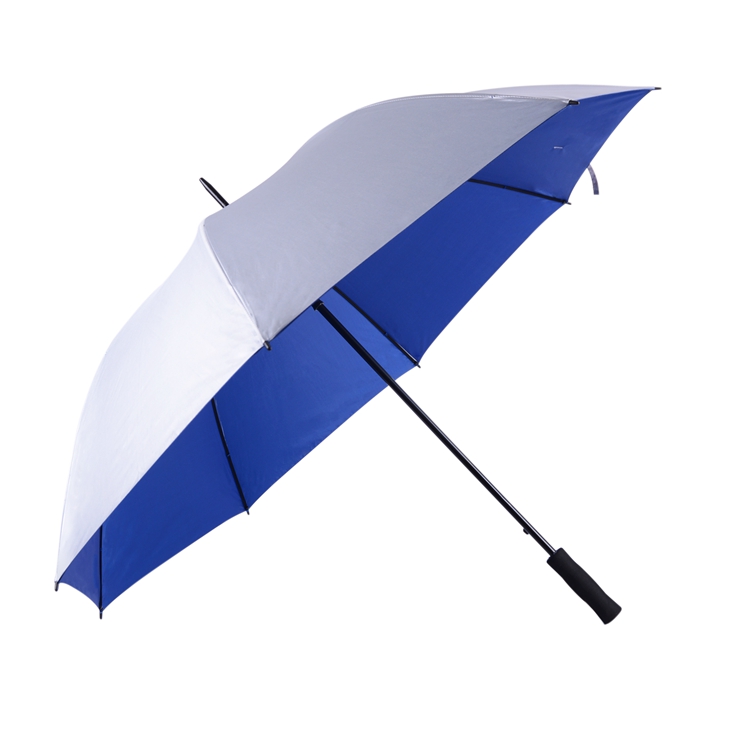
Hotel front-of-house, golf clubs, property management firms and conference secretariats keep coming back to the straight silhouette, and the third photo shows why: a slim semi-gloss black metal shaft, a straight cylindrical grip with a lightly textured matte surface, alternating royal blue and white panels opening above them. No hook, no curve, no folding joints to service. The stick profile slides flat against a coat lining, stands upright in a lobby umbrella stand where guests can see the printed panels without picking anything up, and lies under a conference table without rolling away. Folding umbrellas live in bags; stick umbrellas live in rooms — and room placement is free advertising your folding competitor never gets.
The grip is the quiet quality tell in institutional reorder decisions. A straight foam-or-rubber-over-plastic grip, the kind photographed here, stays comfortable with wet hands and takes a debossed or pad-printed wordmark without looking like a sticker. The small closing strap with its loop, visible hanging from the runner in the third frame, is the tie that keeps the collapsed canopy tidy between guests — a detail item, but its colour can be matched to the canopy for programmes that care about tone-on-tone presentation at the coat check.
There is a durability argument hiding in that simplicity as well: a stick frame carries fewer moving joints than a folder, which means fewer points for a guest to break on a crowded night, and front-desk replacement stock stays on the shelf longer. Hospitality buyers notice that in year-two reorder numbers. It is why the same model turns up at both a spa reception and a regatta committee table, logged as fixed equipment rather than handed-out novelty, and reprinted each season against the artwork file already on record.
Panel-by-Panel Logo Placement, Mapped the Way Printers Need It
A curved canopy prints differently from a flat label sheet. Each wedge is its own print zone, sized by its taper, and the placements that actually perform on real canopies — the ones demoed across the colourway collage in our listing images, where sample artwork sits panel by panel to show reach and not to advertise the sample brand — boil down to three families. Single-panel marks put the full logo on one wedge at roughly chest height when the umbrella is worn open; this is the choice for detailed lockups, university crests and anything with small text that needs room to breathe. Alternating-panel marks repeat a compact wordmark on four wedges so the brand faces whichever direction the canopy turns — the highest-exposure-per-print-dollar option for parades, golf days and outdoor activations where cameras catch the umbrella from many angles.
Third option: combine a wedge mark with a ferrule or strap accent, giving close-range touchpoints for hospitality programmes where the umbrella is handled, handed over and stored under counters. Print method follows the file: screen print for solid one- or two-colour marks that must survive season after season of rain, heat transfer where gradients and photographic detail matter, and both chosen against your artwork’s minimum line weight before anything is approved. Whatever you pick, the canopy colours are stock-dyed rather than painted, which is what lets a spring conference and an autumn top-up carry the same blue.
The white panels in the third photo are as print-ready as the solid blue canopy above — two-tone alternation is simply the cheapest way to make a mark pop without a second press pass. Put the logo on light panels against dark neighbours, or invert it, and contrast does the work your budget would otherwise pay for. Full eight-panel repeats exist but stay rare outside marathon and festival use, where the canopy is photographed from every bearing and a single wedge mark spends half its life facing away from the camera. The mock-up stage is where these choices stop being theoretical: your artwork lands on the wedge geometry in pixels first, so the decision gets made before anyone commits to a screen.
What Can Be Customised on This Model
- Canopy colour: solid dyed panels or two-tone alternating panel sets as photographed
- Logo zone: one wedge, two opposing wedges, or four alternating wedges
- Print method: screen print or heat transfer, selected against your file’s line weights
- Shaft and grip colour, with a debossed or pad-printed wordmark on the grip as an upsell touchpoint
- Ferrule and closing-strap accents for close-range visibility
- Per-unit OPP bag, blank or branded hang tag, barcode sticker for retail or Amazon inbound
- Gift-box packaging for VIP runs, matched to the corporate colour story
- Mixed colour splits inside one programme — quantities lock per design, see ordering below
Specification Sheet
| Item | Custom automatic open straight (stick) umbrella |
| Canopy | 8-panel woven fabric, solid or alternating two-tone colourways as photographed |
| Frame | Black-coated ribs and stretchers, moulded runner, shaft spring shown in the underside photo |
| Shaft / grip | Slim metal shaft, straight matte textured grip; open width and length per model spec sheet travelling with your quote |
| Colour | Stock dyed canopy colours; PMS matching on request |
| Logo | Screen print or transfer onto chosen wedge panels; free digital mock-up before approval |
| Packing | Individual OPP bag, cartons for pallet or mixed-pallet export |
| MOQ | 100 pcs per design |
| Sample time | 3-5 days |
| Lead time | 7-15 days after artwork approval |
| Capacity | 1,000,000 pcs per month across our gift lines |
Sampling, Ordering and Event-Date Maths
Work backwards from the date the umbrellas must be in guests’ hands. A conference on the fifteenth needs cartons on the ground by the eighth, and that clock starts when artwork is signed, not when the enquiry lands. Digital mock-ups come back within the enquiry cycle and physical samples return in 3-5 days, so a two-week window from shortlist meeting to a desk-approved sample is realistic; production between approval and despatch then runs 7-15 days on top of that. Rainy-season programmes all compress into the same windows, which means the queue for coating lots, print frames and shipping space is shortest in the calm months — buyers who lock colour and mechanism in the first round ship while late negotiators pay for air freight a fortnight’s earlier signature would have avoided.
Two numbers decide your real cost. MOQ sits at 100 pcs per design, and a design means one canopy colour plus one print specification — a two-colourway programme needs two qualifying lines, and we will say that at quotation rather than at customs. The figure displayed on this page anchors the 100-piece tier; it is not a standing unit price, and the number that matters moves with quantity, panel count, print method and freight mode. A single-wedge screen mark at three thousand pieces behaves very differently economically than a four-panel transfer at three hundred, and the quotation states both without embarrassment because the lines share one sheet. Monthly output across our gift lines runs to 1,000,000 pcs, which is why a repeat order after one wet season does not queue behind somebody else’s product launch.
Packing Cartons and Choosing Freight for Umbrella Orders
Umbrellas ship individually bagged, nested head-to-tail in export cartons rated for stacking, with carton marks and packing lists matched to your purchase order so receiving teams can audit without opening anything. Freight goes by sea for volume, by air for event rescue, or door-to-door on DHL, UPS, FedEx and TNT for sample runs and top-ups. FBA prep is routine work on this line: FNSKU labelling, poly-bag compliance and carton routing to the fulfilment centre of your choice are handled in-house before the pallet leaves, priced in the freight section of the quote instead of discovered at the dock. Mixed-container programmes — umbrellas consolidated with drinkware or desk gifts — share one pallet plan and one bill of lading, which is where multi-category buyers save their real margin rather than on unit price.
Carton construction gets boring attention on purpose. Stick umbrellas are long, and a carton that is merely standard will flex on a four-high pallet stack and transfer that flex into bent shafts at the receiving end. Ours are cut to the nested head-to-tail orientation with stiffened corners, and the packing count per carton is fixed at quotation so your warehouse team learns one number and keeps it across reorders. Pallet patterns for full containers or LTL consolidation ship with the packing list, and reference photographs of closed cartons come back to you before despatch — an audit trail that costs nothing and has resolved more receiving disputes than any warranty paragraph ever written.
Choosing the freight mode is arithmetic, not optimism. Sea is the default for orders measured in full cartons with a date that is weeks away; air buys back roughly three to four weeks and is the correct call when a conference flyer already has the date printed; courier runs sample-to-door in days and covers the awkward top-up of a hundred or two that arrives after the main pallet is already sitting on a client’s loading dock. Tell the quote desk which of those three situations you are in and the shipping line in your quotation reads like advice instead of a menu.
Documentation moves with the goods, not after them. Commercial invoice, packing list and the certificates your freight forwarder demands for the destination port are prepared from the same data as the PO alignment, and the HS code applied to umbrellas is stated on the quote so customs entry is not a surprise charge at the border. Buyers importing for the first time should send their forwarder’s details with the artwork approval — the handover between our loading dock and their booking then happens between two professionals, and the umbrellas clear while the programme team is still designing the display stand.

Is the opening action a push-button or a slide runner?
How many canopy panels can carry my logo?
Can two canopy colours share one 100-piece order?
Do the logos printed in your product photos ship on my umbrellas?
How far ahead of my event should artwork be approved?
Can you ship direct to Amazon fulfilment centres?
Related Gift Lines Worth Cross-Listing
Bulk weather goods and volume drinkware share the same buyer calendar, and our catalogue carries both sides of it. Browse the umbrellas category for folding and compact builds, or step back through the Other Gifts range for the rest of the promotional lines. Pair the stick umbrella with a branded umbrella and electric fan gift set for summer hospitality kits where guests walk outdoors, add desk-side items like the notebook, pen and flash drive gift sets for delegate packs, and round out the corporate basket with the small-mouth stainless steel bottle or the LED temperature display water bottle — gifts that keep the brand on the desk long after the weather breaks.
Request the Mock-Up Before You Commit Anything
Send the logo file, the canopy colour and the delivery city to the quote desk, or reach the team directly at [email protected] / +86-15967739086. A digital mock-up showing your artwork re-keyed onto the wedge panels costs nothing, names the mechanism variant in writing, and answers half the FAQ above with pixels instead of promises.