Custom Stainless Steel Water Bottles, Small Mouth Screw Cap
$3.20
The classic reorder in promotional drinkware: narrow-mouth steel bottles with colour-matched screw caps, matte powder-coat barrels photographed in thirteen stock colours, a polished stainless threaded neck and a gasket-sealed cap shown apart from the body, and a three-step height ladder from short-stout to tall-slim. No capacity or holding-time figures are guessed in this listing — volumes and tested insulation hours travel on the spec sheet with your quote. MOQ 100 pcs per design, samples in 3-5 days, production 7-15 days after artwork approval, FBA prep and sea, air or courier freight available. The displayed figure anchors the 100-piece tier.
Custom stainless steel water bottles with logo artwork are the safest repeat purchase in promotional drinkware, and this narrow-mouth model is the version buyers reorder instead of replacing. Straight matte powder-coated barrel, colour-matched screw cap, small drinking opening that seals clean and slides into a car cupholder: nothing exotic, nothing that needs explaining at a reception desk or a checkout counter. Every claim on this page is backed by the photographs you are looking at — the thirteen-colour outdoor cluster, the uncapped threaded neck, the detached cap, the three-bottle height lineup — so what your committee approves from these frames is what arrives by the carton, and what the frames cannot prove is written on your spec sheet instead of into marketing copy.
Thirteen Colours on One Table: The Blank Palette, Photographed
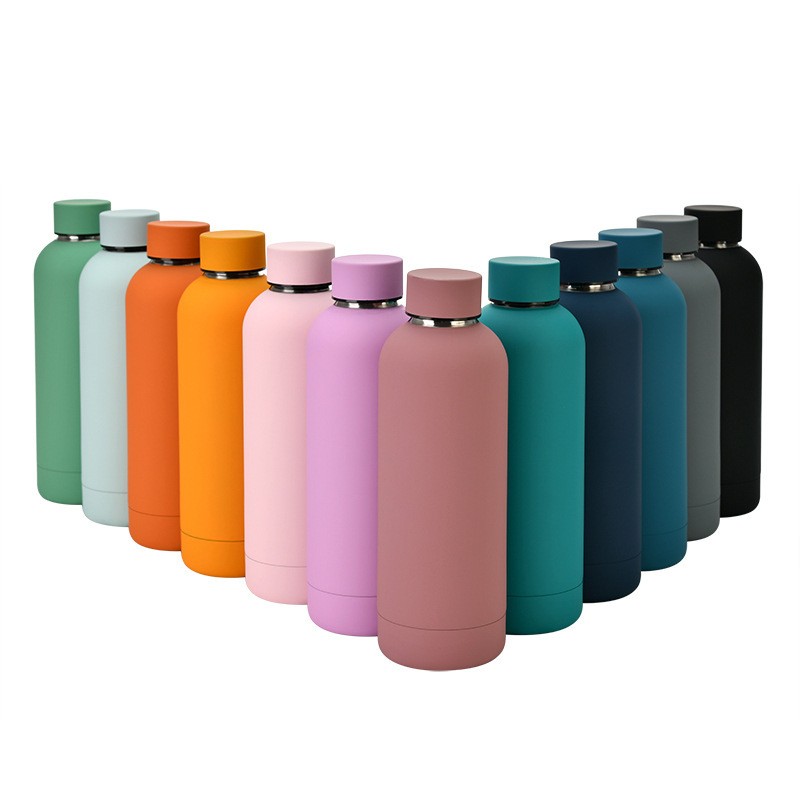
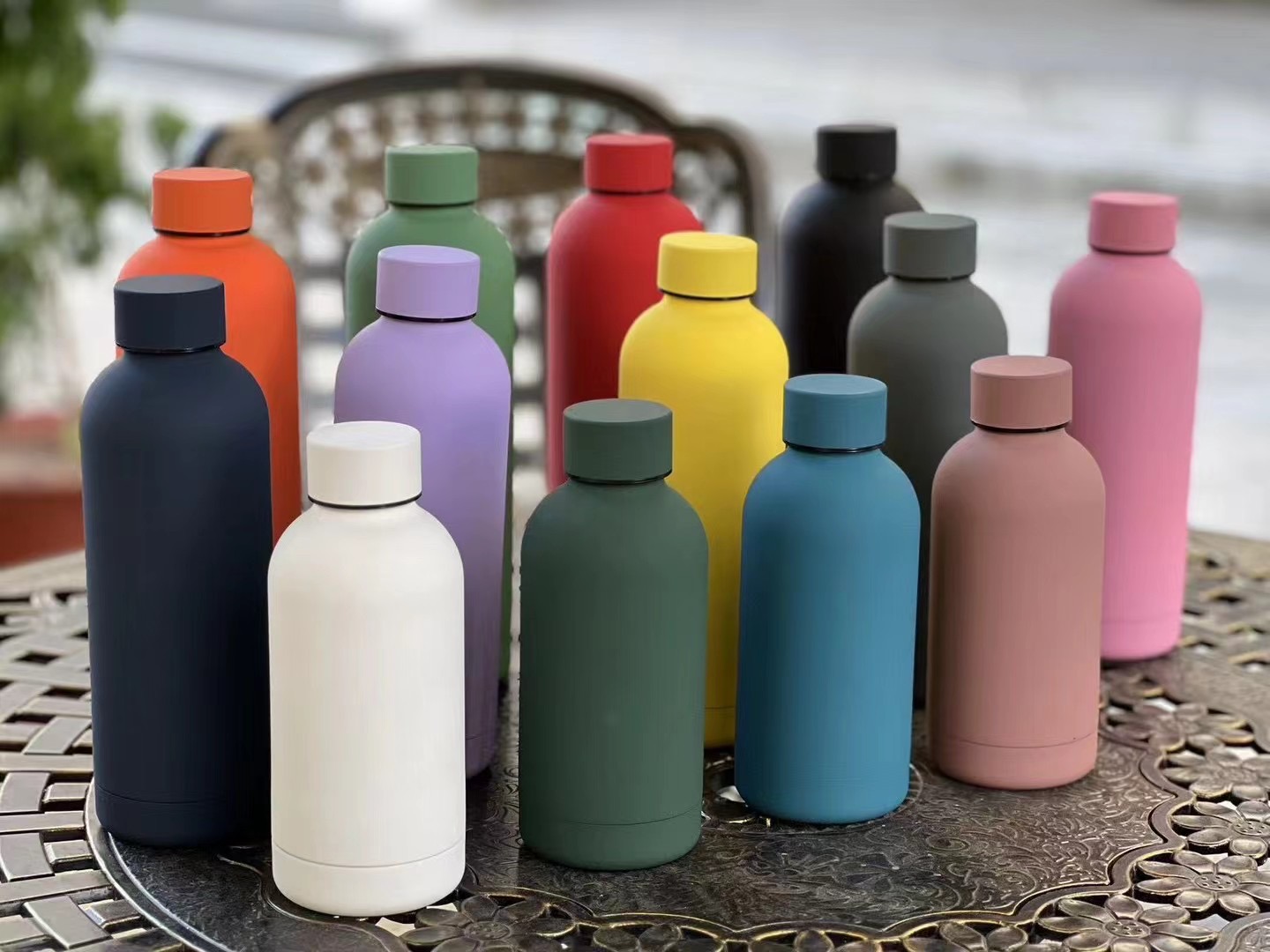
The opening photograph clusters thirteen empty bottles on an embossed bronze-toned metal garden table, arranged in three overlapping depth rows so no colour hides behind another. Orange, navy, sage, lavender, cream, red, yellow, forest green, black, charcoal, teal, dusty rose and light pink — every barrel matte, every cap screwed on in the same hue as the body, every surface blank of printing. A horizontal crimp seam circles the lower body of several units, the visible join of an insulated steel build, and two height classes read clearly even without a ruler beside them: taller-slim bodies in the back row, shorter-stouter units in the front.
That staging does specific work for a procurement conversation that a render never does. These are powder-coat colours held as stock lots, repeated across production runs, which is what a brand-palette programme needs when the same corporate green must survive a spring launch and an autumn top-up without drifting a shade. Outdoor daylight is also an honest light: it shows the true flatness of the matte finish — no studio gloss hiding an orange-peel coating — and it shows the bottles at real size against a table you recognise, thirteen of them, no single hero angle doing the selling.
Because every barrel is blank, print placement starts as your decision rather than a crop fight with somebody else’s pre-printed graphic. Blank-body programmes also mix better: an HR kit can carry a sage bottle with a charcoal accent, a university can run navy with a cream alternative for legacy students, which is why a programme that approves a sample once keeps reordering from the same approved pigment rather than re-specifying it every season. The image is a colour chart with physics attached — the coating, the silhouette and the cap geometry you will actually receive, at a count that hints at how many units a photo studio can line up, and by extension how many a production floor can repeat.
The Small Mouth Is the Whole Argument
Wide-mouth bottles clean easily and spill easily. The narrow screw neck on this model is a drinking geometry first: a controlled sip path that cannot gulp when you walk, a cap that threads onto machined metal rather than a moulded plastic shoulder that creeps oval after a year in a bike cage, and a seal line short enough to stay genuinely tight when the bottle rolls around the bottom of a bag. It drops into car cupholders, stroller holders and bicycle cages that reject oversized lids, and it keeps hot drinks from steaming a bag liner the way an open-mouth flask does when a cap goes loose in a backpack on a warm afternoon.
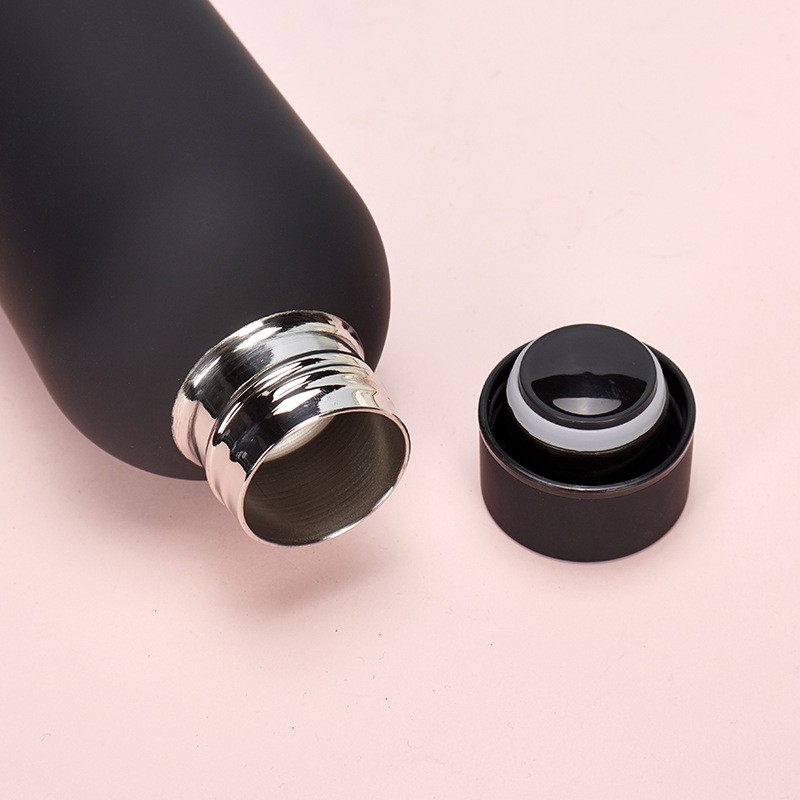
Uncapped, the neck is the quality tell, and the second studio photograph makes that argument on a blush-pink background: the black bottle lies on its side with its cap set apart, and the mouth finishes in a polished stainless ring with visible internal threads and a bare metal bore. That is machined steel you can inspect with a fingertip, not a plastic collar that ages cloudy or a painted rim that chips at the thread. Every closed bottle in the thirteen-colour cluster shows the same detail from outside — that bright ring peeking under the cap — which is why the lineup photographs read as hardware rather than novelty plastic in a corporate gift hand.
The detached cap lying beside the bottle in that same frame carries the other half of the leak story: a pale grey sealing gasket seated inside the matte black skirt, pressed home by the threads and holding the seal at the mouth. Two parts, one interface: threads choose alignment, gasket chooses dryness. Replace nothing, lose nothing — the closure is a single screw cap, the configuration with the fewest failure modes in drinkware, which is exactly the reliability argument resellers make when they price this bottle above a lid with a hinge, a straw or a second moving part.
For the receiving side of your programme, the geometry keeps paying. A narrow mouth pours slowly enough that a half-finished bottle jostled in a commuter bag does not empty itself through the cap threads the way a wide opening can, and the small sip hole means ice cubes stay as cubes rather than turning a wide-neck bottle into a cold-water waterfall on the first tilt. None of that is a lab result; it is basic drinking physics that the screw geometry makes reliable day after day, and it is why the office-gift crowd that abandons novelty lids within a month tends to keep a single-screw bottle for years.
Cap Engineering, Photographed Apart
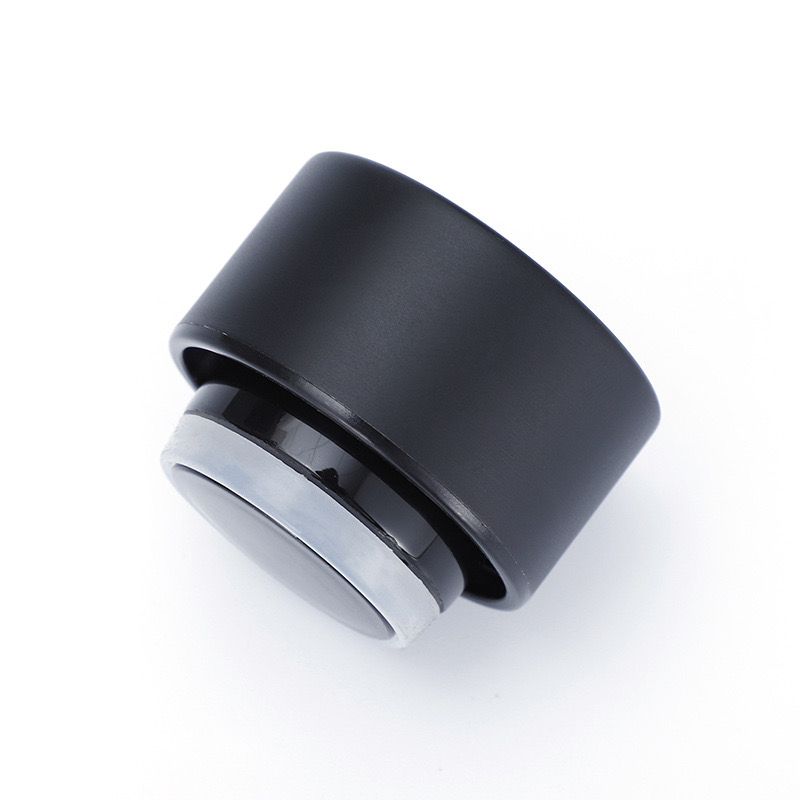
A cap photographed loose from outside sounds like filler imagery until you notice what a standalone shot proves about mould quality. On seamless white, the black screw cap stands alone: a matte cylindrical skirt with clean vertical walls, a glossy shoulder band catching the studio light in a thin ring, and a flat pale top face finished smooth enough to read as a deliberate design surface rather than a moulding remnant. Two finishes, one tool: the matte skirt matches the barrel coating family so the cap ages with the body in the same pigment, and the gloss band is where you can see the parting line is tight — the detail that separates a closure that threads smoothly from one that cross-threads after three uses.
The flat top face deserves attention as a commercial surface. It is level, reasonably wide and unbroken, which makes the cap an optional secondary print zone for programmes that want the mark visible when the bottle stands on a desk or a conference table — the exact situation where nobody sees the barrel anyway. The front photograph shows the gasket and thread geometry from the inside; this one shows the exterior shell a decorator works against. Together the two cap views answer the questions a technical buyer asks before artwork: what seals, what screws, and where can a logo sit.
Two notes for your file. First, gasket compounds and thread pitches differ between production variants, so the engineering details a compliance team wants — seal material, torque feel, cycle durability — travel with the pre-production sample and are named per build on the quotation rather than described from a photograph. Second, nothing in this listing claims a leak rating, a drop-test result or a warranty figure; those belong on documents we send with pricing, where they can be signed, dated and version-controlled against the exact production lot your order draws from. A buyer assembling a vendor file will find those documents more persuasive than this paragraph, which is precisely why we write paragraphs this short about them and route the substantive conversation to the sheet where it belongs.
There is a quieter reason the cap is shown apart: programmes that hand bottles to children, students or care settings often ask who replaces a lost or warped closure. On a single-screw geometry the answer is a standard overcap rather than a whole discarded bottle, and spare-cap lots can be quoted alongside the production run so a school keeps a drawer of matches instead of a shelf of retired bottles. Ask for the spare-cap price break in the same enquiry — it is a five-minute line item here and an emergency at week twenty of a programme year.
Two Height Classes, One Design Language: The Size Ladder
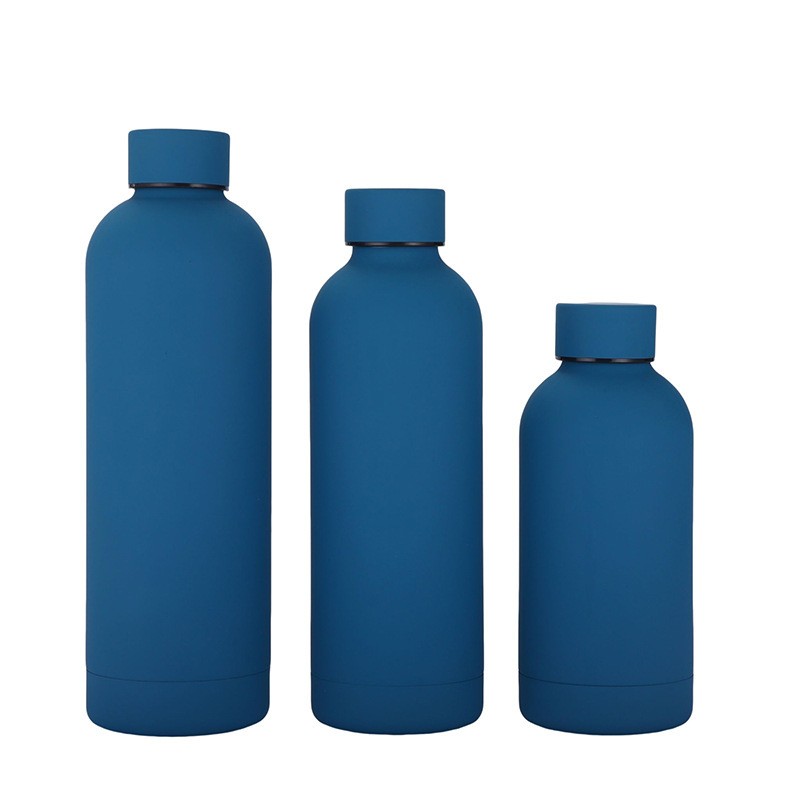
Three bottles of the identical matte blue stand in a row on white, arranged in descending height, silver neck rings showing under colour-matched caps, shadows pooling to one side. Nothing else is in the frame because nothing else needs to be: the picture is a size ladder. A tall-slim daily unit that reads commuter — the proportions that fit a bag side pocket and a cupholder without asking. A mid bottle for desks, gym bags and coach kits. A short-stout unit that disappears into a jacket pocket or a child’s rucksack and stops overfilling small hands.
Ladders like this matter because buyers almost never order one size honestly. A department gift looks tidy on paper at 1,000 tall-slim bottles; two weeks after distribution the HR inbox holds the complaints from the commute crowd who wanted pocketable and the desk crew who wanted capacity. A launch planned across two rungs from the start — say 600 tall for the welcome kits and 400 stout for the field teams — lets the same artwork file serve both and lets next season’s reorder data decide which rung becomes the standard. You get that learning cycle without paying for a second tooling conversation, and the photograph of three same-colour bottles in three heights is the cheapest possible planning meeting for it.
Same pigment, same coating, same cap across all three rungs — that consistency is the reason institutions order the ladder rather than a single size. A school sports department can put the stout in junior kits and the tall on staff shelves while the logo stays identical; a hotel group can size lobby retail without changing colour lot. The exact volume behind each height is a question the quotation answers per market, because no capacity marking appears anywhere in the photographs and this page refuses to invent one in text; what the image proves is the geometry ladder itself, and that is what the copy commits to.
Splitting a programme across two rungs carries one more planning benefit that buyers discover at inventory time: shared artwork and a shared cap mean the two sizes print on the same screens and pack on the same carton plan, so a mid-season switch from tall to stout — or a top-up of whichever rung sold through first — never re-opens the artwork file or the tooling conversation. That interchangeability is the quiet reason the size ladder photographs, with its identical blue and identical cap on three different heights, functions as a purchasing argument rather than a gallery shot. The artwork you approve once survives across the whole family of bodies, and a warehouse keeps one logo inventory instead of three.
Honest Limits of Insulated Steel
A double-wall bottle is thermos behaviour, not thermos magic, and gift programmes that survive their first winter know the difference. Hot drinks inside insulated steel stay hot longer than buyers expect, which turns the first sip from a narrow mouth into a scald risk if nobody mentioned it. Recipients who were not briefed put the bottle down and go back to paper cups. If your programme hands bottles to commuters, kids or event staff, print fill guidance on the card that ships with the sample: warm, not boiling, and crack the cap before the first drink after a long seal. It costs one line of copy and protects the entire gifting decision from the recipient’s first burned tongue.
How many hours this build holds a temperature is a tested figure that lives on the spec sheet attached to your quotation, issued per production variant. We keep marketing hour-numbers out of the listing because a brochure figure and a laboratory figure are not the same document, and your procurement file deserves the second one. The same discipline applies to capacity: the photos show silhouettes and a height ladder, so that is what this page describes, and the millilitre options arrive on paper with your tiered pricing rather than in a paragraph next to a price tag. A cold-drink programme in a hot climate has different needs than a desk-side tea habit, and the document — not the listing — is where that conversation belongs.
Customisation Points on the Classic Bottle
Before the list, one orientation note. Customisation on this bottle happens in three places, and they are not equal: the barrel is the main stage because it is flat, wide and matte; the cap face is a secondary mark zone because it is level, reasonably generous and visible on any desk; and the gasket and thread interior are functional surfaces that take nothing — no print, no texture, no clever finish upsells. Programmes that understand that hierarchy end up with product photos that read clean; programmes that try to decorate every millimetre end up with a lid that looks like a sticker sheet and a requote they did not budget. The mock-up exists to keep you in the first group, and nothing on this list hides a surcharge surprise, because every line on it is quoted item by item.
- Barrel colour from the photographed matte range, matched to the nearest stock shade of your PMS reference
- Colour-matched screw cap; optional secondary print on the flat cap face
- Logo method: laser marking for a permanent tone-on-tone mark, pad print or full-colour transfer where the file needs fills
- Size rung: tall-slim, mid or short-stout per the photographed height ladder
- Individual box — blank white, colour-printed or foil-stamped lid for gift tiers
- Barcode sticker, hang tag, poly-bag or shrink band per retail or Amazon inbound requirement
- Mixed colour or size splits — each colour-plus-artwork combination counts as one design for minimums
Classic Small-Mouth Bottle Specification
| Item | Custom small-mouth stainless steel water bottle |
| Set contents | Bottle body with colour-matched screw cap and internal sealing gasket |
| Construction | Powder-coated steel with insulated body profile visible at the base seam; polished stainless threaded mouth as photographed; volumes and holding times on the quote sheet |
| Colour | Matte stock colourways including orange, navy, sage, lavender, cream, red, yellow, forest green, black, charcoal, teal, rose and pink as photographed |
| Logo | Laser, pad print or transfer on the barrel; optional cap-face mark; free digital mock-up before approval |
| Packing | Individual box, export cartons, FBA labelling on request |
| MOQ | 100 pcs per design |
| Sample time | 3-5 days |
| Lead time | 7-15 days after artwork approval |
| Capacity | 1,000,000 pcs per month across our gift lines |
From Enquiry to Reorder: Sampling and Pricing Math
The figure displayed on this page anchors the 100-piece tier; it is not a fixed unit rate and should never be quoted as one in your budget sheet. Where an order actually lands depends on four variables — size rung, decoration method, bag-versus-box packing and quantity break — and the quotation itemises all four instead of folding them into a headline price that quietly moves at invoice. Mock-ups come back free within the enquiry cycle, physical samples in 3-5 days, and production closes in 7-15 days after artwork approval, so the distance from a shortlist meeting to cartons on a pallet is measured in two to three weeks plus transit rather than a semester.
Monthly output across our gift lines reaches 1,000,000 pcs, which is the unglamorous reason the same bottle can carry a 300-unit department gift and a 30,000-unit reseller restock without changing factories, pigment lots or cap tooling. Reorder programmes benefit directly: when the spring induction bottles become the autumn induction standard, the colour you approved once is the colour the line still runs. And the MOQ rule that governs every mixed order is simply stated: 100 pcs per design, where a design means one colour plus one artwork specification — a split across three colours means three qualifying lines of one hundred, not a blended three-hundred that clears on a technicality and fails at the coating booth.
Packing, Freight and Retail Readiness
Units pack individually boxed with corner protection, nested in master cartons sized for pallet tiers, PO-aligned marks and packing lists your receiving team can audit against a screen without a box cutter. Freight leaves by sea for volume programmes, by air when the event date is already printed on flyers, and door-to-door on DHL, UPS, FedEx or TNT for samples and emergency top-ups before a conference week. For resellers and Amazon sellers, FNSKU application, bagging compliance and fulfilment-centre carton routing run as standard quoted line items; photographs of packed and labelled cartons return to you before despatch, so the inbound shipment your seller account creates is the inbound shipment our floor actually built.

Why choose a small mouth over a wide mouth?
What capacities are available?
How long does it keep drinks hot or cold?
Can you match our exact brand colour?
Is the cap colour ever different from the body?
Do you handle Amazon inbound requirements?
Neighbours in the Catalogue Worth a Look
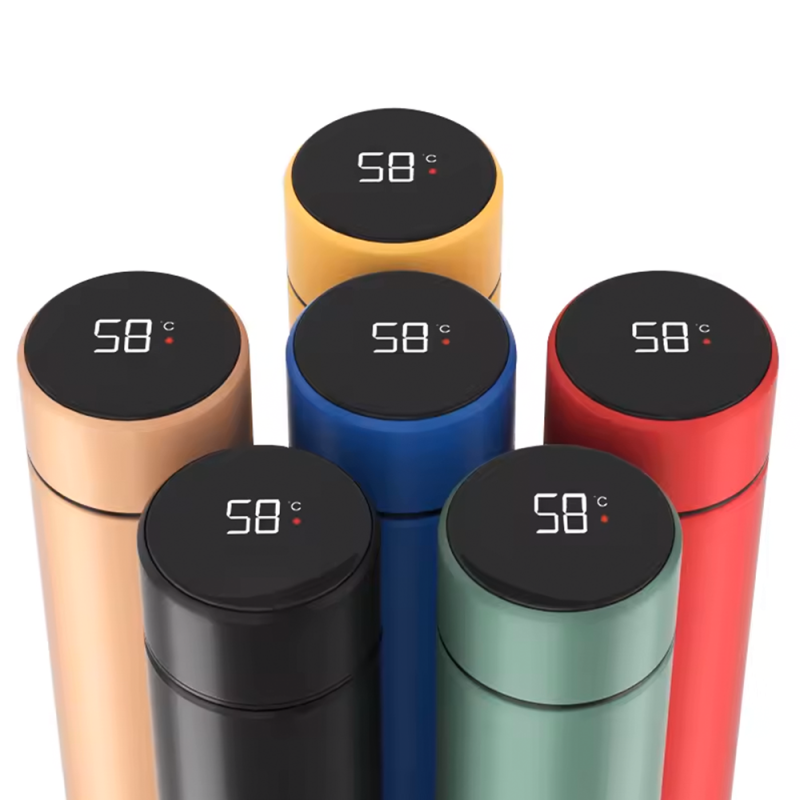
When a programme needs the tech demo rather than the classic, the LED temperature display bottle puts a lit readout on the cap and turns every recipient into an operator of the gift. When unit weight and freight maths lead the decision, the flip-top plastic sports bottle wins the per-gram shipping argument for gym and campus volumes. Desk-facing sets pair the steel bottle with companion pieces in the luxury water bottle gift sets, and everything else on a venue or gifting shortlist sits under the cups category or the wider Other Gifts range.
Order a Sample Before the Colour Locks
Send artwork, target colour and quantity to the quote desk, or write [email protected] / call +86-15967739086. You receive the free digital mock-up, the spec sheet with tested holding figures and capacity options, and a sample path of 3-5 days — so the bottle your committee approves under fluorescent office light is the same bottle that arrives by carton, in the same green, with the same threads.