Custom Plastic Sports Water Bottles, Flip Top With Loop
$1.20
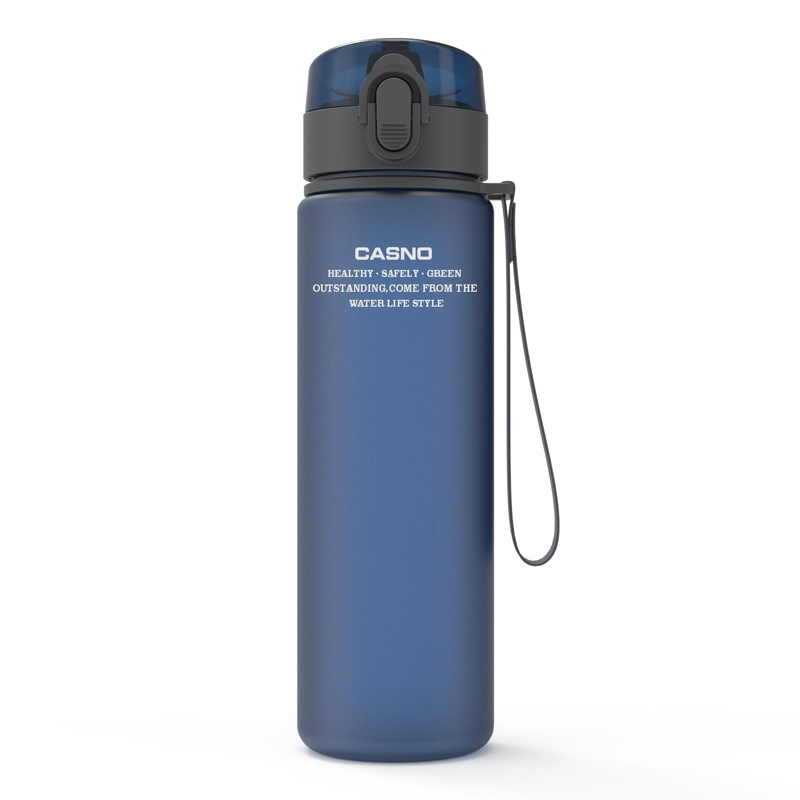
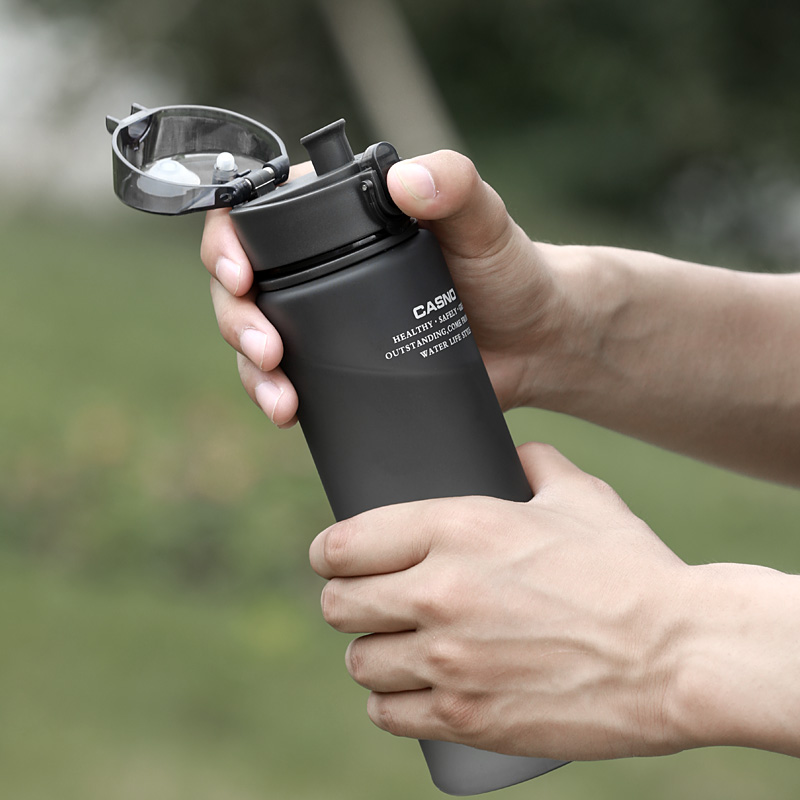
Volume-drinkware arithmetic: matte plastic barrels that ship light, a hinged flip cover with ridged thumb latch and white push spout proven one-handed in the outdoor photo, and a hanging carry loop that keeps the bottle — and your mark — in daily circulation. Slate blue, charcoal, brick red and olive green as photographed, with a large flat front panel for screen or pad print; the artwork block in our renders is placeholder demo art, never printed on your order. Exact resin grade and food-contact test reports travel on the quote sheet. MOQ 100 pcs per design, samples 3-5 days, production 7-15 days after artwork approval, FBA prep and sea, air or courier freight. The displayed figure anchors the 100-piece tier.
A custom plastic sports water bottle is the arithmetic answer to a volume question: gym intakes, campus weeks, race-day bags and sales-force kits where thousands of units cross an ocean and every gram of the barrel shows up on the freight invoice. This flip-top model carries a matte plastic body, a one-hand press-to-open spout and a hanging carry loop — the three features that decide whether a free bottle is used once at the event or every day after it. The photographs on this page show all three in working order, including a pair of hands opening the lid outdoors, plus the large flat print panel on the barrel that gives a logo room to read at a price point coated steel cannot reach.
Weight Is the Business Case
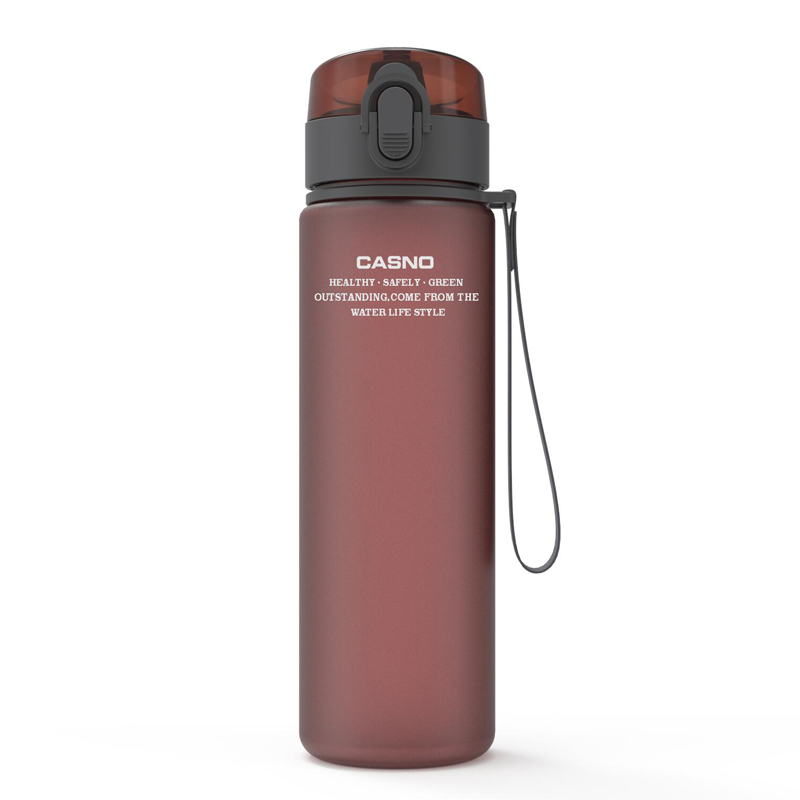
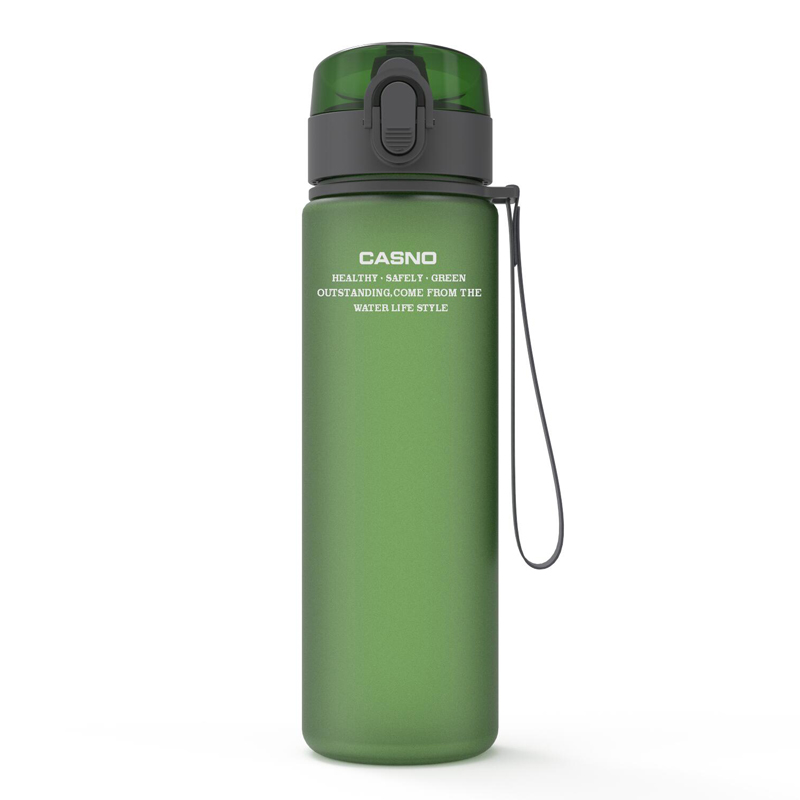
Compare cartons, not spec sheets. A pallet of plastic-barrel bottles ships meaningfully lighter than the same unit count of double-wall steel, and on air-freighted event stock that gap converts straight into landed cost per piece — the number that decides whether a 5,000-bottle activation stays inside budget or becomes a 3,000-bottle activation with better flyers. The barrel here is an opaque matte-coated plastic cylinder, straight-walled with a domed seamless base, shown standing alone on white in the studio renders: no metallic sheen, no cold gloss, just the soft low-sheen surface that screen and pad print sit on cleanly without the laser-marking conversation coated steel requires.
Lightness changes what a programme can afford to be. A steel-bottle budget buys a few hundred units for a leadership retreat; the same money in plastic buys a whole campus orientation, one bottle per arriving student, and the exposure maths follows the quantity, not the material grade. The flip side is honest and stated here rather than hidden: a single-wall plastic barrel is not an insulated vessel, and nobody should quote it as one. Cold-water drinking, gym hydration, trail-day kits — that is this product’s lane, and the quotation’s spec sheet carries the wall construction and weight figures for the exact build, because those numbers belong on documents, next to the resin identification, not inside a marketing paragraph.
The Lid: Flip Cover, Thumb Latch, Push Spout
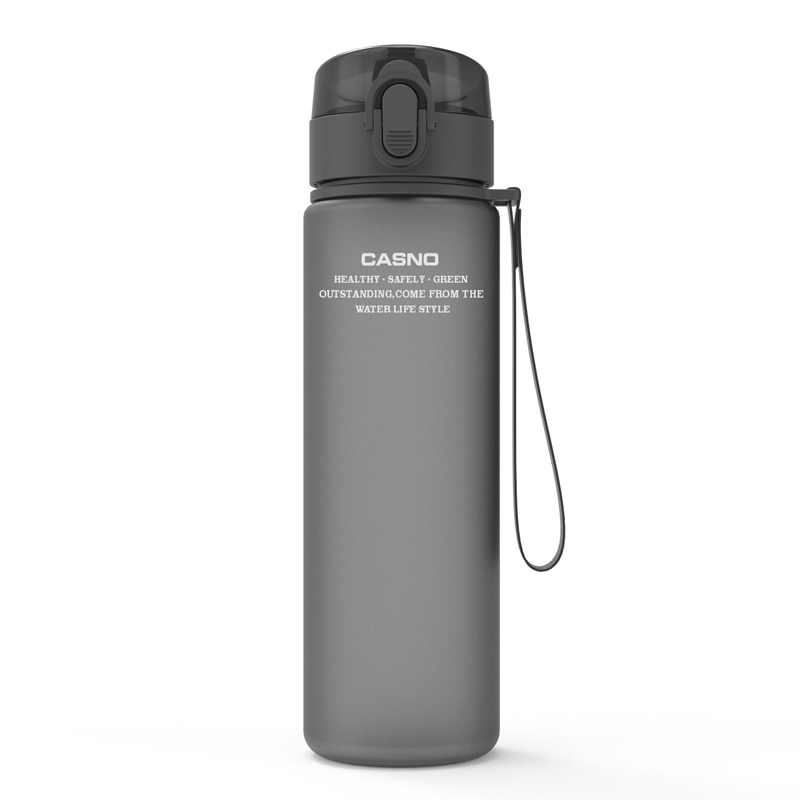
Three lid parts are visible in every photo on this page, and they work as one motion. A dark charcoal screw collar ribs around the neck, giving grip when hands are wet, chalky or cold. Above it, a translucent tinted dome shields the drinking mechanism — smoky grey over the charcoal barrel, amber over the red, green-tinted over the olive — and the dome reads glossy while the barrel stays matte, a deliberate two-finish product from one lid family. The front face of the collar carries a thumb tab with horizontal grip ridges: press it and the hinged cover swings back, exactly as demonstrated in the outdoor photograph where one hand thumbs the latch open while the other simply holds the barrel and the white push-pull spout stands exposed.
Buyers comparing lids for a volume programme usually weigh three options, and it is worth naming them so the quotation conversation is specific. A screw-off cup is the cheapest closure and the one guests lose within a week. A straw lid invites sipping at a desk but fails the rinse test in shared gym environments. A flip top with an integrated hinge and protective dome, the geometry shown here, sits between them on cost and ahead of both on retention: nothing detaches, the spout stays covered in a bag, and the act of drinking takes one thumb. For hydration programmes that measure success in bottles still in use at month six, that combination is the whole design brief.
That one-hand sequence is the entire feature list for sport and commuting buyers, and it is worth describing in operational terms because procurement teams compare lids the way chefs compare knives. Open while walking, no unscrewing, no setting anything down on a gym floor. Sip with the lips on a soft nozzle rather than a hard threaded rim. Snap the cover forward before the bottle goes into the bag. A screw-off cup lid gets lost in the first week — the cap is the single most-losable component in drinkware — while a hinged flip top cannot be separated from its bottle by anything except deliberate destruction, which is why hydration programmes, school sports kits and race organisers standardise on this geometry. Event staff love it for the same reason: a water station full of flip-top bottles needs no instruction sign, because the thumb tab teaches itself.
Two honesty notes from the photography. The spout nozzle itself is visible only in the opened outdoor shot — every studio render shows the lid closed, so the white valve inside is a once-per-page reveal rather than a repeated feature. And nothing on this page claims the lid is leakproof in a rucksack at zero degrees: collar thread engagement, latch tension and seal design are engineering properties handled per build, listed on the spec sheet that travels with your quotation, where your quality team can interrogate them properly instead of taking a listing’s word.
The Carry Loop: Cheapest Retention Feature Molded Into the Product
Anchored at the shoulder beside the collar, a thin flexible strap hangs as a long teardrop down the bottle’s flank in each studio view — grey against grey, dark against the brick red, a fine line against the olive. It exists for one commercial reason: a bottle you can hook over a finger, loop onto a backpack strap or hang from a gym-bag ring is a bottle that stays in daily circulation, and daily circulation is the only advertising a promotional water bottle ever delivers. The loop moulds as part of the lid assembly, so it takes the closure colour and never arrives as a mismatched tone on a reorder batch — the small consistency detail that separates programmes which repeat orders from programmes that order once and quietly switch suppliers.
Scale matters in the outdoor shot: the loop is sized for a hand, not a carabiner, and no clip, strap accessory or bag attachment appears in any photograph on this page, so none is promised in this text either. If a programme needs bottle-to-bag hardware, that is a separate component and a separate conversation with the quote desk, priced on its own merits. What the loop demonstrably does: lets a recipient carry the bottle through a full day without holding it, which is the difference between a giveaway that lives on a shelf and one that walks past hundreds of other students with your mark facing outward.
The Print Panel: A Straight Cylinder Is Real Estate
Our studio renders carry placeholder demo artwork printed on the upper barrel — a bold wordmark over three smaller tagline lines, white on the matte field. Treat that block as a sizing ruler only: the artwork in the photographs belongs to neither us nor you, it is sample decoration shot to show what the panel can hold, and your file replaces it panel for panel. The placement maths is simple because this barrel is a straight cylinder with a long flat sightline from shoulder to base. The centred upper-third position shown in the renders is the classic front mark; a wrap is possible on the same geometry; and because the wall is constant-diameter rather than tapered, small text survives the print without the distortion that conical bottles introduce at their edges.
Method follows artwork. Screen print lays solid spot colours over the matte surface and takes a beating in daily use; pad print handles tighter detail and curved reach around the cylinder; full-colour transfer serves files with gradients and photographs, at a per-unit cost the quotation states plainly. If your legal or procurement review requires material documentation, exact resin identification and food-contact test reports for the build you order travel with the quotation — we deliberately name no resin in this listing, because the photographs show a matte plastic barrel and that is the extent of what they prove. Print positions, sizes and method choices are marked up on a free digital mock-up against your actual artwork before approval, and the physical sample that follows carries production art, never the demo block.
Colour Family, as Photographed
Four barrel finishes appear across this page’s images: the slate blue of the listing front view, charcoal grey, brick red and olive green from the standing studio renders, and the near-black read of the outdoor hand shot under overcast daylight. They share one matte coating family, so a mixed programme — team colours, house colours, department colours — keeps a single design language across the split instead of turning into four unrelated products wearing one logo. Red reads warm and athletic, olive sits outdoors and gender-neutral, charcoal is the safe institutional choice, slate blue splits the difference for education buyers; none of that is marketing poetry, it is simply what the four frames show side by side.
The colour family also shapes how marks read. White and light-coloured artwork pops against brick red and charcoal without any underprint; the olive green swallows pastels and wants a solid bright fill; slate blue flatters both a reversed knockout mark and a single dark tone. That is a real constraint when one logo file must survive four colourways, and the mock-up stage is where it gets solved: we place your artwork on each chosen shell colour separately, flag the combinations that need a reversed version, and hand you a per-colour print sheet instead of one file hoping to work everywhere. Programmes that skip that step ship four colours of one logo and three versions of their patience. The per-colour sheet becomes your reference document for every later top-up, so the venue’s next order matches the last one without anyone re-eyeballing a bottle from a drawer.
Stock-dyed lots repeat better than one-off paints across a season. When the autumn intake reorders what the spring intake received, the olive is still the olive, because colour drift lives in coating batches and the production plan controls batches — a fact your quotation states in writing with the lot commitment, rather than a listing paragraph swearing the bottle will never shift a shade. Programmes with strict brand colour needs should say so at enquiry: nearest-stock matching, custom coating commitments and the volume threshold for a dedicated colour lot are all quotation questions with real numbers behind them. One practical staging detail supports repeat orders: because the collar, latch and loop all ship in the same charcoal family across every barrel colour, a reorder that switches barrel tone never needs to re-tool the closure, which keeps both the minimums and the lead time predictable.
Colour, Print and Packing Choices on the Sport Bottle
- Barrel colour from the photographed matte family; PMS targeting and custom coating lots at committed volumes
- Lid pairing: charcoal collar and tinted translucent dome as shown across the renders
- Logo position: centred front panel as demoed, wrap, or front-plus-back stacked marks
- Print method: screen, pad or transfer, chosen against your file’s line weights and colour count
- Individual poly-bag or box, hang tag, barcode sticker for retail or Amazon inbound
- Size selection from the capacity options on your quotation — no volume marking appears in the photos, so none is claimed in text
- Mixed colour splits — each colour-plus-artwork combination counts as one design for minimums
Sport Bottle Specification Summary
| Item | Custom portable sport plastic water bottle with flip top |
| Set contents | Bottle barrel; flip-top lid assembly with screw collar, hinged translucent cover, push spout and integrated carry loop |
| Material | Matte-finish plastic body per the stated build; exact resin grade and food-contact test reports issued on the quote sheet |
| Colour | Slate blue, charcoal grey, brick red, olive green as photographed; lid family charcoal with tinted dome |
| Logo | Screen print, pad print or transfer on the flat barrel panel; free digital mock-up before approval |
| Packing | Individual bag or box, export cartons, FBA-ready prep on request |
| MOQ | 100 pcs per design |
| Sample time | 3-5 days |
| Lead time | 7-15 days after artwork approval |
| Capacity | 1,000,000 pcs per month across our gift lines |
Volume Orders, Event Dates and the 100-Piece Tier
The 1.2 displayed on this page anchors the 100-piece tier and is the lowest per-unit conversation in this batch’s drinkware set — which is precisely why the freight and packing decisions matter more here than on the steel pages: cheap units with expensive logistics is how volume programmes die. Real quotes move with quantity break, print complexity, bag-versus-box choice and destination, and the quotation shows unit price and shipping side by side instead of folding one inside the other. Mock-ups return free within the enquiry cycle, physical samples in 3-5 days, production in 7-15 days after artwork approval, against monthly output of 1,000,000 pcs across our gift lines.
Race dates and term starts are fixed objects; approval windows are not. Send the calendar with the artwork file and the schedule gets built backwards from the event, with the freight mode chosen to protect the date rather than discovered after the container misses the cut-off. The mixed-split maths follows house rules everywhere: 100 pcs per design, where a design means one colour plus one print specification. Four hundred bottles across four team colours clears; 250 across the same four does not, and knowing that before the committee meets beats explaining it after the artwork files are drawn.
Freight Economics of Light Barrels
Bottles ship nested cap-to-base in poly-bags with interleaving between colour lots, dense columns inside master cartons marked to your purchase order. Because the barrels are light, air freight for event rescue is the rare case where the express surcharge still lands below the cost of missing the date, and sea covers the volume baseline for everything that can plan eight weeks ahead. Samples and emergency top-ups run door-to-door on DHL, UPS, FedEx or TNT. Amazon-bound programmes get FNSKU labels, bagging compliance and fulfilment-centre routing as standard prep line items quoted with the freight, and packed-carton reference photographs go back to you before the shipment books so inbound paperwork matches physical reality.

What plastic is the barrel made from?
Is the flip cover really one-hand operable?
What volume does the bottle hold?
Can we order four colours for one team programme?
Does the printed artwork in your photos ship on my bottles?
Are these suitable for reseller and Amazon channels?
Related Picks When Plastic Is Not the Answer
Programmes that need held temperature rather than held weight should compare the small-mouth stainless steel bottle, whose insulated body and threaded neck are photographed apart on its own page, or step up to the 30oz thermal tea and coffee mugs for the big desk-drink tier. The LED temperature display bottle covers tech-demo gift budgets where the cap feature sells itself, and venue buyers frequently pair this sports bottle with the handled plastic beer cups so one shipment equips both the gym floor and the bar. Everything sits under the cups category or the wider Other Gifts catalogue.
Send the Calendar and the Artwork File
Quantity, colour split and event date go to the quote desk; direct conversations land at [email protected] or +86-15967739086. The first reply bundles the digital mock-up with your artwork replacing the demo block, the resin and test-document pack for your compliance file, and tiered pricing built around the 100-piece anchor displayed on this page — numbers on paper, not adjectives in a listing.