Custom Kraft Spiral Notebook, 60 Sheets, Wholesale
$0.68
The entry tier for promotional notebooks: a blank brown kraft cover with no stock decoration, bound on a black twin-loop coil over a 60-sheet lined pad, so one spot-colour logo makes the whole book branded at the lowest print cost in the range. Built for trade-show handouts, café and bookstore co-brands and agency campaigns that reorder the same plate across events. The MOQ is 100 pcs per design – two client logos are two designs, restocks of one approved mark run 7-15 days after artwork approval. Samples ship in 3-5 days, the displayed figure anchors the 100-piece tier, and freight moves by sea, air, DHL, UPS, FedEx or TNT with FBA prep available.
Ask a promotional-products distributor what they actually resell and the answer is rarely the premium leatherette journal. It is the entry line: the notebook a trade-show floor hands out by the thousand, the café loyalty gift, the bookstore tote add-on, the conference pad that still has to carry a legible logo. Price per handout decides that market, and this custom kraft spiral notebook wholesale quote is built for it. The construction in our photographs is stripped to the load-bearing parts: a brown kraft card cover with zero stock decoration – no frame, no border, no pre-printed word occupying your logo space – bound on a black double-loop coil over a 60-sheet pad. Because the face arrives blank, the cheapest possible branded version of this book is one ink colour on one cover, and a one-colour mark is the fastest, most repeatable print decision in gift stationery. The displayed figure anchors the 100-piece tier, the MOQ is 100 pcs per design, and a digital mock-up is free – which means an agency can quote a 2,000-piece campaign against a real proof instead of a rumour. This page lays out what the kraft line is for: the price math, the print-zone economics, the ruling you can verify in the frames, and the reorder logic when a client runs a second event in the same quarter.
The 60-sheet pad and what the opened book shows
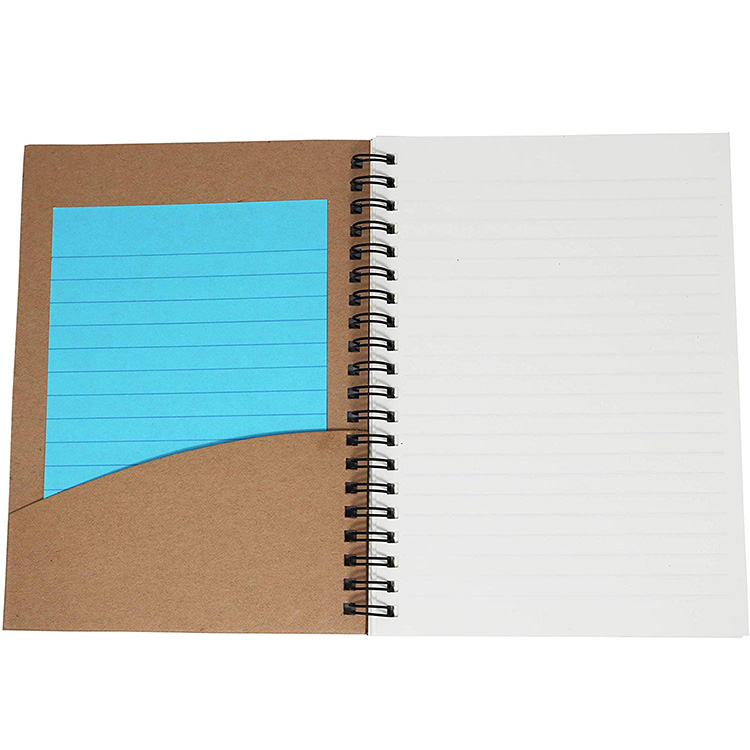
The opened flat frame proves the interior the kraft face protects. On the right of the black Wire-O coil sits a white page ruled with fine, evenly spaced horizontal lines – a working college-ruled sheet, photographed blank. On the left, the cover carries a cyan-blue panel in the upper region, ruled in darker blue lines and finished with an upward-sweeping curved edge where the kraft overlaps it: a printed design element on the cover face, shown here as the stock example of what a decorated kraft cover can look like when a client wants more than a blank field.
The listing carries a 60-sheet pad as its standard configuration. Sixty sheets is a considered number for promo work: deep enough that a conference attendee keeps using the book after the event – which is the entire point of a handout – and shallow enough that the pad stays cheap to fly, to hand out, and to stock in a booth cabinet. Other sheet counts are quoted on request when a campaign wants a slimmer giveaway or a thicker year-long pad; the coil, cover and print zone do not change between them.
What the open book also tells you is construction tolerance. The pad lies dead flat across the coil with no domed memory in the page block – the sign of sheets that will stay flat after a flight or a long sea leg in a humid container, which matters when your cartons sit on a warehouse floor for a month before the event. Kraft card bends but does not crack at the punch column, so a black coil can be re-tightened during packing without the cover splitting along the hole line the way a coated board does. These are the small mechanical facts that decide whether a handout becomes a working notebook or a landfill case study.
A blank kraft face is a print-zone decision
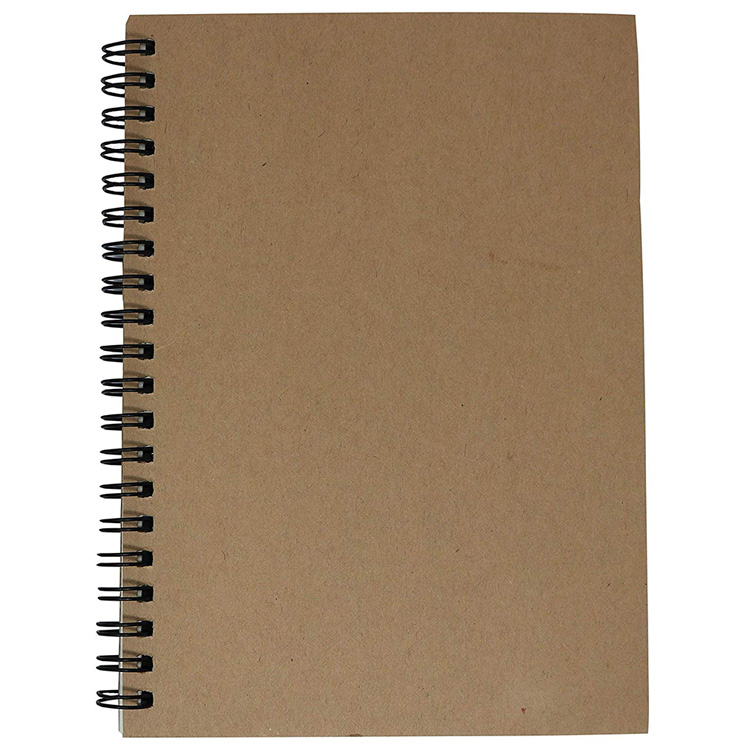
The upright single notebook says everything the artwork department needs. Medium-brown kraft card, uncoated and matte, the fibre flecks and a faint horizontal crease in the stock visible under studio light – and nothing else. No logo, no rule, no barcode, no tag, no shrink. Roughly twenty black-coated wire loops run down the bound edge. That total absence of decoration is deliberate: the whole front panel is yours. On a pre-printed cover you negotiate artwork around someone else’s graphic; on this face the only print decision is where your mark sits and how big it goes.
One spot colour is enough to make the book belong to a brand. Kraft brown sits in the warm half of the colour wheel, so a dark single-colour mark – black, deep green, espresso – reads cleanly without the white underprint that coloured logos on brown stock would add. Full-colour artwork is available at quotation, but the honest money-saving path on this SKU is one ink, one pass, cover position locked on the mock-up. The agency who wants a two-colour logo for one campaign is quoting a line item, not a philosophical debate. Full colour on the matte kraft face prints true because the stock takes ink without the dot-gain bounce of a gloss sheet.
Placement rules are worth deciding before the quote, not during it. A centred mark at mid-height photographs best for social posts; a mark in the upper third clears the wrist of someone writing one-handed; a small mark near the coil edge reads as a maker’s signature and keeps the cover mostly paper. All three cost the same to print and all three look different in a booth photo, so the free digital mock-up shows your logo in each position on the real cover dimensions before a plate is committed. That proof step is where brand teams stop guessing.
Tonal variation is part of the material contract with kraft, and we say it before your client discovers it. Kraft card is a natural fibre product: a faint fleck, a hairline crease, a shade lighter or darker between card batches – the upright photograph shows the texture honestly, marks and all. Promotional buyers who promise clients ‘exactly the photo’ should promise ‘the same tone family inside one production lot’ instead: every carton from a single order matches, and a restock booked months later gets the current batch tone flagged on the proof before ink lands. Agencies that brief this honestly never have the conversation; agencies that overpromise get returns. The black coil and the blank field stay constant either way.
Size and trim follow the same lot logic. This line’s portrait pad as photographed is the configuration we stock-shot, and the exact trim arrives on your quotation sheet before tooling, because buyers reselling to chain accounts need the pad to pass a planogram review, not just a logo review. A centimetre of cover either side of a shelf pocket decides placement, and placement decides reorders, so dimension is a commercial spec on kraft the same way it is on the premium coil lines – except here it is the cheapest way to get it right.
The triple stack: mixing colour and artwork inside one order
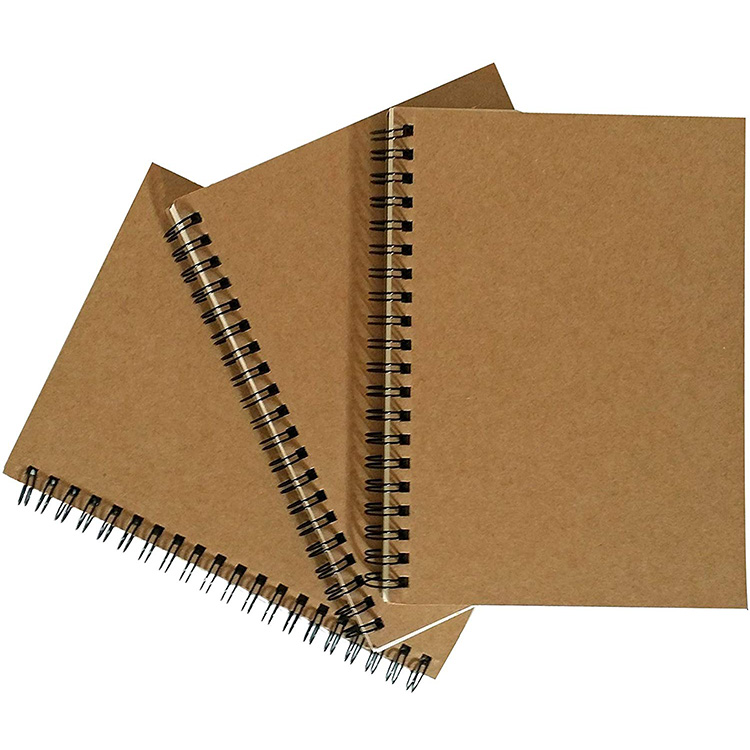
Three identical notebooks lie fanned across the white ground, each blank kraft cover and black coil rotated to a different angle, one back flap lifted so the coil reads edge-on. Nothing distinguishes one from the other – that uniformity is the production fact the photo exists to show. Every unit of a run comes off the same stock face, so artwork is the only variable between your event and your client’s rebrand.
For mixed campaigns the arithmetic is simple and we say it plainly: the MOQ is 100 pcs per design, and a design means one logo file on one specification. Two sponsors, two marks, two hundred pieces. One mark across five events, five reorders against a single approved plate – each restock lands in the 7-15 day window after artwork approval, which is short because the artwork is already approved and only the press time counts.
That is how a distribution house turns one notebook line into a recurring account rather than a single fire-sale quote. The stack shot also makes a freight point without words: three loose books fan like that because they are light. Kraft cover plus uncoated sheet keeps the carton weight down, which is the real margin lever on air-shipped promo stock. A campaign that flies thirty cartons pays for the air by the kilogram, and every gram the cover does not add is a gram your quote keeps.
Uniformity across a run is the other fact the triple photo defends. Same card batch, same coil colour, same punch pitch on all three units, which is what a distributor reselling to several end clients needs: no carton in the pallet should look like a different product. We lock that by producing all pieces of one order from one card lot and one coil reel, and we say so on the packing list – a restock months later gets a fresh lot, and the proof shows the new tone before ink lands rather than after cartons ship.
One reseller pattern worth copying: run the blank kraft face as the house SKU and print the sponsor mark as a second pass only when the campaign is signed. The unbranded pad keeps one lot in stock for five future campaigns, and each client’s 100-pc tier prints on the shelf-ready book within the 7-15 day window after artwork approval. Nobody waits on tooling, nobody owns dead stock, and the plate file for each sponsor is a single one-colour print layer your design team can produce from a vector logo without a studio retainer. The house-SKU model also shortens the sales cycle: the proof a sponsor signs is the pad on the booth table, not a rendering of it.
Ruling options visible on this shell
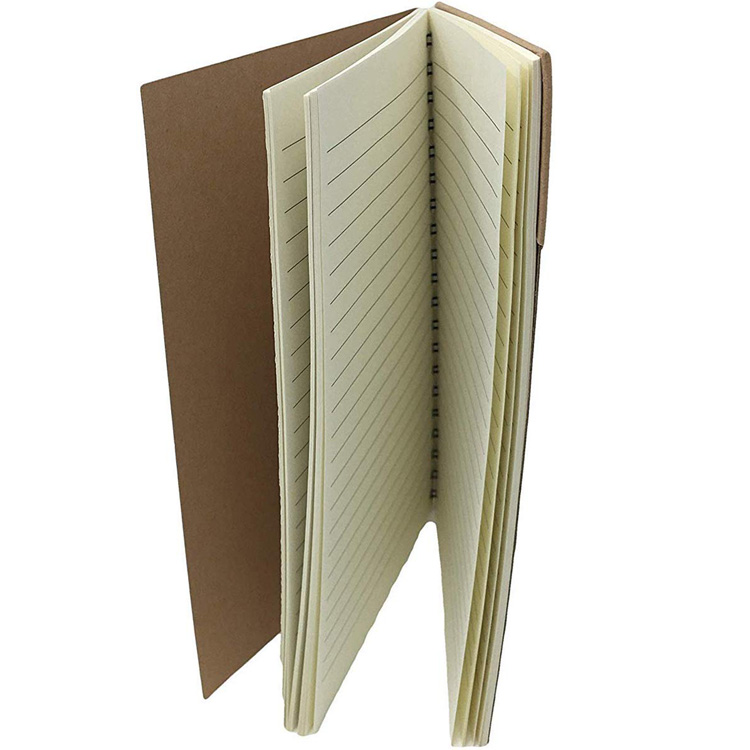
The fourth frame is the stock photo used for the listing’s main image, and it shows an interior variant worth photographing honestly. The notebook stands open against the viewer: blank kraft on the inner cover face, and a fanned text block of warm cream sheets ruled with diagonal guide lines – the slanted parallel strokes used for handwriting practice and shorthand-style note systems – gathered down the gutter by a column of small dark loops.
So the kraft shell does not commit you to one page. Standard lined is photographed in the opened-flat frame; the slant-guide ruling in this stock frame shows the interior print is a layout decision, not a structural one. Blank, dotted and grid interiors are quoted on request against the same cover and coil. When a school-supply buyer, a café chain and a conference house order the same SKU, only the sheet print differs – and none of them pays for a different book.
The cream tone of the photographed sheets is a working decision too. Bright white reads under stage lighting but shows every coffee ring; a warm-cream sheet hides the day-to-day abuse of a booth counter and photographs softer in a brand’s social feed. We sample both tones on request, because paper colour is the one spec every recipient notices without knowing they noticed it. Whatever ruling and tone you pick, the black coil and kraft cover in the photographs stay the fixed frame around it. Agencies that run the kraft SKU year after year learn to change only the sponsor mark on the face: the spec frame holds, the proof updates, the carton arrives.
Slant ruling also earns its place in specific promo contexts: language schools order it for handwriting classes, and a shorthand or stenography training programme asks for it by name. When a gift wholesaler stocks the kraft shell alongside lined and blank variants, the diagonal-guide SKU turns slow-moving end-of-term stock into an education-season line without any new cover tooling – the same blank brown face doing three different jobs depending on what the plate underneath the coil says. Interior print is always proofed as its own mock-up page, because a guide angle too steep for a child’s pencil, or too shallow to bother an adult, is decided in one proof round if you make it one. Cafés and bookstores that co-brand the kraft shell usually settle on lined or blank; the slant-guide variant moves almost exclusively through school channels, and the frame lets a generalist reseller stock the education angle without becoming one.
Configuration lines for this SKU
- Cover: blank kraft card as photographed, or a printed design panel in the style of the blue-ruled sample face
- Logo colour: single spot colour is the price-optimal path; full-colour artwork quoted on request
- Interior: standard lined as photographed; slant-guide shown in the stock frame; blank, dotted or grid quoted on request
- Sheets: 60-sheet pad as the listing’s standard configuration; other counts quoted on request
- Coil: black double-loop wire as photographed on every frame of this line
- Mock-up: free digital proof with your mark at cover position before any plate is committed
Specification table
| Item | Custom kraft spiral notebook wholesale, blank-cover promotional pad |
| Size | Portrait pad as photographed; exact trim quoted on request against your line sheet |
| Paper & Ruling | Standard 60-sheet pad; lined interior as photographed, slant-guide variant shown, other rulings quoted on request; gsm quoted on request |
| Cover | Brown kraft card, uncoated matte, blank print-ready face |
| Binding | Black double-loop wire-o coil through punched holes |
| Logo & Finish | One-colour cover print (recommended) or full-colour artwork; free digital mock-up before production |
| Packing | Export cartons, palletised or loose; FBA labelling and prep supported |
| MOQ | 100 pcs per design |
| Sample time | 3-5 days |
| Lead time | 7-15 days after artwork approval |
| Capacity | 1,000,000 pcs per month across our gift lines |
Price math, samples and the approval clock
Wholesale buyers should read the number on this page as what it is: an anchor for the 100-piece tier, not the landed cost of a container. The quote that matters comes from quantity band, logo colour count, ruling choice and destination, and it arrives against your actual forecast. What does not move is the commercial frame: 100 pcs per design minimum, physical samples out of the plant in 3-5 days, bulk finished 7-15 days after artwork approval. For a trade show that means the safe path is artwork locked with your client three weeks before booth doors open, sample approved by the decision-maker who is allergic to surprises, and the restock conversation scheduled while the first carton is still on the water.
Our capacity of 1,000,000 pieces per month across the gift lines sits behind this SKU too, which is why a client who wins a last-minute 20,000-pad conference rebooking gets a real date instead of a polite no. Reorders of an approved mark skip the proof stage: the file stays on record, production slots are booked against the repeat PO, and the 7-15 day window applies from that day forward. The cheapest campaign notebook is the one whose second event did not need a new sample run.
Packing and freight for promo warehouses
Promo stock lives or dies on pallet logic. Kraft pads ship in export cartons with counts set to your warehouse’s pick pattern, palletised for container loads or split for parcel carriers – sea for the quarter’s replenishment, air or express couriers like DHL, UPS, FedEx and TNT when a client rescheduled the launch. FBA-bound units arrive labelled and prepped at our dock so your inbound shipment needs no second handling step. Ask and we send carton dimensions and per-carton weight before you book freight, not after. The photograph below shows the load discipline: cartons squared, corner-boarded and shrink-wrapped on pallets sized to the container floor, labelled to the plan you file with the PO.

Distributor FAQ before you quote a campaign
What is the cheapest way to brand this notebook?
Do two client logos on the same notebook count as one order?
Can I see the 60-sheet pad and paper weight before committing?
Is the blue-ruled panel on the sample cover part of every notebook?
How fast can a restock arrive between two events?
What does the displayed price on the listing include?
Other notebook lines to weigh against this one
The kraft face is the entry tier, not the only tier. The clear-cover coil notebook is the step-up for shops that want a sleeve and a four-way ruling menu on the same order form, and the stave music notebook covers school-music demand without pulling this SKU off its price point. Compare everything in the notebook category, add collateral from the printed items range so a campaign ships in one carton, and send quantity bands to the quote desk.
Put a number on your next campaign
Send the logo, the event date and the quantity band; the team returns a mock-up and a tiered quote, not a brochure. Samples in 3-5 days, production 7-15 days after you approve artwork, 100 pcs per design to open. Email [email protected], ring +86-15967739086, or use the form below – whichever your account manager checks first.