Custom Sewn-Bound Planner Notebooks | Casebound Hardcover
$0.90
Custom sewn bound planner notebooks built on a visibly thread-sewn book block: stitch dashes run down every spine in the photographs, folded signatures open flat and keep reopening flat through a full year of daily use. Kraft covers print blank as a private-label canvas, cream ruled stock carries No and Date header fields, and the dimensioned format is 8.3 by 5.9 inches. Belly-banded multi-packs, dated or undated planner layouts, ribbon and elastic hardware, and FBA-compliant carton builds all quote per design. MOQ 100 pcs per design, samples in 3-5 days, bulk production 7-15 days after artwork approval — and the sewn construction survives the re-shelving and refill cycles that crack glued blocks open at the hinge.
A custom sewn bound planner notebook is bought for a behaviour, not a look: the book opens flat and stays flat. The photographs on this page show where that behaviour comes from — thread stitched through folded signatures, running in visible dash rows along the spine, so the text block is sewn as a book rather than glued as a pad. That construction is why planners survive being reopened to the same spread every morning, why archive copies do not shed pages on the shelf, and why a casebound journal lies open under a pen while writing. Glued alternatives exist and quote on request; this page argues, from evidence, for the sewn one.
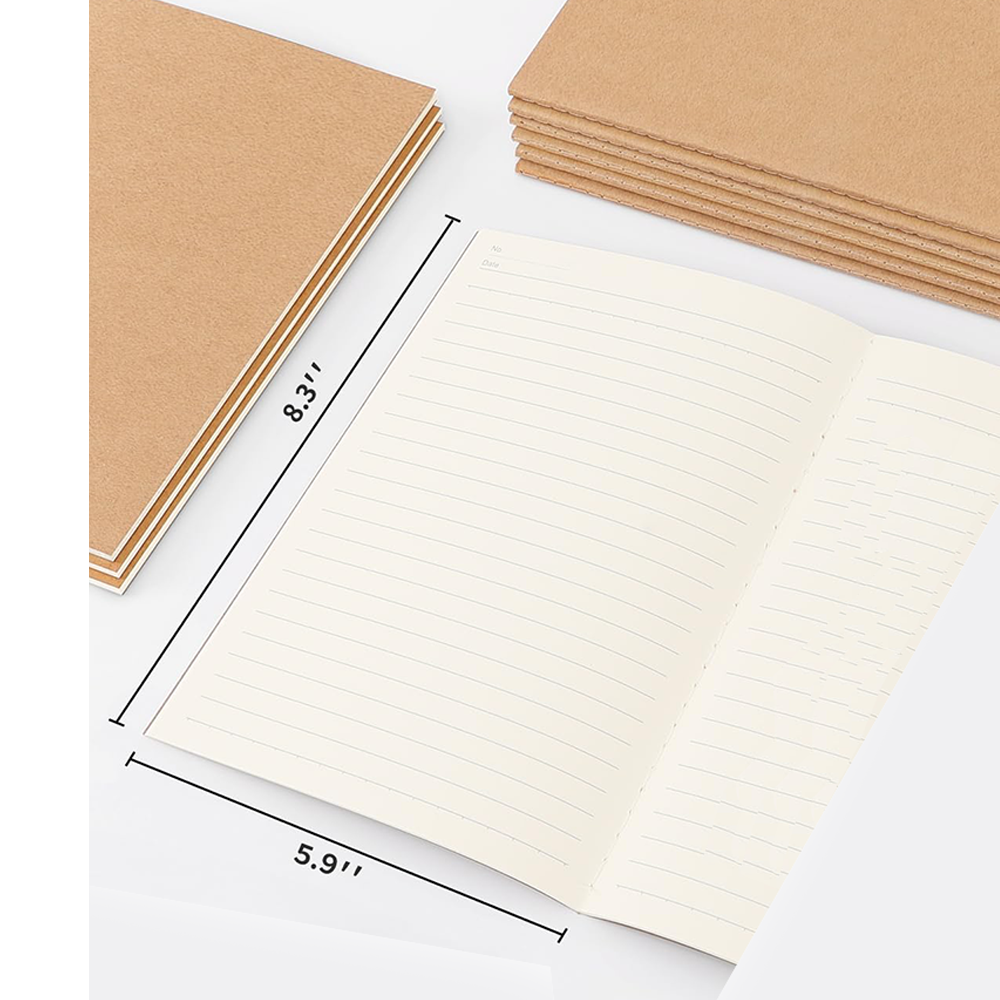
The sample books are deliberately plain: kraft covers with no print, cream ruled stock with a small printed No and Date field in the page header, page height and width marked at 8.3 in and 5.9 in in the dimension photo. Nothing competes with the construction, which is the point — your logo, colourway, ruling and hardware replace the blank surfaces, and the sewn book block underneath stays exactly as photographed. Ordering runs MOQ 100 pcs per design, samples in 3-5 days, and 7-15 days after artwork approval for the bulk, with production capacity of 1,000,000 pcs per month across our gift lines.
Thread Through Folded Sheets: What the Photos Actually Show
Take the fanned-stack photograph first, because it is the one most buyers cannot fake. Five closed notebooks rest on a sixth opened flat, and along the spine edge of every closed book runs a regular row of small dashes — the sewing stations where thread passes through folded signatures, spaced down the full height of the spine. In the open book below them, the same dashes appear in the gutter, holding the sections together. This is the anatomy of thread sewing: sheets folded in groups, the folds stitched, the stitched groups bound into one block. A glued spine has none of this — it is a milled edge and a bead of adhesive, smooth where the sewn block is dashed.
The second stack photo confirms the read from another angle: a taller pile with the bound edges facing camera, dashes aligned across every copy, and an open spread showing pages curving into a stitched gutter rather than breaking against a stiff glue line. Both photos also carry the No and Date header fields printed on the ruled page — a quiet signal that this stock is intended for records, logs and dated entries, where the book has to stay whole to be worth anything.

Why Sewing Outlives Glue on a Real Shelf
Perfect binding is engineered for a book that opens twice and sits still. Its failure mode is the one planners and archive staff report: the glue line stiffens, the first reader forces it flat, and the sections crack out at the hinge within months — pages with dates on them, detached into the bottom of a drawer. Sewn signatures behave differently under the identical abuse. Each section is folded and stitched through the fold, so opening the book flexes paper on thread instead of cracking adhesive on a milled edge. Reopen the same weekly spread four hundred times and the thread simply moves; there is no bond to break. When a compliance officer, a records clerk or a shopkeeper says a notebook has to survive re-shelving, this is the sentence that justifies the few cents of difference.
Lay-flat behaviour is the second dividend. A sewn block opens toward one hundred eighty degrees — visible in the dimension photo, where the spread sits flat on its own without a hand holding it — which converts directly into writing quality: no gutter loss in a two-page diary week, no bridging over the spine when writing across open pages, no fighting the book during long meetings. Rigid glue spines keep the pages cupped at the joint; sewn blocks hand the pen a flat surface and ask nothing back.
Dimensions, Hardware and the Refill Habit
The dimension shot lays the product logic out plainly: one notebook closed in the stack view, another opened flat, height marked 8.3 in and closed width 5.9 in — a portrait format at approximately A5 height that fits a tote pocket and a desk tray equally. Cream pages carry grey single rule with the printed No and Date fields in the header band, the kind of page an instructor, supervisor or project lead can skim chronologically without reading a word. Kraft covers are unprinted by design in every sample: the cover is your file, and the photography proves we are not hiding a generic house design underneath it.
That blank-canvas decision is also a freight decision in disguise. Unprinted kraft covers carry one plate instead of eight spot colours, tolerate scuffs that printed wraps show, and age honestly on a shelf — which is why the sample line photographed this way exists at all. A program that later wants print, foil or a colour-matched wrap adds it around the same book block; the sewn interior does not care what the shell wears.
Case construction around the sewn block is spec-time territory. A plain kraft wrap like the photographs is the baseline; printed boards, cloth spines, edge-painted blocks and ribbon markers are build options quoted per design. Glued or mixed sewn-and-glued constructions are available when a shallower budget or a thinner book demands them — quoted on request, never substituted silently. What you should insist on for anything that will be archived or reissued annually: the sewn block, because it is the only construction here that tolerates a hundred reopens a year, and it is what the dashes in these photographs are made of.
The argument extends to anything filed rather than re-bought: studio session logs, lab notebooks that graduate into an archive, inspection books that outlive the inspector. Archival practice dislikes coatings and adhesives that change chemistry over a decade, and a folded-and-threaded block is mechanically the simplest object in the room — paper and cotton thread, no glue bead to embrittle. That simplicity is why the format shows up in record-keeping contexts at all, and why a planner program run on this construction quietly doubles as the year’s paper trail when anyone asks what happened and when.
Planners, Diaries and the Programs That Reorder Them
Planner notebooks have a shelf life problem that other stationery skips: a dated planner is, by design, out of date in twelve months — but the physical book outlives its calendar, and owners hate shredding a well-bound object. Sewn construction turns that annoyance into a reorder feature. The book that survives the year in good shape is the book whose next edition gets bought without deliberation; the one that disintegrates teaches the buyer that planners are disposable, which is the last lesson a subscription-style program wants. That is the argument for threading your annual planner, diary or company datebook on a sewn block: the object’s survival is the retention mechanic.
The buyer patterns on this page cluster accordingly. Corporate planners dated to a fiscal year; studios and clinics keeping appointment books and intake logs, where the No and Date header fields match actual practice; retail stationery brands publishing undated planners and journals in shelf families; schools and camps buying year-books and duty logs that get reopened daily. Undated versus dated layout, monthly, weekly or ruled-only as photographed — all artwork-stage choices. Sheet counts and bond weights are not printed on these photos, so they quote per tier.
There is a quieter reorder driver hiding in the planner business: version discipline. A company that ships a dated planner every January usually wants next year’s to be recognisably the same object — same format, same page feel, same opening behaviour — with only the dates and maybe the cover colour changing. Sewn formats make that continuity cheap, because nothing in the construction is seasonal: stored dielines, stored stitch settings, one date-layout refresh per year. Disposable glued planners force the opposite pattern, where every annual edition is quietly a new product decision and nothing compounds. If your planner program is a franchise rather than a one-off drop, the construction choice on this page is what lets the franchise exist.
Worth naming the one buyer group this argument misses: gift-with-purchase programs that expect the book to live three weeks. For those runs a glued block quoted on request is the honest answer, and we will say so in the quote rather than upsell thread into a disposable. Everything else — the appointment book, the intake log, the shop diary, the studio session notebook, the planner your organisation mails its people every January — is a daily-open object, and daily-open objects get sewn for the same reason office chairs get rebuilt instead of replaced.
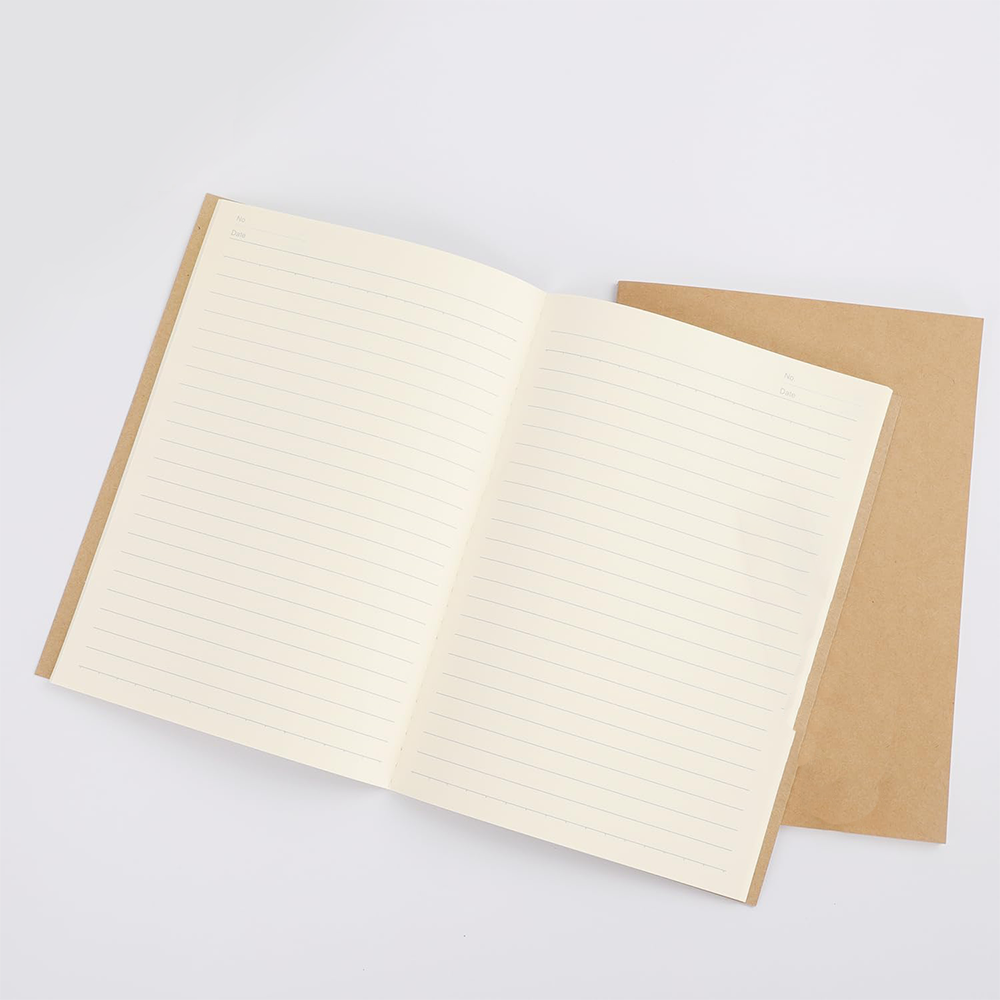
A conversation worth having now that the open book above is on screen: buyers frequently ask whether the No and Date fields can be moved, dropped or doubled — a bottom-of-page signature line, a left-column project field, a week-number strip for diary formats. All of it is header artwork, so all of it moves with the file, and the sewn block is indifferent to where the ink sits. The single flat-lay spread here also carries one honesty note for engineers weighing the evidence: its wrap cover hides the actual spine, so the sewing read in this frame comes from the flat-open geometry and folded gutter rather than visible thread — the stack photographs above show the thread itself. The one thing not negotiable is keeping date-and-checker fields on every leaf if the book will ever leave the room as evidence; a signature line on page one only protects the first page.
Blank Multi-Packs and the Retail Shelf
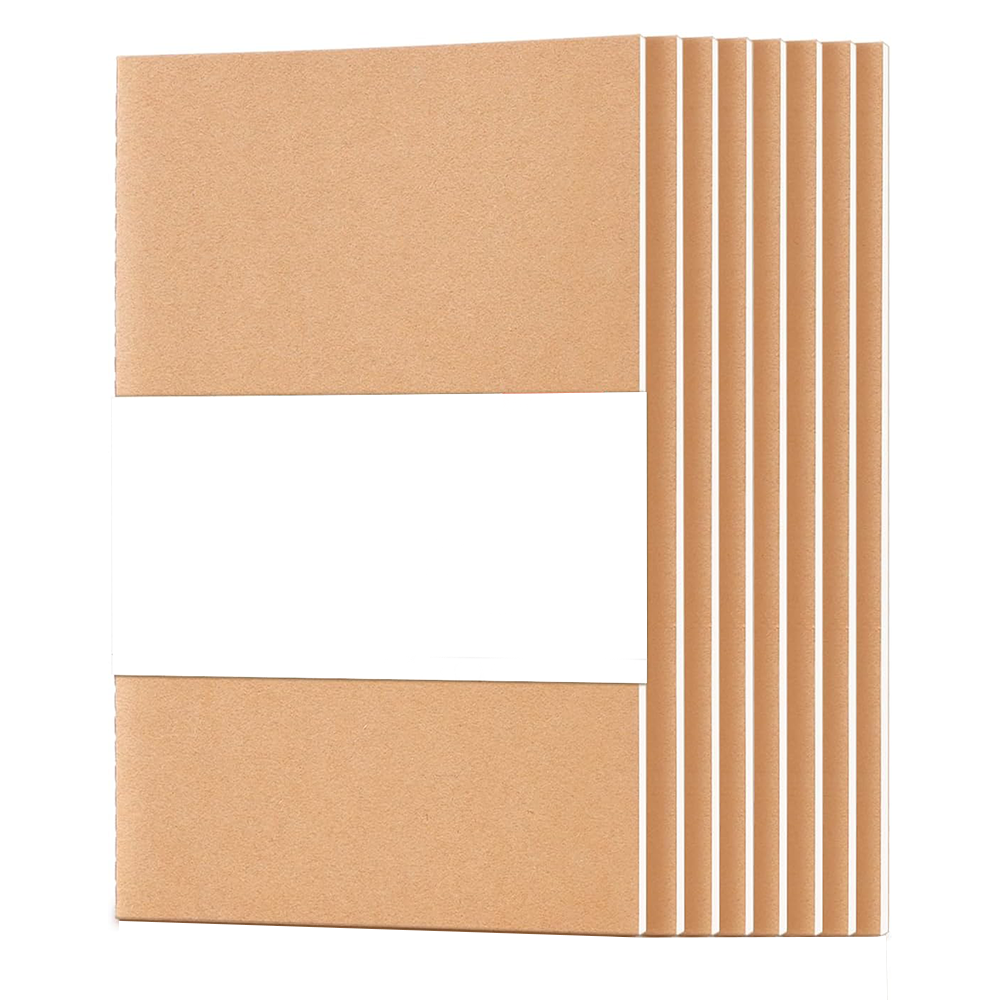
The pack photograph is the merchandising half of this construction: eight blank kraft notebooks fanned into a single retail unit, held by a plain white paper belly band. The band is the whole packaging story — unprinted stock, re-printable with your lockup or a product name at trivial cost, and no plastic sleeve, glue tab or molded insert to tool. Multi-packs like this ship to bookshop shelves, welcome-desk drawers, studio supply cupboards and marketplace listings where the set is the unit of sale.
Note what the fanned arrangement sells beyond quantity: uniformity. Eight identical trimmed edges in one frame is a production statement — the same fold, the same stitch length, the same cut across every copy in a batch, which is the quality signal buyers actually check when a listing photo is all they get. A program that orders banded packs for three branch offices or a teacher who hands one book to each of eight students should be receiving objects that match each other, and the photograph is the factory’s way of promising it.
Banding as a pack format also solves a small logistics annoyance that paper brands know well: loose stacks travel badly. A belly band keeps a fan of eight books squared inside a carton, stops edge bruising between units, and lets a receiving clerk open one carton and see eight identical retail units instead of a brick of shrink that needs cutting. For warehouse programs that repack nothing, that single detail converts directly into man-hours at the dock. And when your brand eventually scales past banded sets into boxes, sleeves or magnetic closures, the same book block moves into those formats untouched — the pack is packaging, not construction, and it can be upgraded between seasons without retooling the notebook itself.
Two retail consequences hide in that band. First, the blank cover plus plain paper band is a private-label canvas: it makes no printed claim the buyer has to back up, and the same sewn book serves a museum shop under one band print and a corporate gifting desk under another, with MOQ applying per design so each program stands up at 100 pieces. Second, banded packs cube differently from shrink-wrapped singles, so carton counts and pallet heights get planned around the pack format, not the unit — a detail that changes the freight line on your quote, and which we settle before the artwork deadline rather than at the dock.
Configurable Points Before Production
- Block: thread-sewn signatures as photographed; glued or hybrid constructions quoted on request
- Page layout: ruled with No and Date header fields as shown; grid, dotted, plain or dated planner layouts per design
- Cover: blank kraft as photographed, printed board, cloth spine or colour-matched wraps
- Format: 8.3 in x 5.9 in dimensioned in the photos; other sizes quoted per build
- Hardware add-ons: ribbon marker, elastic closure, back pocket — mounted at binding stage, quoted per design
- Pack logic: singles, belly-banded multi-packs, or shrink-wrapped retail units per channel
- Logo: your file replaces every blank sample surface; free digital mock-up before any tooling decision
Construction Specification
| Item | Custom sewn / glued planner notebooks, case-bound book blocks |
| Size | 8.3 in x 5.9 in dimensioned in photographs; alternate formats quoted on request |
| Paper & Ruling | Cream uncoated stock, grey rule with printed No and Date header as photographed; grid, dotted, plain and dated layouts per design; sheet count and bond weight quoted on request |
| Cover | Blank kraft wrap as photographed; printed boards and cloth spines quoted per artwork |
| Binding | Thread-sewn folded signatures — stitch dashes photographed on spines and gutter; glued (perfect-bound) option quoted on request |
| Logo & Finish | Sample covers unprinted; print, foil or deboss added at case stage from your file |
| Packing | Singles, belly-banded multi-packs or retail shrink; carton counts planned to channel |
| MOQ | 100 pcs per design |
| Sample time | 3-5 days |
| Lead time | 7-15 days after artwork approval |
| Capacity | 1,000,000 pcs per month across our gift lines |
Approval Path and the Calendar Behind It
Because sewn blocks carry more hand steps than a glued pad, the sample round is where the decision actually gets made — not the quote. Files come back as a digital mock-up first, at no charge; the physical sewn sample follows in 3-5 days, and you should hold it open face-down on a table before approving anything: that twenty-second test settles the lay-flat argument better than this entire page. Bulk then runs 7-15 days after artwork approval. Dated planners work backwards from January with a September-October artwork lock; undated journal programs and retail packs flex with reorder windows, and the displayed listing figure anchors the 100-piece tier while volume tiers move in the quotation.
Cartons, Freight and Fulfilment Prep
Bulk books pack into five-ply export cartons on planned counts; banded retail sets ride the same cartons with divider boards where the pack format demands them. Freight routes by sea for production runs, by air when a planner program has a fixed launch, or by DHL, UPS, FedEx and TNT express for sample rounds and mid-season top-ups. Marketplace sellers get FBA-ready handling from the same line: unit labels, bagging with required warnings, cartons built to shipment-plan piece counts and weights so inbound appointments clear without rejections. One production week can split between bulk cartons and fulfilment cartons when you send the plan structure with the artwork.

How do I know these books are actually sewn and not glued?
Is a sewn block worth the cost over perfect binding for planners?
Can the sewn book hold a dated planner layout, not just ruled pages?
How do multi-packs affect minimum order and cartons?
Can ribbon markers, elastic closures or pockets be added to this construction?
What page size is the photographed book, and does it ship to US planners directly?
Related Constructions in the Notebook Catalogue
For buyers shopping the wider binding range: the ruled, plain and dotted hardcover line covers ruling-first private label; record-driven formats with printed field blocks live on the laboratory notebook page; full-bleed printed cases belong to the printed hardcover journals; and classroom-volume purchasing sits with the marbled composition book. The notebook category indexes everything else, and sewn journals pair into the notebook-pen-flash-drive gift set when planners ship as kits.
Send the Sample-Inspection Request
Tell us the year dates, ruling, cover and pack structure; [email protected] and +86-15967739086 both route to the same desk, or the form below does it for you. The sewn sample arrives in 3-5 days — hold it open, face-down, and decide.