Rigid Drawer Boxes with Ribbon Pull and Insert Tray
$5.50
Rigid drawer gift boxes with a printed outer sleeve, sliding tray, grosgrain ribbon pull tab and die-cut black insert – the jewelry-grade reveal mechanic for watches, rings, cosmetics and refills, in foil on matte white.
Minimum order: 100 pcs per design | Proofs: 3-5 days | Bulk: 7-15 days after artwork approval
Make it yours: 9 × 9 × 3.2 cm and 5 × 5 × 3.5 cm formats on file or custom dieline, tray-slide tolerance tuned per order, cavity die-cut to your product, foil / spot UV / embossed logo, PMS-matched ribbon, free digital mock-up
Packing: assembled boxes in dividered export cartons, foil faces protected; carton labelling for FBA supported
Delivery: sea freight, air freight or express (DHL / UPS / FedEx / TNT)
Unit price displayed is a reference at the 100-piece tier — ask us for quotes on larger runs, mixed footprints and matching pack suites.
A Rigid Drawer Box That Reopens Like a Keepsake
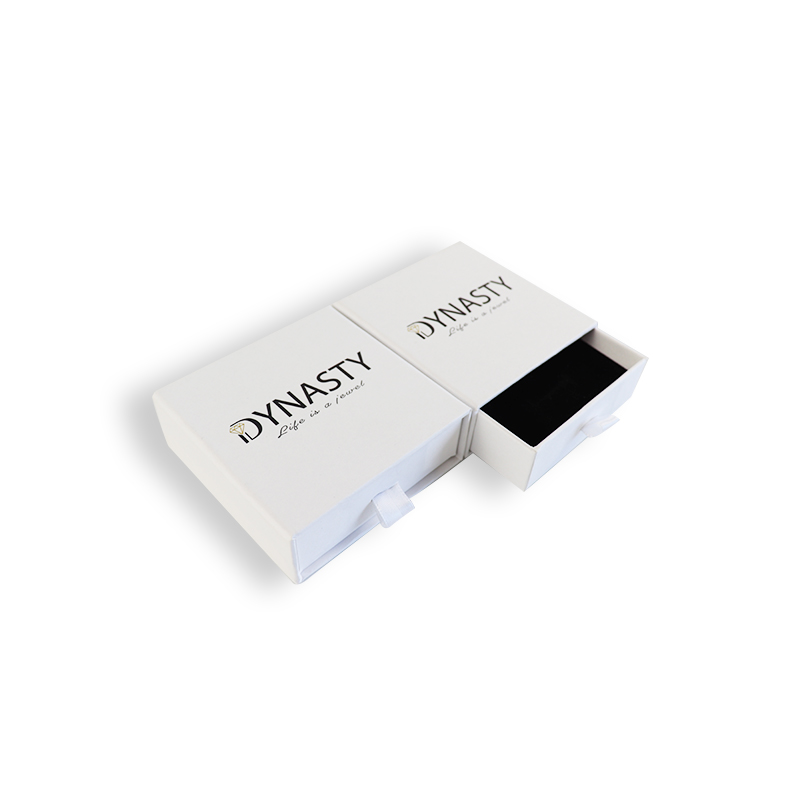
This is a sleeve-and-tray rigid drawer box: a sliding inner tray pulls out of a fixed outer sleeve on a grosgrain ribbon tab, and the tray carries a die-cut black insert that holds each piece in its own cavity. There are no magnets and no hinged lids on this construction — the reveal is entirely mechanical, and it repeats identically every time the box is opened.
The pair above shows the mechanism mid-action, one box closed and one drawn open: matte white cover paper over rigid chipboard, print wrapping around the sleeve, a white ribbon tab emerging from the tray end, and the black die-cut insert sitting flush inside. A single gold-foil element catches the light against the dead-matte surface — that contrast is why foil-on-white reads as jewellery-grade packaging rather than promo print.
Watch and ring brands, cosmetics refill lines and event-gift buyers choose this format when the product is small, valuable and photographed in hand. The drawer slides out toward the camera, the insert presents the piece centered, and the sleeve stays pristine in the customer’s hand.
Customisation Points on the Sleeve, Tray and Insert
The whole assembly is built to your inputs:
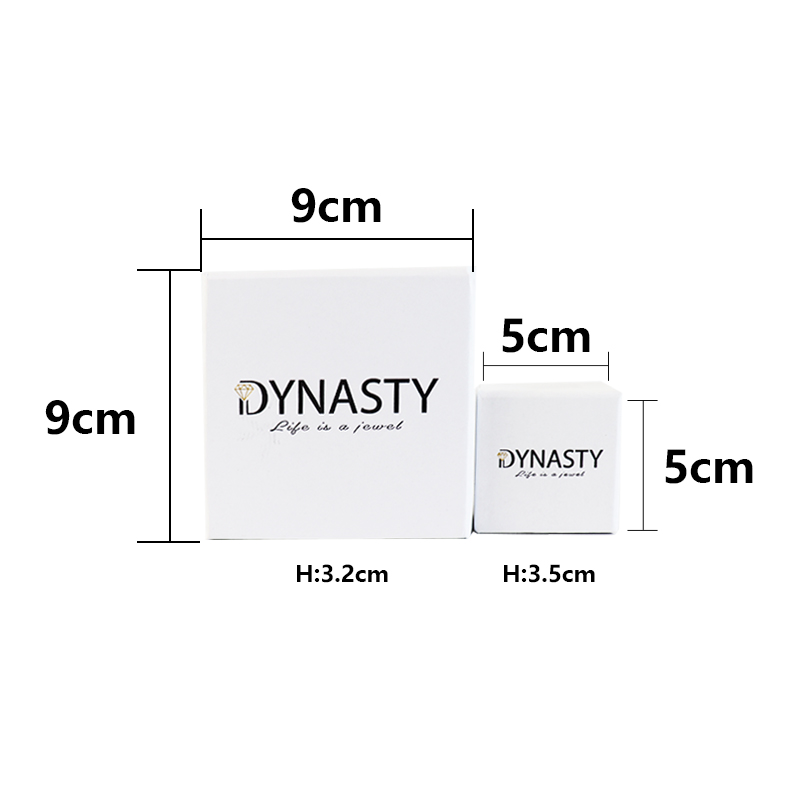
- Footprint and depth – two working formats are shown on the spec graphic below (a 9 cm square at 3.2 cm height, a 5 cm square at 3.5 cm); other footprints are cut to your product on a custom dieline.
- Slide fit – tray-to-sleeve clearance is tuned per order: snug enough that the tray does not fall out in handling, light enough that one finger draws it open smoothly. This tolerance is checked on the physical proof.
- Insert cavity – black die-cut board as standard, sized around your item’s real footprint so the piece sits centered with the logo face up; flocked-style surface is available on request.
- Pull tab – grosgrain or satin ribbon anchored inside the tray end; width and colour matched to brand, and tab placement decided against your artwork orientation.
- Cover and print – matte white as photographed; other coated or textured papers, CMYK or PMS colour matching, with the logo foil laid in gold, silver or holographic tones.
- Artwork geometry – logo centred on the sleeve or offset toward the pull end, single or double-sided print; we map the wrap before the die is made so the mark stays square as the tray moves.
- Design service – free digital mock-up from your logo file, before any tooling starts.
On the tray itself, the two workhorse builds are a routed single cavity, where the opening is cut through a layer of black board glued to the tray floor, and a folded-paper insert, where pre-scored board sits inside the tray and locates the item with tabs instead of a routed pocket. The routed version photographs deepest and is what the black inserts on this page are; the folded version costs less per unit, ships the same footprint and is the default choice when a campaign runs thousands of drawers rather than hundreds. Sleeve style is the second lever: a wrap-around printed sleeve hides the tray completely at rest, while a windowed or open-end sleeve lets a coloured tray edge peek through — used when the assortment reads by colour code across SKUs.
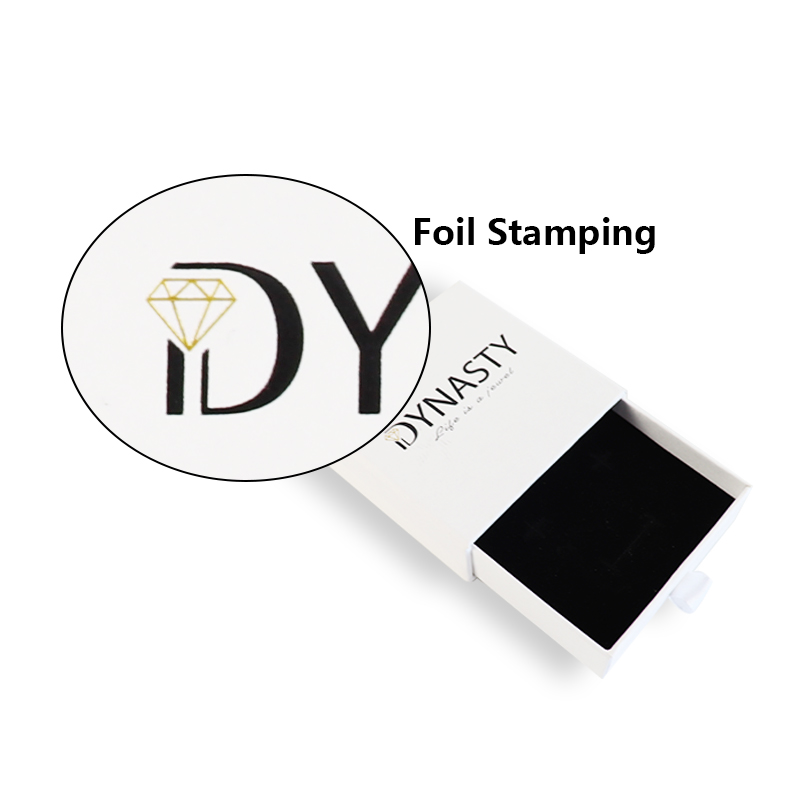
The close-up panel underneath shows the tray pulled at an angle with the magnified foil callout: grain of the matte sheet, edge of the foil impression, and the ribbon exit point at the tray end — the three details a buyer judges the whole batch by.
Two cavity layouts cover most briefs in this format. A single centred seat presents one hero piece — the ring cube in the 5 cm footprint is built around exactly that shot, product lifted out with the mark facing the camera. A routed row of shallow pockets carries sets: three refill capsules, a watch plus spare band, a mini assortment, each item pressed into its own opening so nothing migrates when the tray is tipped. Either way the insert board stays flush with the tray lip — a proud insert edge is what telegraphs “cheap” on otherwise good rigidware, so the proof is checked with the product actually seated.
Specifications
| Item | Rigid Drawer Gift Box with Ribbon Pull Tab and Die-Cut Insert |
| Construction | Rigid chipboard sleeve plus sliding tray, wrapped in cover paper; assembled, not flat-pack |
| Sizes on file | 9 × 9 × 3.2 cm and 5 × 5 × 3.5 cm formats; all other footprints custom dieline |
| Insert | Die-cut black board cavity quoted to your product footprint; flocked-style surface on request |
| Pull tab | Grosgrain or satin ribbon anchored inside tray end, PMS-matched colour |
| Printing | CMYK or PMS colour matching, matt / gloss lamination |
| Surface options | Gold, silver or holographic foil logo, spot UV, embossed / debossed mark |
| Cover paper | Matte white as shown; coated and textured stocks quoted to artwork |
| Packing | Assembled boxes in dividers and export cartons; FBA prep supported |
| MOQ | 100 pcs |
| Sample time | 3-5 days |
| Lead time | 7-15 days after artwork approval |
| Production capacity | 1,000,000 pcs per month across our printed lines |
Board thickness and tray wall strength are quoted to your product weight and cavity layout — a ring cube and a refill vial do not need the same build, and we specify it with the dieline.
Fit Problems We Solve Before the Die Is Cut
Tray too tight or too loose. Slide clearance is a per-order number, adjusted to paper thickness and cavity depth. Proof units are cycled open and closed before you sign; a tray that sticks or self-drops gets corrected at that stage, not in the bulk carton.
Insert cavity off-centre. The cavity is die-cut from your item’s measured footprint, not estimated from box outer dimensions. Send the product or a drawing with tolerance, and the centring is confirmed on the mock-up and again on the physical sample.
Foil lifting or smudging on coated stock. Foil sits in the paper grain, not on top of heavy gloss varnish: stock and foil colour are paired during proofing so edges stay crisp and the mark survives thumb rubbing on a counter.
Logo versus pull direction. The tray travels, the sleeve stays; we set artwork orientation against how the customer holds the box when drawing it open, so the mark faces correctly at the moment of reveal. Left- versus right-hand pull is also a real choice: the tab can exit on either end of the tray at no extra tooling, and brands with asymmetric lid graphics pick the side that keeps the mark upright in the unboxing video. The dimension sheet below shows two footprints carrying one identical lockup — scaled to each face, not stretched.
From Enquiry to Approved Proof
Send the item you pack, target quantity and where cartons must land. Within one working pass you get a digital mock-up with the sleeve wrap, cavity layout and tab position drawn out; approve it and a real box follows in 3-5 days so you can feel the slide, check foil edges and verify the cavity against the product. Bulk production runs 7-15 days after artwork approval. MOQ is 100 pcs per design, and mixed-footprint orders — say the 9 cm square for watches plus the 5 cm cube for rings — can be split within one PO while sharing artwork and tooling.
What arrives in the proof parcel is what we expect you to test, not a pretty prop: cycle the tray ten times and note any stick at the end of travel, press a thumb across the foil and look for lifting at the corners, seat the product and sight down the box to confirm the cavity centring, and pull the ribbon tab hard once — it should hold as though it were part of the board. If any of those four checks bothers you, say so on the call and we adjust the tolerance, the stock pairing or the anchor before the first plate is made. Corrections at proof stage cost a day; the same correction after bulk costs a carton you cannot sell.
Two decisions are worth making before the mock-up, because they change the dieline rather than just the file. First, sleeve graphics: a full-wrap print runs artwork continuously around the box, which photographs richly but costs plate area on faces the customer rarely sees; a face-only print puts the mark on the top panel and leaves the sides clean board, cutting cost and letting a small foil logo carry the whole look, exactly as on the photographed pair. Second, tray direction: most briefs draw the tray out along the short axis, presenting the item end-first; some watch displays want a side-open travel so the dial faces up at the reveal. Say which hand motion your packaging video uses and we mirror the mechanism around it before the die is cut.
Reorder logistics are equally explicit. Once a design is approved, the dieline, plate set and PMS draw-down stay on file under your account name, so a seasonal top-up reproduces against those records instead of reinterpreting a logo email. We keep the last press sheet with each tooling set; if a reorder shifts board lot or foil batch, that sheet is the reference the new run is matched back to at start-up. Ask us for a staggered plan — one proof round in March, bulk in April, replenishment in September — and the calendar is written that way, with each window quoted against the 7-15 day production clock rather than one open-ended promise.
Packing and Shipping Rigid Drawers
Unlike flat-pack magnet formats, these boxes ship assembled: each unit rides in a dividered export carton so sleeves stay square and foil faces never touch, with poly bags inside for moisture protection in ocean freight. Choose sea, air or express courier — DHL, UPS, FedEx, TNT — and FBA labelling plus carton prep are handled here before dispatch. Because assembled rigidware costs volume, carton count and pallet cubes get confirmed on the quote itself: we send the outer dimensions, units per carton and estimated shipment volume with the price, so you see landed freight before committing, not after.

Drawer Box Questions, From the Purchase Side
What is the smallest order for a logo drawer box?
Are the two shown sizes (9×9×3.2 cm and 5×5×3.5 cm) stock items?
Can the insert hold two different items in one tray?
Will the ribbon pull tab fray or detach after repeated opens?
Do you supply matching paper bags or sleeves for these boxes?
Can I get the sample before deciding on foil colour?
Other Rigid Formats in the Same Programme
If your line needs a keepsake box that folds flat, see our magnetic closure gift boxes with ribbon; for a value-tier slide box in plain paperboard, the sliding drawer cardboard boxes page covers that build; the custom printed paper shopping bags round out the counter-sale set, and everything in this family lives in the printed boxes category.
Request a Quote on This Drawer Format
Tell us the product dimensions, the cavity count and the quantity, and use the form below or attach this format to the gift box quote request list to bundle it with bags or cards. A digital mock-up, unit price and production calendar come back from the team. WhatsApp / Tel: +86-15967739086 | Email: [email protected]