Custom Hotel Welcome Gift Sets
Build your front-desk experience on one logo lockup: custom hotel welcome gift sets produced as a single program, from the satin-black vacuum tumbler and rope-handle carrier bags to the magnetic-flap journal, blind-debossed travel folio, click pen and luggage tag. Every component is printed, foiled or engraved from one signed Pantone and artwork sheet, so what a guest unwraps at check-in reads as designed rather than assembled. Minimum order is 100 pieces per design, samples run 3-5 days and production completes 7-15 days after artwork approval — enough to reverse-engineer delivery from your arrival wave. FBA prep is available for the retail half of a split program, and the displayed price anchors the 100-piece tier. Request a quote with your crest file for a mock-up across every component.
Custom Hotel Welcome Gift Sets Built On A Single Lockup
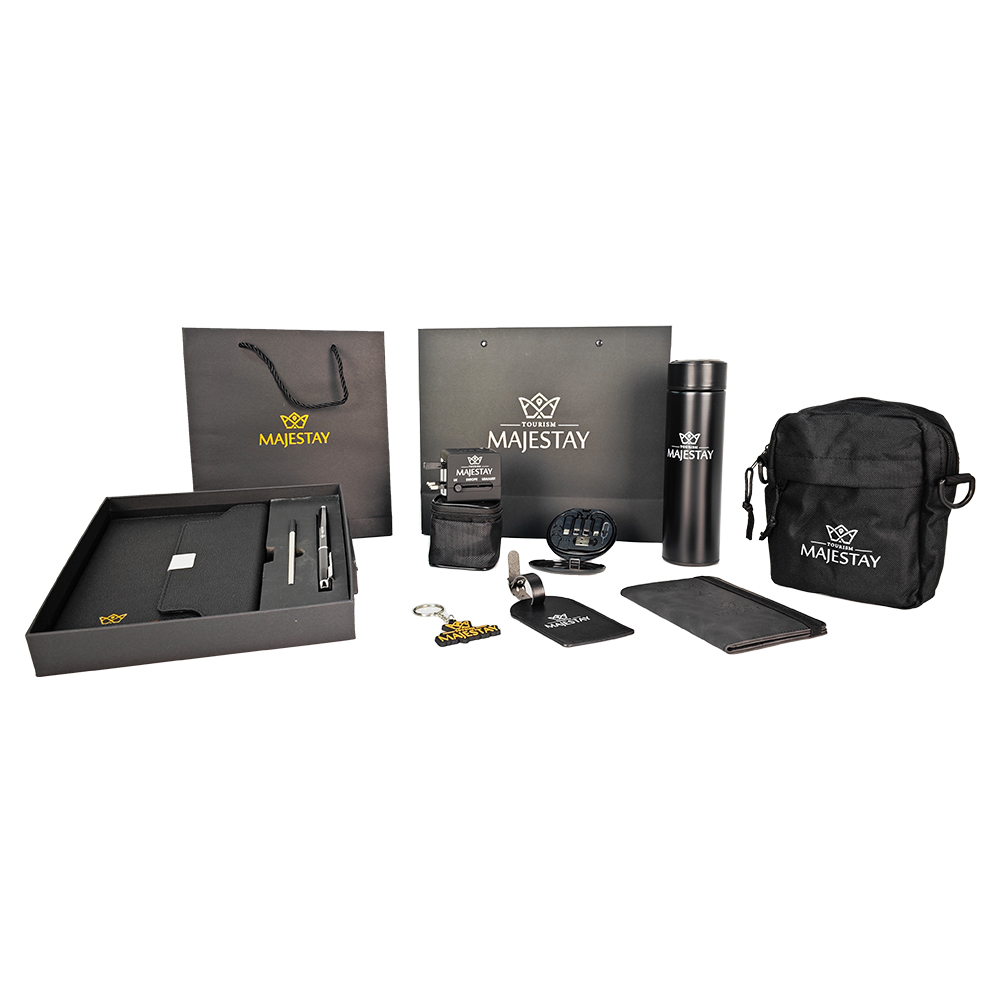
A guest decides within the first two minutes whether a property deserves the review it is about to write. Custom hotel welcome gift sets are how front-office teams control that moment: one carrier, one colour story, one logo repeated across every object handed over at check-in or left on the in-room desk before arrival. This page covers our black-and-gold hospitality kit — the insulated tumbler, the elastic-loop notebook, the click pen, the magnetic-flap journal, the travel folio and the matching carrier pieces shown in the opening flat lay — built as one program so a hotel, resort group, airline lounge or destination brand can order the whole experience from a single production line instead of stitching together five vendors with five slightly different shades of black.
Every line below is written for procurement, not for impulse buyers. Minimum order is 100 pieces per design, which means a two-piece arrival bag and a nine-piece VIP amenity tray can share one artwork file and one delivery window. The price figure displayed on this product anchors the 100-piece configuration; deeper quantities with fewer print positions move the number, and your quotation locks it. Sample time runs 3-5 days on the standard photographed pieces, production 7-15 days after artwork approval, and the same file replenishes room-block gifting, conference trays and suite amenities without three separate vendor conversations.
What Reaches The Guest, Component By Component
The hero photograph lays the full kit out on a white ground: two upright paper carrier bags with twisted rope handles, one printed light and one in metallic white; a rigid open box on the left with the journal and pen nested in a moulded tray; a zippered mesh pouch, a boxed small accessory, a flip-top case, a rubberised keychain, a luggage tag, a flat document sleeve, the insulated tumbler and a zippered crossbody shoulder bag. All of it shares one emblem-and-wordmark lockup. That single-image completeness is the point of hospitality gifting: if the tumbler carries the crest and the luggage tag does not, the guest reads carelessness. When the crest sits at the same relative position on each piece, the tray reads as designed, not assembled.
Front desks typically split this program into three tiers: a two-piece arrival bag (notebook plus pen) for standard check-ins, a five-piece VIP tray for suite and loyalty guests, and the full amenity set for press trips, group leaders and opening-week gifting. All three tiers draw from the same component catalogue, so you scale the experience by tray depth rather than by swapping vendors mid-season.
The Tumbler Is The Piece Guests Keep
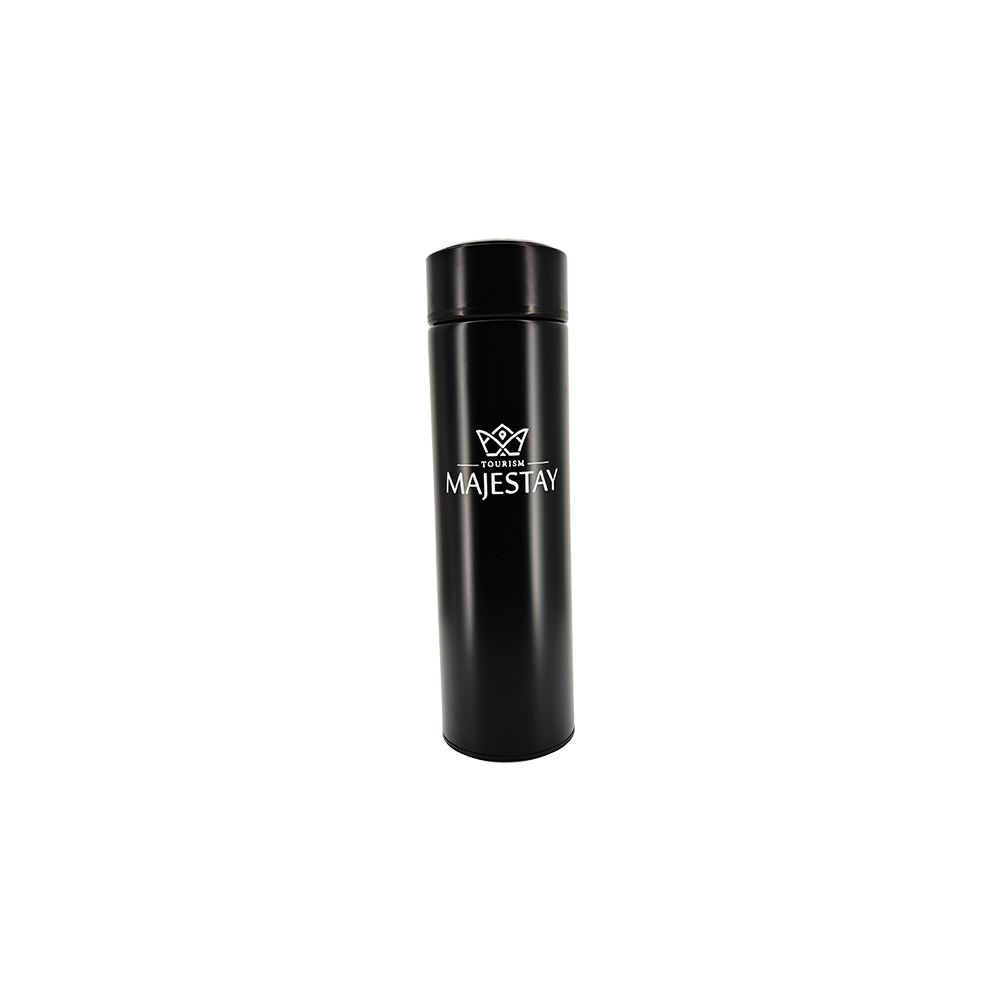
The photographed vessel is a tall, slim vacuum flask in satin black with a screw-on lid marginally glossier than the body; the broad diffuse highlight running down the front face confirms a smooth coated surface, and the only marking is one centred lockup in flat white on the upper flank. Black coating on steel takes screen print and pad print cleanly and does not yellow under lobby lighting or humid housekeeping carts. Because the barrel is uninterrupted elsewhere, teams can stow it in a welcome bag without the print face scuffing against a zipper — a small manufacturing decision that decides whether the mark still looks new at month six.
From an operations standpoint the tumbler does quiet work for the property: it travels to the beach, the airport, the office. That is months of secondary exposure per guest at the cost of one line in a gifting budget. The lid threads on with a visible seam and is left unprinted on this configuration, keeping the food-contact surface simple; if you want the crest on the lid edge instead of the barrel, that is a plate change we will price at artwork stage rather than surprise you with later.
Write this off as a line item only after watching what survives a season: the printed bag gets reused at the market, the keychain opens every door at the rental office, and the flask sits on a conference table in another city carrying your emblem into photographs you will never see. Welcome kits are slow-burn advertising with a hospitality wrapper.
Buying behaviour differs by property type, and the tumbler tier is where budgets concentrate. City business hotels order it inside the suite amenity tray and skip the soft goods; resorts with a spa or kids program push the crossbody bag and mesh pouch into the arrival gift because families physically carry them to the pool deck; tour operators treat the set as transfer gifting, where the luggage tag does the talking. We quote per component rather than only per tray, which lets a purchasing manager cut the shoulder bag from a winter spec and keep the flask line running at the same print plate all year. Plate and screen assets, once paid for an approved design, stay on file; a re-run in a different colour of the same model does not restart your tooling cost.
One more operational note on the flask: the satin coat photographs flat, which is why the sample print is white rather than metallic. Metallic inks on matte black read as grey under most camera lighting and worse under lobby lamps. If your brand standard demands a foil crest on the tumbler, we will produce it on the glossier lid face or move the foil to the box instead — decisions like that belong in the mock-up round, when there is still time to change the plate without changing the delivery date.
Stationery And Writing Hardware That Survives Front-Desk Wear
Stationery is the part of a welcome program that gets judged by hand rather than by eye. A guest opens the notebook in the taxi, clicks the pen at the restaurant bill, and forms a permanent impression of the property from two objects that cost pennies per room per night. That asymmetry — tiny unit cost, high contact frequency — is why hotel groups put more specification effort into the pen than almost anything else on the tray, and why we treat barrel gloss, clip spring tension and cover grain as named spec lines instead of supplier guesses.
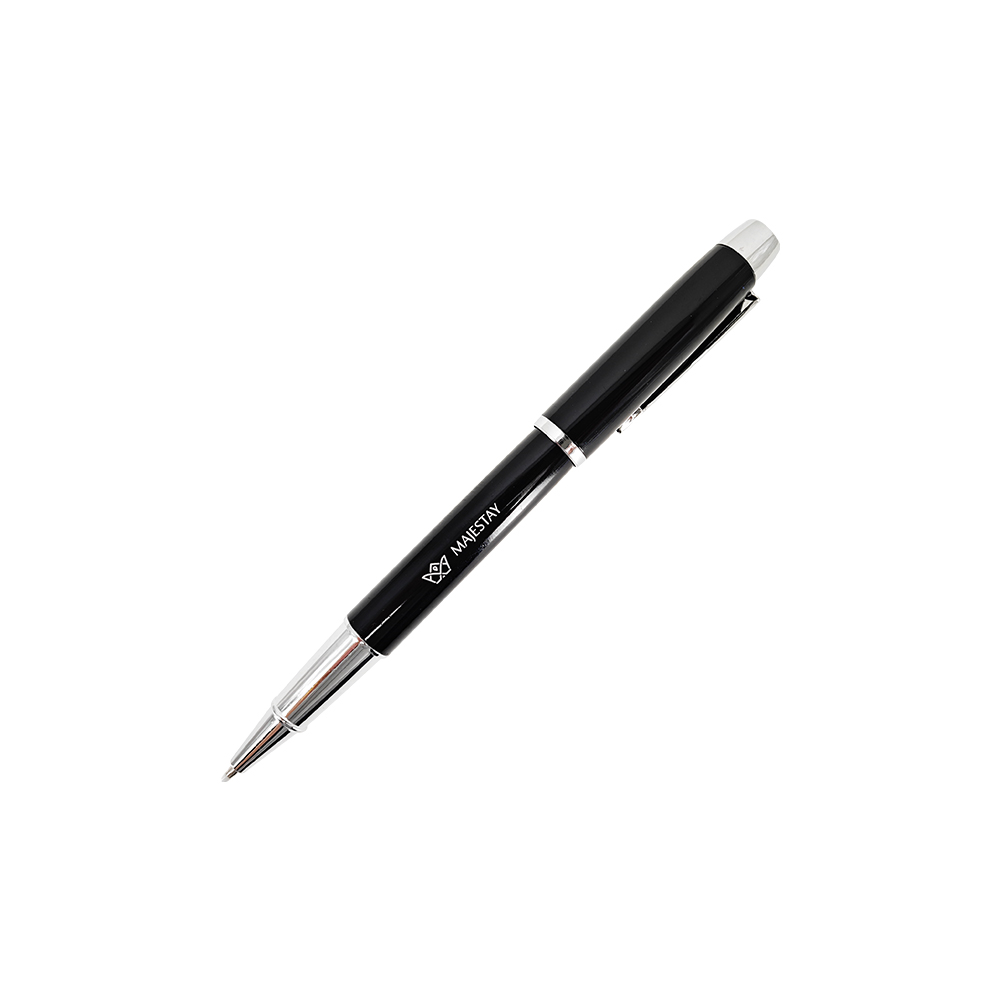
The pen shown on its own is a click-retract ballpoint: two gloss black barrel sections split by a polished chrome centre band, a chrome conical tip, a riveted chrome clip and a domed push button. A small white mark sits on the grip section; the upper barrel stays clean so a second position — property name, not just crest — can be added at print without crowding the clip side. Metal-plated barrels accept pad print at one or two positions inside the standard 100-piece tier; a full wrap is a different quote and we say so at artwork stage rather than discovering it on the line. Refills are a consumable we ship alongside bulk pen orders so a conference block mid-program never runs dry.
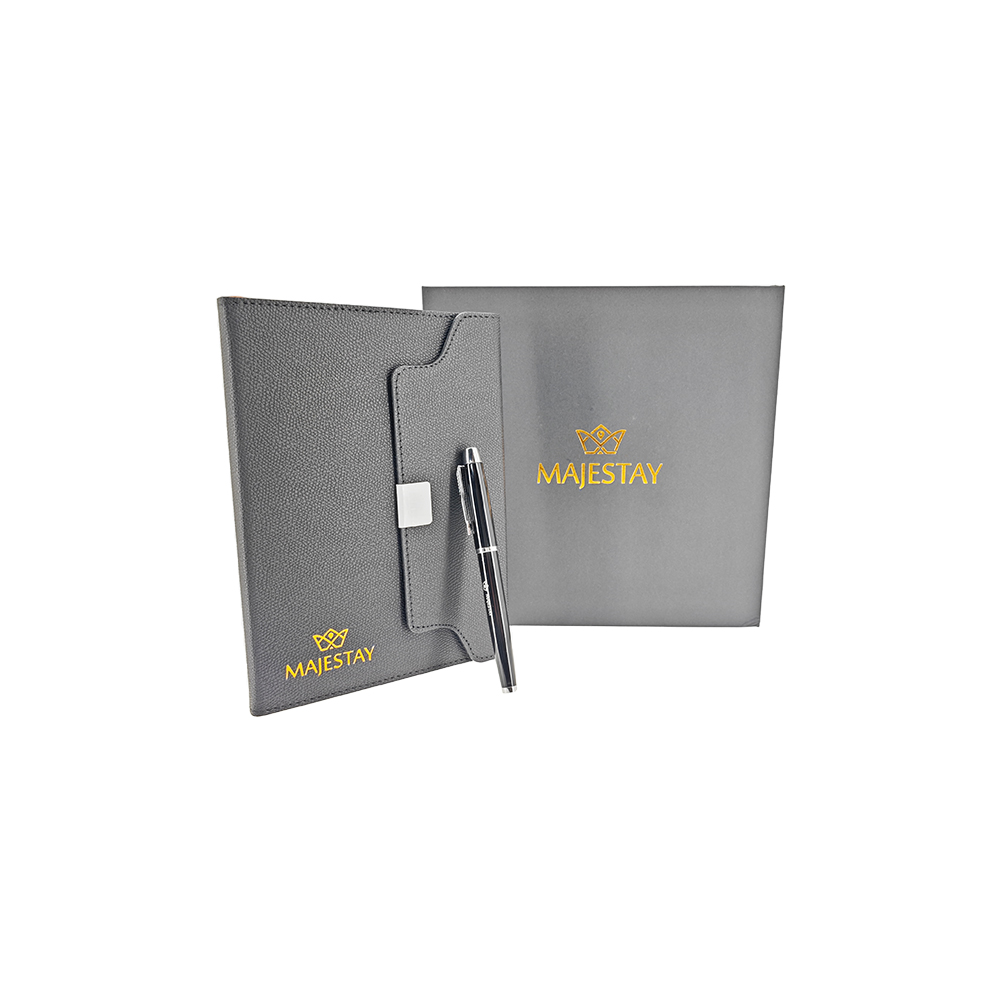
Two notebook formats appear in this kit because properties use them differently. The grey colourway photographed against its presentation box pairs a pebbled cover with a stitched vertical pen loop, a small square metal tab at the loop edge, and a matching rigid box for gifting — the format delegate kits prefer, because the pen travels with the book instead of loose in a tray. The box lid carries the emblem centred in gold, the cover corner carries it smaller; the two-position rhythm is deliberate, and your file replaces both samples at the same relative scale.
Inside both formats the page block is the specification buyers actually ask about: cream-toned ruled stock with enough paper depth that the book survives being written in rather than being displayed as a prop. Front-desk notebooks that stay blank are decorative; the ones guests use become luggage, then office supplies, then a permanent object on a colleague’s desk in another country. If your program includes a printed insert — property map, spa menu, transfer instructions, a QR code to the digital key — we place it at artwork stage as a tipped-in leaf behind the cover, sized so it never falls out mid-stay. That insert is the one element of the notebook guests read on day one, and it is the line item purchasing teams most often forget to spec until the sample arrives; raise it with the sales desk before the mock-up round and it costs paper, not tooling.
Two Closure Systems, One Brand Standard
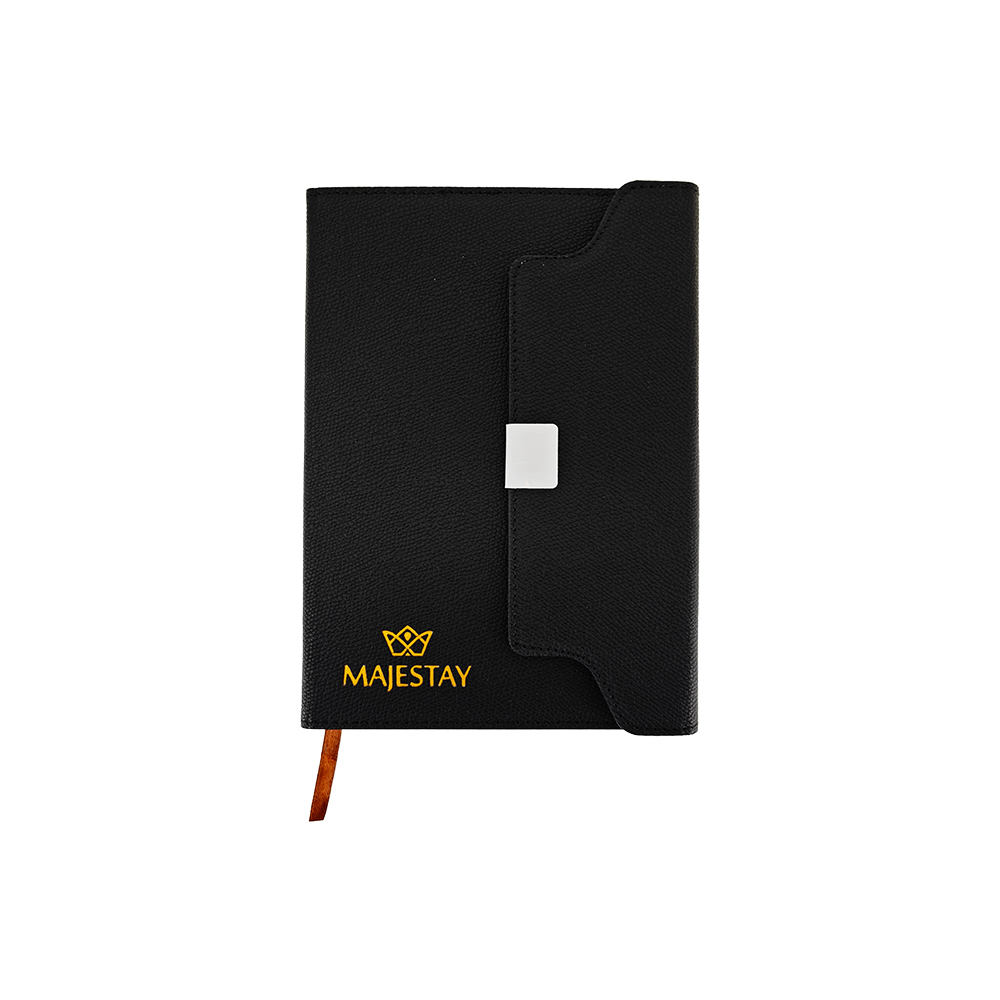
The second journal is a black crosshatch-grain book that closes differently: a fold-over flap with a brushed metal magnetic snap plate, stitched contour, a copper satin ribbon bookmark emerging from the bound edge, and the sample emblem foiled at the lower left of the cover. The snap plate is left blank on this sample run on purpose — hotels frequently engrave that plate with the property crest while the cover carries nothing, which reads more expensive than full-foil treatment and resists fingerprint wear at the point guests actually touch. The ribbon serves a real function too: welcome notebooks that survive a stay tend to be the ones guests actually opened, and a bookmark invites opening.
The mesh pouch, keychain, luggage tag and crossbody bag visible in the hero shot complete the soft-goods ring around the hard goods. The keychain tag is rubberised with a metal split ring; the luggage tag carries the same lockup in white with a buckle strap; the shoulder bag is woven fabric with a zippered flap and a side D-ring. None of these pieces is exotic on its own — their job is positional: they repeat the crest at eye level in airports, mirrors and closets long after checkout, at per-unit quantities the amenity budget can sustain.
The mesh pouch deserves a word because purchasing teams misread it in flat lay. A zippered ventilated pouch is not filler — it is the piece that holds the pool goggles, the chargers, the sunscreen sample the guest was never going to keep in a leather sleeve. Small soft goods earn their place in a welcome tray by absorbing the objects a stay produces, and a mesh zip pouch that returns home still in the guest’s carry-on keeps the crest in a bathroom drawer for years. The flat document sleeve shown folded in the hero image does a similar job at a dressier spec: a slip pocket for boarding passes or a folded property brochure that does not crease in a jacket pocket.
Hardware finish is the detail that separates a kit that reads premium from one that reads giveaway. On this program every metal touchpoint — the snap plate, the pen band and clip, the split ring, the tag buckle, the tumbler rim — lands in the same silver family, and the print colours alternate by piece: gold on the paper bags and keychain, white on the flask, the tag and the shoulder bag, blind deboss on the folio. That alternation is a deliberate rhythm, not an accident of the sample file; when you brief your own version, decide the print-colour logic once and let us hold it across all lines, because the cheapest way to break a welcome kit visually is one component printed in the wrong metallic.
Traveler-Piece Detail: The Document Folio
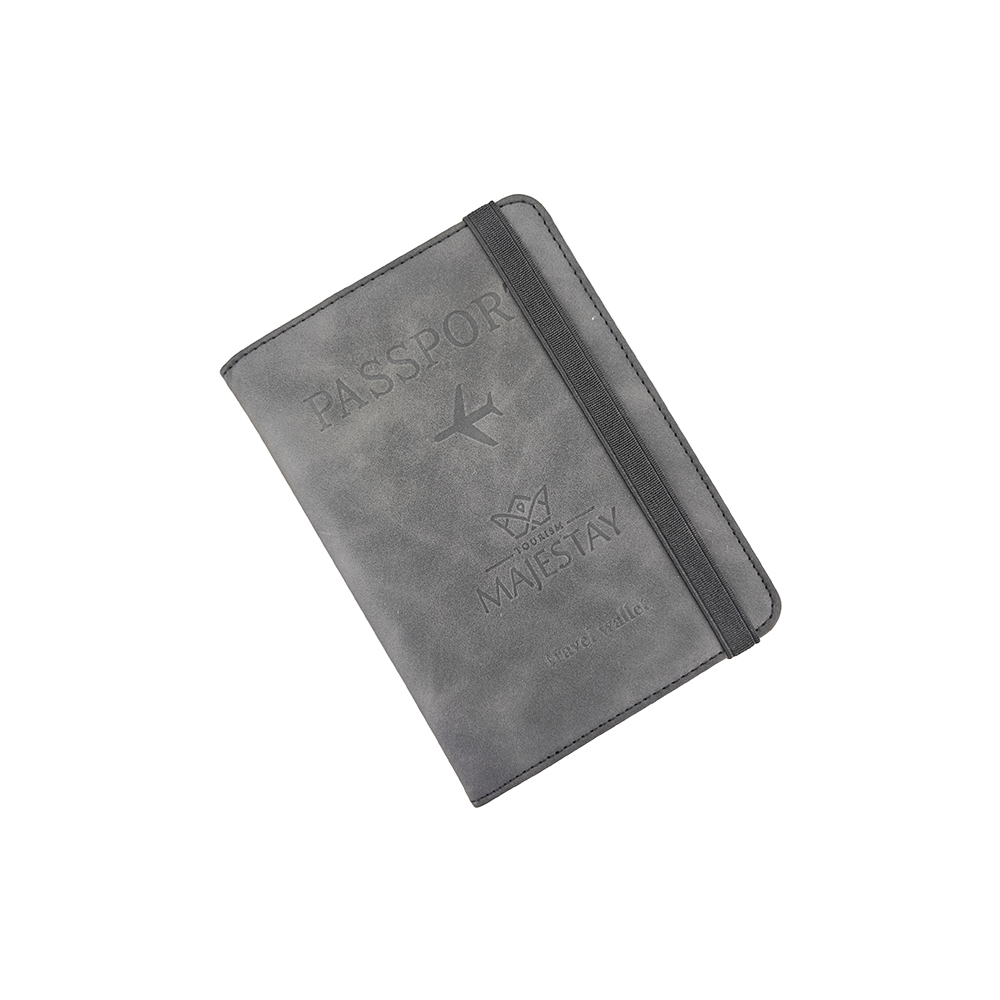
The folio photographed at an angle is a folio-format travel document wallet in mottled smoky grey with rounded corners, a full-perimeter stitch line, and a ribbed charcoal elastic band wrapping the cover to hold it shut. Its decoration is blind — debossed into the material rather than printed with ink: a descriptor word at the top, an aircraft silhouette, the emblem lockup, then a small product descriptor line near the bottom, all pressed as tonal impressions in the same grey family. Blind deboss is the quietest luxury move available on a welcome kit: nothing scratches off at bag-compartment friction because nothing sits above the surface.
Construction details matter more on a folio than on almost any other amenity, because it lives inside a carry-on sleeve under real load. The photographed piece shows a single row of evenly spaced stitch dots running just inside all four edges, matched thread, and a mottled vintage-distressed grain that hides thumb oils — a practical choice for an object that gets handled at every border checkpoint, not just admired at check-in. The elastic band is a woven ribbed band in charcoal rather than a thin filament loop: it keeps tension after months of being stretched over documents, and its tone is deliberately one step darker than the cover so the closure reads as a design element instead of a repair. Interior pockets are not visible in the frame, which is exactly how we would spec yours: document windows, boarding-pass slip and card slots, laid out to your sheet at artwork stage.
The sample cover text belongs to the hospitality client whose kit was photographed; your column, your crest and your descriptor line replace it one-for-one, and we can run a plain variant with deboss on the back panel only for properties that want the front face unmarked. Depth of the press is adjustable too: a shallow blind impression reads stationery-crisp, a deep one reads club-and-lounge. Paired with the luggage tag, the folio gives the program an arrivals-and-transfers story: welcome bag at check-in, documents and tag for the onward leg, tumbler that ends up in a gym bag for months. Each piece keeps printing the property long after the stay, which is the actual return on a per-guest gifting budget. For concierge desks, the folio also works inverted — debossed with the property crest on the back, left blank on the front — a configuration city hotels use when guests are expected to stash it in a jacket pocket rather than display it.
Logo Zones And Print Options
- Carrier bags: coated paper, twisted rope handles; emblem plus wordmark printed centre-front in metallic gold or flat white
- Vacuum tumbler: satin black body; one broad pad-print or screen-print position on the upper flank, lid left clean
- Grey notebook and box: gold emblem on cover corner and box centre; pen loop keeps a second micro position
- Black journal: cover emblem at lower left, or blank cover with laser engraving on the magnetic snap plate
- Click pen: one position on the grip barrel; clip band stays polished
- Travel folio and luggage tag: blind deboss columns, tonal stitching, matching elastic tones
- Crossbody bag and keychain: front-panel emblem; split ring and D-ring hardware in matching silver
- Colour alignment: black body, gold or white print per item, Pantone matched to your brand standard across the set
We reproduce your mark, never the reverse: the sample lockup printed across the photographed pieces belongs to the property that commissioned that run and does not appear in our copy, image descriptions or files we send you.
Reference Specifications
| Item | Hospitality welcome kit components — tumbler, notebooks, click pen, travel folio, carrier bag, accessories |
| Set contents | Configured per property; the photographed program spans two-piece desk sets up to the full amenity tray shown in the hero image |
| Materials | Coated stainless steel; PU leatherette covers with crosshatch or pebble grain; coated paper bags; metal trim in polished chrome or brushed silver |
| Colour | Black base programme with gold and white print positions; grey and smoky-grey accents as photographed; other Pantone colours on request |
| Logo | Pad print, screen print, foil stamp or blind deboss; laser engraving on metal plates and snap studs |
| Packing | Individual gift box or fitted tray, outer export cartons; inner dividers sized to component mix |
| MOQ | 100 pcs per design |
| Sample time | 3-5 days |
| Lead time | 7-15 days after artwork approval |
| Capacity | 1,000,000 pcs per month across our gift lines |
Ordering, Proofing And Working Backwards From High Season
A welcome-kit program is scheduled in reverse. Winter city properties and summer beach resorts both want inventory in place before their arrival wave, and freight space — not print speed — is the usual binding constraint. Work back from the date the first bag should sit on the bell desk: allow 7-15 days of production after artwork approval, then the transit window for your chosen mode. Sea freight suits volume replenishment booked ahead; air fills a gap when one property runs empty; DHL, UPS, FedEx or TNT move proof pieces and executive samples. A free digital mock-up places your crest on every photographed component so the buyer can see position and scale before anything is committed. Physical reference samples run 3-5 days when the item is one of the photographed standard pieces, longer when you are asking for a new colour or a non-standard print plate.
Artwork approval closes the spec. After that, changes restart the print-line queue, which is why we require the full component matrix — crest version, print colour, method per item — signed on one sheet rather than one email per department. Group hotels with several flags usually freeze the crest first and let each property order its own descriptor line second; that sequencing keeps shared components in one production batch while still letting the tower on the waterfront differ from the inland lodge.
Packing, Freight And FBA Prep
Components ship nested in fitted trays so metal trim cannot travel against print faces; rigid boxes are corner-guarded inside double-wall master cartons, and rope handles are packed flat to prevent creasing on the fold line. Carton marks, quantities and item codes follow your routing sheet so a receiving team at the property can palletise without opening boxes. If part of the program is sold through an online gift shop rather than handed over at a front desk, we pick, pack and label to FBA requirements directly from the line, so the welcome-kit listing and the physical shelf stay in step without a consolidation stop. Freight terms cover sea, air and the usual express couriers; the packing-stage reference below shows how a set leaves our floor before it is labelled, shrinked or trayed for a specific property.

Buyer Questions For Hospitality Programs
Can we order the welcome kit as mixed components under one MOQ?
Is the crest printed in the photographs your in-house brand or a client sample?
How do you keep the black matching across five different component categories?
We need restocking mid-season. What is a realistic replenishment window?
Can the tumbler and journal be sold separately in a gift shop as well as gifted at check-in?
What is the practical difference between the grey notebook and the black journal in your photos?
Related Gift Programs Worth Cross-Checking
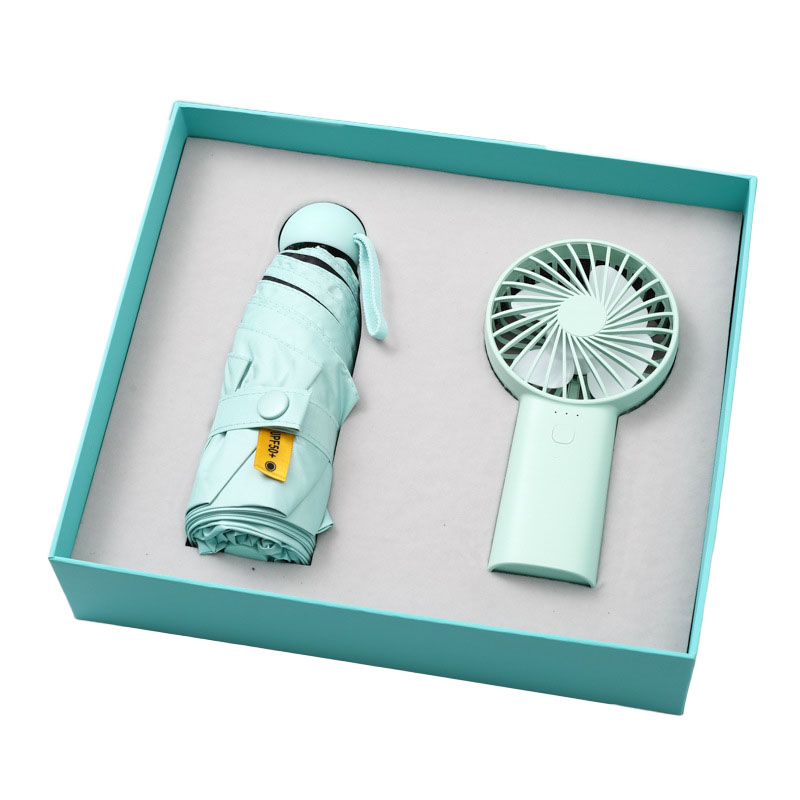
Before you close a spec, see how adjacent programs solve the same single-lockup problem: the full gift sets category covers every boxed program we run, and the box-packed gift sets shelf is the closest sibling to the tray format used here. For arrival-season bundles that add weather gear, the custom umbrella and electric fan gift sets page pairs a compact umbrella with a handheld fan in one coordinated box. The desk-heavy versions of this page’s components appear at the notebook, pen and flash drive executive sets listing, the drinkware-led variant at the tumbler, notebook and pen boxed set, and the seasonal desk-gift angle at the mug and warmer gift box. Institutional programs, including bookstore-retail apparel lines, run through the campus merchandise sets page.
Request The Welcome-Kit Quotation
Send the crest file, the component list you want in the tray and your first required date; the sales desk returns a tiered quotation, a digital mock-up across every component, and the production window that fits your calendar. Direct line: +86-15967739086, email [email protected], or work through the request-quote page. The form below reaches the same desk.