

Custom Water Bottle Gift Sets With Logo
$6.50
Box the bottle with what a desk actually uses: custom water bottle gift sets with logo pair a matte vacuum tumbler, a crosshatch notebook with a blank engraving-ready metal nameplate and a metal pen inside one fitted rigid box, with a shrink-sleeved lid and matching carrier bag for retail or gifting channels. Five photographed colourways — teal, forest, black, navy, royal blue — share one tray geometry and one artwork governance rule, and every third-party logo visible in our demo photography ships replaced by your file. Electrical display variants are quoted with full specification documents, never assumed. MOQ 100 pcs per design, samples 3-5 days, production 7-15 days after artwork approval; FBA prep available from the line.
Custom Water Bottle Gift Sets With Logo: Tumbler, Notebook And Pen In One Box
Drinkware-led corporate gifting works when the bottle does not travel alone. Custom water bottle gift sets with logo solve the packaging problem: the matte vacuum tumbler, the grained notebook with its blank engraving-ready nameplate and the metal pen sit side by side in one fitted rigid box, carrying one mark across three very different surfaces — coated metal, leatherette and print plate. The featured photograph shows the teal configuration exactly as it ships for a client who has not sent artwork yet: forest-green flask body blank, silver plate empty, pen barrel clean, box lid unprinted. Every centimetre that carries someone’s sample logo in the other photographs on this page is demo artwork from that client’s run; in your order those zones carry yours, at the coordinates your brand manager signs.
The commercial frame: 100 pcs per design minimum, free digital mock-up before tooling, physical samples in 3-5 days, production 7-15 days after artwork approval, and the displayed price anchoring the 100-piece tier of the three-piece box. USB-free, app-free, charger-free — this is the desk-and-hydrate pack that clears IT review by default.
What makes the trio format work operationally rather than just aesthetically is the tray. One insert holds three objects with different geometries — a cylinder, a rectangle and a rod — in fixed orientation, which means the logo on each one lands exactly where the mock-up said it would, every unit, every wave. Loose-component gifting cannot promise that: the bottle rotates in its own sleeve, the notebook gets flipped, the pen ends up behind the insert lip. The moulded cradle is the quiet quality-control device inside the whole programme, and the five desk-staged photographs on this page all show the same answer to the same question: what does your mark look like when nothing moves inside the box.
Two buyer archetypes order this page and they brief it differently. The procurement lead treats it as a program: one artwork file, a component matrix, replenishment codes, and a requirement that the March box and the September box be indistinguishable on a shelf. The event or marketing buyer treats it as a moment: a conference delegate pack, a close-gift for accounts signed in Q4, a batch of fifty that has to photograph well on a stage. The boxed trio serves both because the box itself is the deliverable — it converts three commodity objects into one occasion — and because the same line that runs a thousand-unit program can run a hundred-unit moment without changing tooling, only quantity. What the rest of this page does is make the invisible decisions visible: where the print sits, which surface wears first, how the insert holds under courier abuse, and what happens to your date if artwork slips a week.
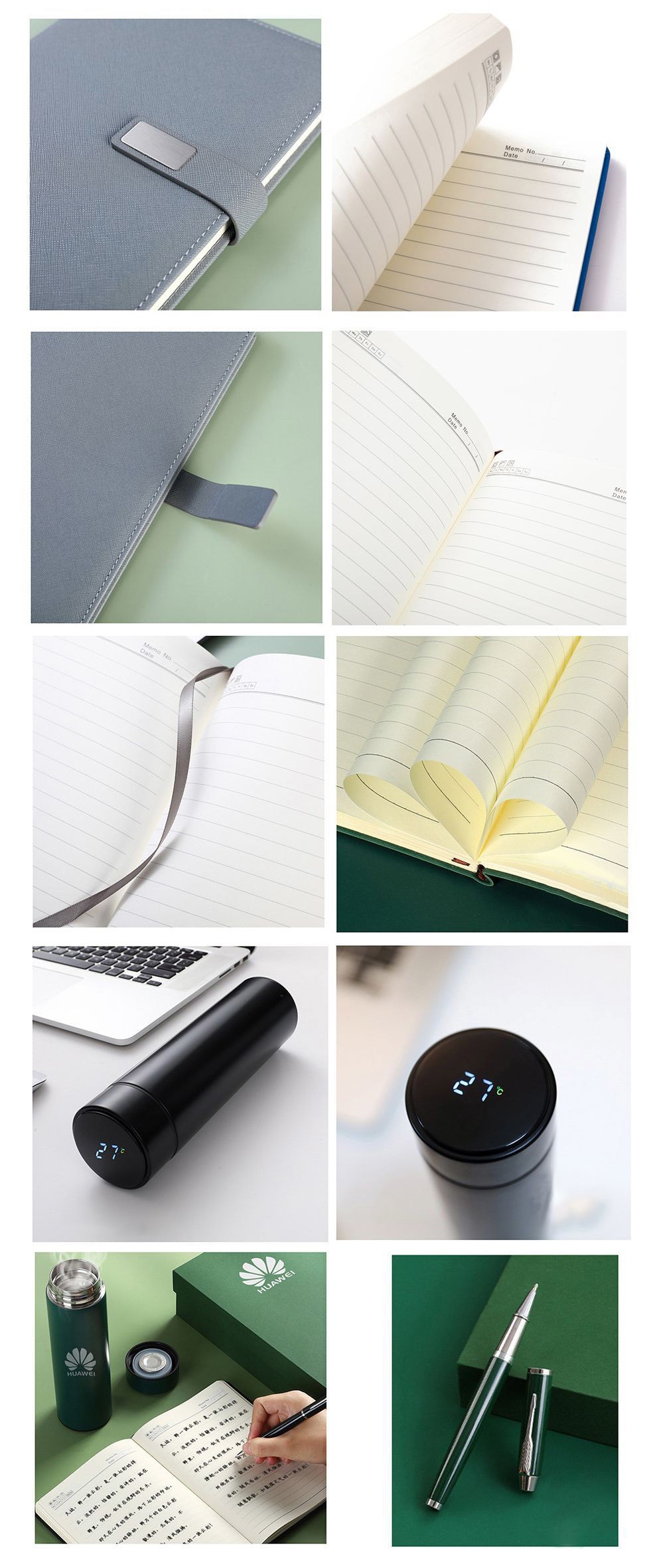
Read The Detail Strip Like A Specification Sheet
The tall image above is the engineering document of this product in ten panels. The notebook gets the first six: crosshatch-grey cover with white contrast stitching, the elastic closure band terminating in a blank brushed-metal nameplate — the same unprinted plate logic seen in the featured shot — then the interior, cream ruled pages carrying a header line for numbering and dating, a tonal ribbon bookmark and a flexibility demonstration showing the stock bends without cracking. Nothing surprising there, and that is the point: executive notebooks fail on warped covers and bleed-through, not on logos. The stitching shown in close crop is what keeps a grained cover from lifting at the spine after months in a bag, and the plate crop is the clearest view on this page of the surface you are buying — brushed, empty, ready for a laser pass.
Then the flask changes the conversation. One panel shows a black lid face lit with a digital temperature readout — the display photographed mid-demo reading 27°C — which tells you this tumbler family includes a touch-display variant: the lid reports drink temperature so a meeting-runner does not burn a tongue or discover lukewarm coffee an hour late. Because it is an electronic element, we state no battery, voltage or endurance figures on this page; spec and certification docs are quoted on request and appear in your quotation, not in marketing text. The final panels show the forest-green flask, its matching gift box and the green rollerball pen carrying sample client print — demo artwork illustrating the print field on the barrel, the flat face on the body and the centred lid position on the box, all zones your file replaces.
A detail worth reading off the strip before anyone asks you: the green pen’s cap is separated in its panel, showing a textured clip and a conical metal tip assembly — a rollerball format, not a throwaway stick. The green flask in the same column is photographed open with its inner steel wall visible and a separate black cap lying beside it carrying an internal mesh filter, which is the tea-and-fruit-infusion configuration; buyers who want the plain lid spec should say so at artwork stage because the cap tool differs, and swapping it after the mock-up is signed resets the plate queue. These are the two-component decisions that separate a catalogue purchase from a specification, and the strip exists precisely so a purchasing team can see them before the sample, not after the complaint.
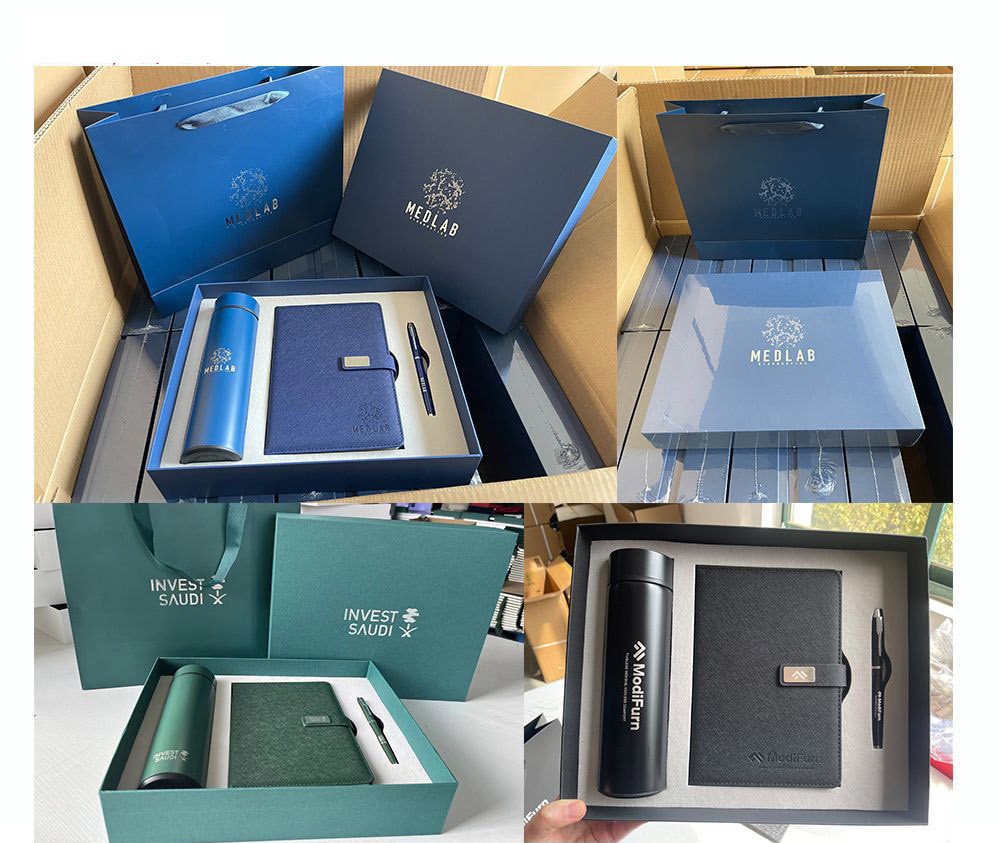
Three Colourways On The Packing Line
The four-panel packing collage is the most commercially useful image on this page because it is shot where money is actually spent: inside open export cartons, mid-fill. Royal blue shows open and shrink-sleeved states side by side — left panel the loaded cream-insert tray with bag and stood lid behind it, right panel the sealed box in clear film in front of its matching carrier bag, which is exactly how a retail-bound or FBA-bound unit leaves the line versus a gifting unit. Sage green shows the same staging with a palm-mark sample print in white. Black shows the grey-insert variant held in a hand, matte flask, debossed notebook corner mark, printed pen barrel.
Three client artwork files, one production system: every panel shares the same tray geometry, the same plate position on the notebook’s elastic band, the same barrel print window on the pen, the same centred lockup scale on lid and bag face. That is the sentence a purchasing manager should take to their brand team — the format is fixed, the identity is variable. The sample wordmarks visible in the collage belong to the accounts that commissioned those runs; they appear here as print-zone evidence and nowhere else in our copy.
Study the sleeve on the blue closed-box panel if you ship retail: clear film over a matte lid kills nothing visually and does two jobs — it keeps the lid on a friction fit during single-parcel courier travel, and it tells the shelf that the box has never been opened. The gifting variant deliberately skips the film because a committee unwrapping boxes at a table finds sleeve removal theatre annoying; this is a channel decision you make at order level, and both states are in the same collage so nobody has to imagine the difference. The bag in each panel matches box colour and carries the same centred mark as the lid — the outer-first impression rule from the zone list below, demonstrated three ways.
Note also what the cartons themselves say about volume discipline. Each export box holds a fixed set count with divider sheets, and the four-panel collage was shot at the pack-out stage of three separate client runs, which is how replenishment actually behaves: your first order ships in one wave, and the mid-year top-up ships from the same tray geometry and the same print screen in a later wave, months apart, visually identical on the shelf. Batch matching is enforced at the coating and leatherette roll level against the signed Pantone, not against the previous shipment’s leftovers, which is the only method that survives a component supplier change between waves without a visible seam.
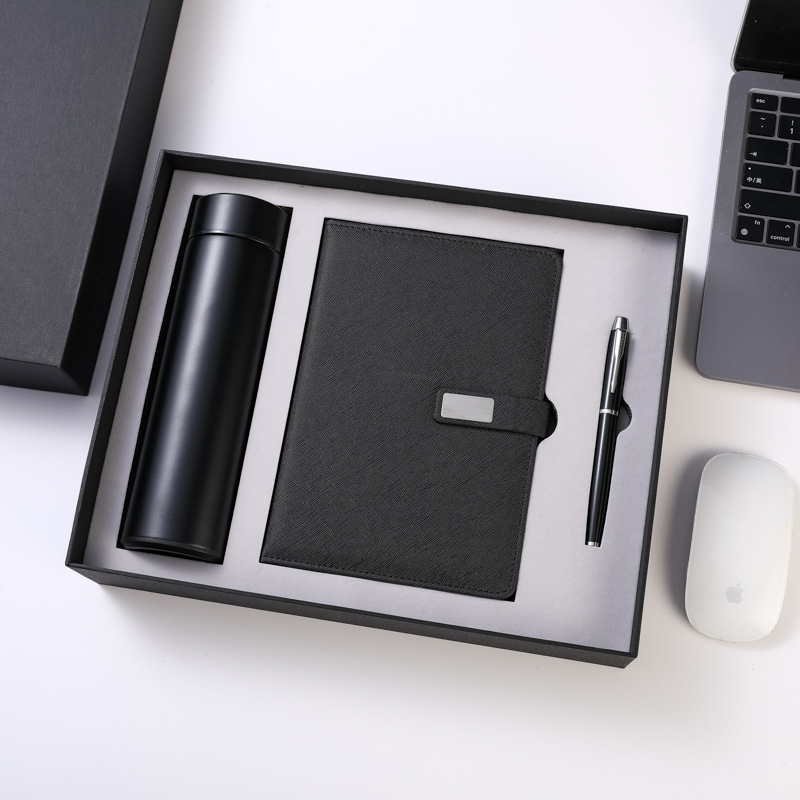
Why The Trio Beats A Lone Bottle
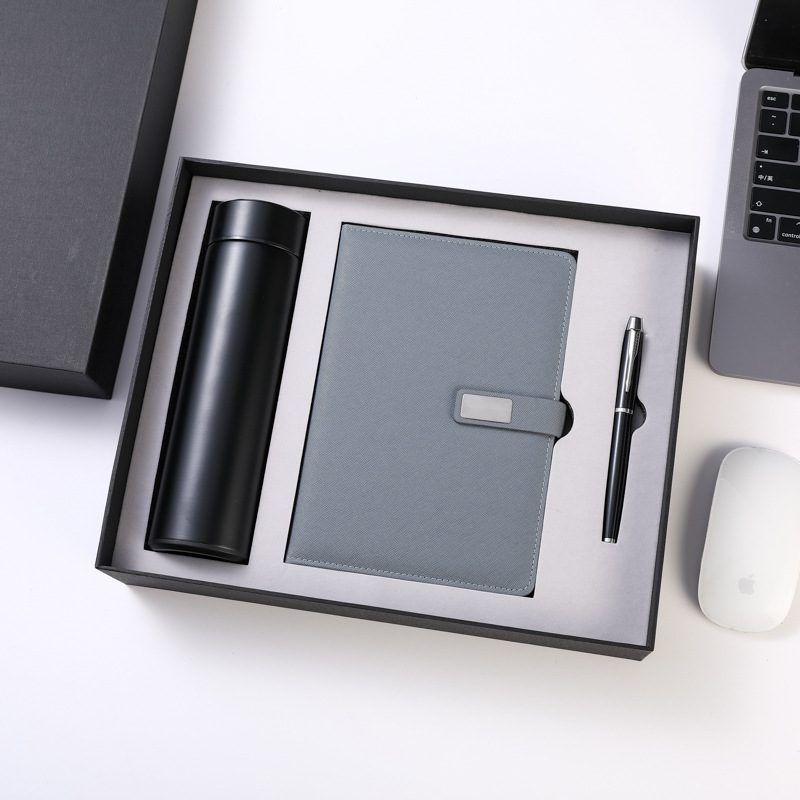
A solo branded bottle is a gym object. A bottle boxed with a notebook and a pen is an appointment object — it gets carried into the meeting it was gifted for. The black configuration above stages exactly that: open rigid box with the matte flask in its left recess, the journal centred, the pen seated right, all three blank and waiting, with a laptop corner and mouse in frame because the recipient’s actual desk is where the gift earns its budget line.
The insert geometry is doing quiet merchandising work. Three precision recesses plus semicircular finger notches mean every item lifts out by thumb without prying — an unglamorous detail until a board member fights a tray at a gala table. The cream insert reads premium against dark components; grey suits the black configuration; the mould is colour-matched per order, and a fourth recess for a drive or a stylus exists as an option for programmes that want the executive-pack crossover without moving to the stationery-only format.
There is a second-order effect to boxing the bottle that finance teams miss and facilities teams love: boxed sets do not get pocketed by accident. A loose crate of bottles at a registration desk invites grab-and-go re-issuing; the same bottles in named boxes with a lid are handed over as an item, counted as an item, and — this matters for per-head budgeting — photographed as an item for the post-event report. The box turns an expense into an artefact, which is why event buyers keep paying for tray inserts even when the components alone would satisfy the brief. For offices running a hybrid of both — loose bottles for the gym floor, boxed trios for the client floor — one signed artwork file spans both SKUs and the brand still looks like one organisation on both shelves.
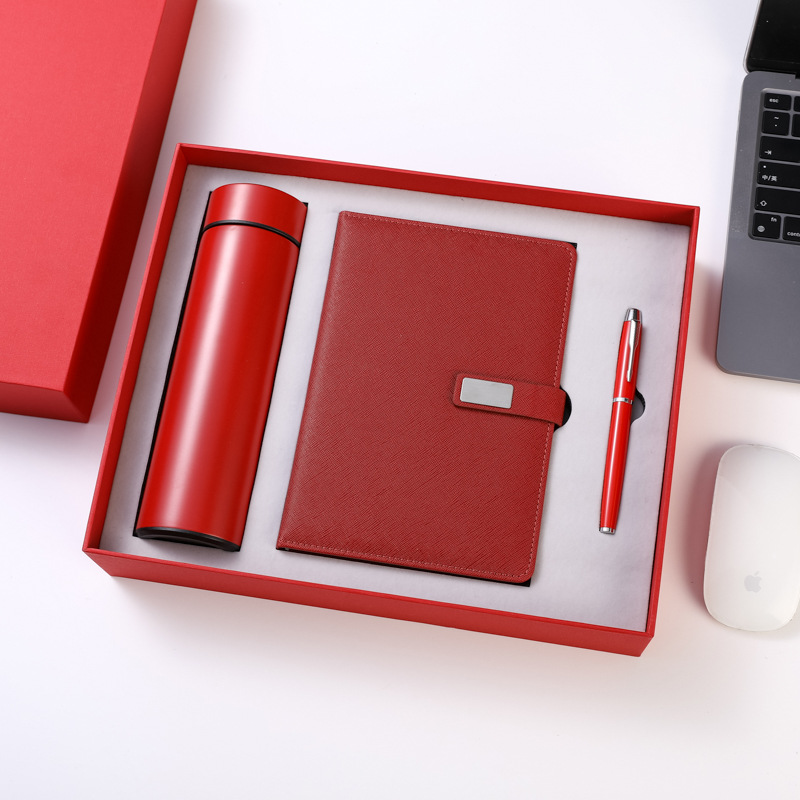
Colour choice across the four photographed configurations follows a simple institutional logic: teal and forest for green-palette brand programmes and general staff gifting, navy and black for finance, legal and executive client closes. Red, shown here as its own staging, is the recognition-and-holiday colour — the one that survives being left on a reception desk in a lobby full of grey bags. The matte powder-coat family flatters every one of them because it kills reflections in photography — your own merchandising shots will match our sample shots, which matters more than buyers expect when a gift shop starts reselling the program.
One staging habit worth copying from these photographs: the boxes are shot open with the lid set aside, not sealed. A closed-box listing sells a mystery; an open tray sells a decision. If your internal comms team re-photographs delivered sets for the year-end recap, shoot them the same way — tray up, three components visible, mark facing camera — because the format you approved at sample stage is exactly the format the photograph should defend.
Engraving And Print Zones
Everything on this page ultimately reduces to five printable surfaces and one rule: the mark scales by zone, never by object. A delegate sees the lid first, the bag second, opens the tray to find the plate at thumb height, the barrel under the clip and the drive face (where fitted) flat on the insert — five chances for the same file at five different physical scales, on coated metal, brushed metal, lacquer, leatherette and printed paperboard. That range of substrates is why one artwork approval here is worth more than five separate vendor sign-offs: each zone is proofed against the same vector, the same clear-space box and the same Pantone, and nothing gets “adjusted to fit” at the print bench. The list below fixes each zone and the methods it accepts; the zone diagram in the detail strip above shows where they sit physically on the objects.
- Tumbler body: single broad flat face — pad print, laser or wrap; matte coat shown holding white artwork crisply in every colourway on this page
- Notebook nameplate: laser engraving into the brushed metal at the elastic band; the blank-plate demo is the featured configuration
- Notebook cover: optional foil, deboss or clean; most programmes keep the cover tonal and let the plate carry the mark
- Pen barrel: one-position print or laser; clip and centre band stay polished hardware
- Box lid and carrier bag face: centred lockup, print or foil; the two outer zones a recipient sees before opening
- Temperature-display lids (where specified): no printing over the display face; side-of-barrel position kept clear of the sensor ring
- Insert tray: tonal moulding only, cream or grey per colourway
- Colour governance: one signed Pantone per programme across coat, leatherette, print inks and bag stock
Send a landscape and a stacked version of your mark with the enquiry and the mock-up shows both on the plate and the barrel side by side — most wordmarks that look fine on a website scale badly onto the plate’s small landscape field, and discovering that in the proof, not the pallet, is the entire purpose of the digital mock-up stage.
One governance note on multi-site programmes: when a group office orders the same trio for four subsidiaries, the trap is four slightly different logo files downloaded from four different intranets. We freeze one master at artwork approval — vector, Pantone values, clear-space box — and every zone on every unit derives from it. Subsidiary descriptor lines, if your brand rules allow them, are a second position at the lid, priced separately and shown separately, never improvised at the print bench.

Reference Specifications
Before the table, one orientation for anyone comparing this product across vendors: the specification that actually decides the delivered experience is the component matrix — which flask variant, which insert colour, whether a carrier bag rides in the carton, and whether the unit is shrink-sleeved. Catalogues that list only “set” without variant rows are where mid-order surprises live, so our own sheet itemises the same decisions below, and your quotation expands each row to your signed choices rather than replacing them.
| Item | Drinkware-led executive gift box — vacuum tumbler, notebook, metal pen, rigid two-piece box with moulded insert, optional carrier bag |
| Set contents | Three-piece as photographed; optional fourth recess for a drive or stylus; temperature-display flask variant where specified |
| Materials | Double-wall stainless with matte coat; PU-leatherette notebook over hardcover; metal pen with chrome trim; greyboard box, cream or grey moulded insert |
| Colour | Teal/forest, black, navy, royal blue and red configurations photographed; programme colourways matched to one signed Pantone set |
| Logo | Pad print, laser, foil or deboss; plate engraving on the notebook band; electrical-spec and certification documents quoted exactly on request |
| Packing | Boxed set with shrink sleeve or bare per channel, gift bag flat-packed alongside, export master cartons to routing sheet |
| MOQ | 100 pcs per design |
| Sample time | 3-5 days |
| Lead time | 7-15 days after artwork approval |
| Capacity | 1,000,000 pcs per month across our gift lines |
Two rows in that table deserve expansion because buyers routinely misread them. “Three-piece as photographed” means the carton contains exactly what the featured image shows — flask, journal, pen, box — and nothing else unless ordered; a fourth item is an addition we quote, not an assumption the factory makes to fill an empty recess. “Temperature-display flask variant where specified” is a fork in the product: the standard lid is a plain screw cap, the specified variant is the touch-display head photographed in the detail strip, and the two travel different compliance and freight paperwork even though they share the barrel. If your organisation needs written electrical spec or destination docs before approving a variant, request them at sample stage — spec and certification docs go out quoted on request, and we would rather hand them over with a sample than explain them after a purchase order.
The final configuration decision that surfaces late and costs a week: whether the carrier bag ships inside the same carton as the boxed trio or loose in a separate bundle. Gift teams want bags pre-inserted because volunteers at a gala table should never be assembling; retail teams want bags separate because a bag folded against a shrink-sleeved box scuffs the film. State the packing channel once at artwork approval and it holds across every replenishment wave — the routing sheet, not memory, carries it forward.
Scheduling A Hydration Programme Around The Calendar
Water-bottle boxes peak on the same three dates every year: onboarding cohorts in September and January, client-appreciation runs before the December shutdown, and conference inventory locked to an event city. Each one fails differently when it is late — a cohort that gifts nothing, a client list that receives January gratitude in March — so the scheduling rule we give every buyer is the same: final artwork in hand ten weeks before the date that matters, mock-up approved inside week two, physical sample signed inside the 3-5 day window, production 7-15 days after approval, and freight mode chosen by the date, not by the budget line. Sea carries a full programme cost-effectively when booked against the calendar; air covers a slipped conference; DHL, UPS, FedEx or TNT covers the ten units that must be at a keynote on Thursday.
Packing, Freight And FBA Prep
The packing collage above already shows the shipping truth: cartons full, inserts loaded, lids either stood for the gifting configuration or shrink-sleeved for retail. Boxes travel in master cartons with divider sheets between layers so a lid’s printed face never rests on a neighbour’s corner; carrier bags ride flat in separate bundles; flasks ship capped with the display face oriented to your artwork spec so orientation errors die at pallet-build, not at unboxing. For programmes resold through an online storefront, FBA pick-pack-label runs from the same line — barcode application on the shrink sleeve, carton quantities to Amazon routing, no third warehouse touch. Freight terms: sea, air, express, EXW or FOB as your forwarder prefers, quoted against the routing sheet you send.
Two freight realities deserve naming for programmes with immovable event dates. First, display-lid variants travel as documented electrical goods in most air lanes: paperwork rides ahead of the pallet, and an undocumented carton can sit in a destination bonded store while a conference runs without its delegate gift. Build the document set at sample stage, when changing it costs a re-print of one sheet, not at customs, when it costs the event. Second, ceramic-adjacent rules do not apply to the coaster body but do apply to winter lanes: a container crossing a frozen port can sit below the threshold where gloss print and adhesive sleeves behave badly, so cold-route programmes should ask for insulated inner liners at order level — a carton choice, visible in the routing sheet, invisible in the price until someone needs it.
Finally, the unglamorous re-order note every programme eventually writes itself: keep your signed master file, your Pantone set and your routing sheet on one record with us between waves. Reorders that reference a code ship like the first unit; reorders rebuilt from a logo someone downloaded off a website in 2019 ship like a surprise. The stored file costs nothing and forgives everything.

Buying Questions For Drinkware Gift Boxes
Who owns the logos printed on your sample photos?
Does the temperature-display lid need charging, and what are its specs?
Can I order the three-piece box without the notebook, or the bottle alone in the same artwork?
Which print method survives dishwasher-adjacent use on the matte coat?
How does the plate engraving look different from printing the notebook cover?
What does the price shown on this product actually cover?
Related Boxes Worth Comparing
For stationery-first programmes that want the same blank-plate logic without the flask, the notebook, pen and flash drive gift set is the sibling page; hospitality welcome trays built around one lockup live at custom hotel welcome gift sets; campus programmes covering apparel through drinkware run through university promotional gift sets; and the seasonal desk-warming box is the mug and warmer set. The wider gift sets index and the box-packed shelf collect the rigid-box range; weather-gear combos sit at umbrella and fan gift sets.
Put Your Mark On The Blank Plate
Send the logo file, the colourway and the required-by date. You will receive a line-itemed tier quote, a mock-up across flask, plate, pen, lid and bag, and a sample window of 3-5 days. Electrical components, if chosen, arrive with full spec and certification documents quoted exactly on request. Contact: +86-15967739086, [email protected], or the request-quote desk — the form below reaches the same team.


