Custom Single-Bottle Wine Gift Paper Bag With Rope Handles
$1.00
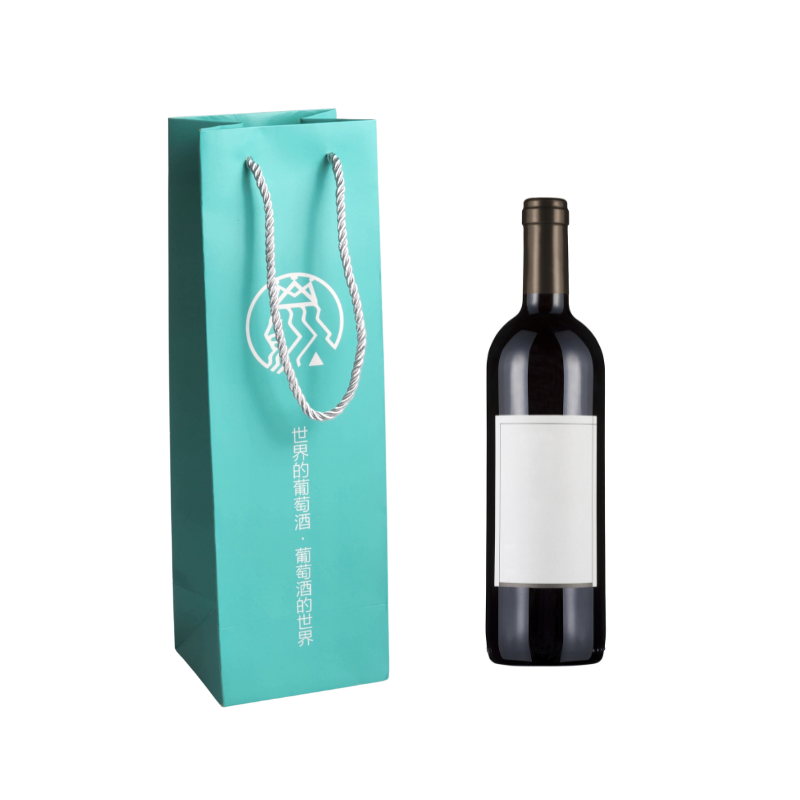
A tall, narrow paper carrier cut around one standard 750 ml wine bottle — teal coated face, pale inner wall, white twisted rope threaded over the rim, hot-foil or printed emblem where your label belongs. Built for wineries, liquor retail, weddings and corporate gifting, where the dieline is fitted to your actual bottle before any tooling.
MOQ: 100 pcs per design; colourways and seasonal artwork split freely on a shared die
Timeline: free digital mock-up first, physical proof in 3-5 days, bulk in 7-15 days after artwork approval
Yours to specify: custom size, 250 gsm ivory board (kraft and specialty on request), PMS-matched print, matt or gloss lamination, foil emblem / spot UV / embossed crest, cord colour
Packing: assembled bags, 100 pcs per sleeve or box in export cartons; DHL / UPS / FedEx / TNT, sea and air freight, FBA labelling supported
The listed price is a reference rate at the 100-piece tier — request a quote against your bottle dimensions and quantity.
Cut Around the Bottle, Not Around a Catalogue
Most wine packaging complaints trace back to one mistake: a bottle dropped into a bag that was sized for something else. A 750 ml bottle rolling loose inside an oversized tote knocks its label against the glass on the way home, tips over at a wedding reception table, and photographs badly in a marketplace listing. This carrier is engineered from the opposite premise — a tall, straight, narrow body drafted around a single bottle footprint, so the glass stands upright, the label stays facing forward, and nothing shifts in transit from our pallet to your customer’s shelf.
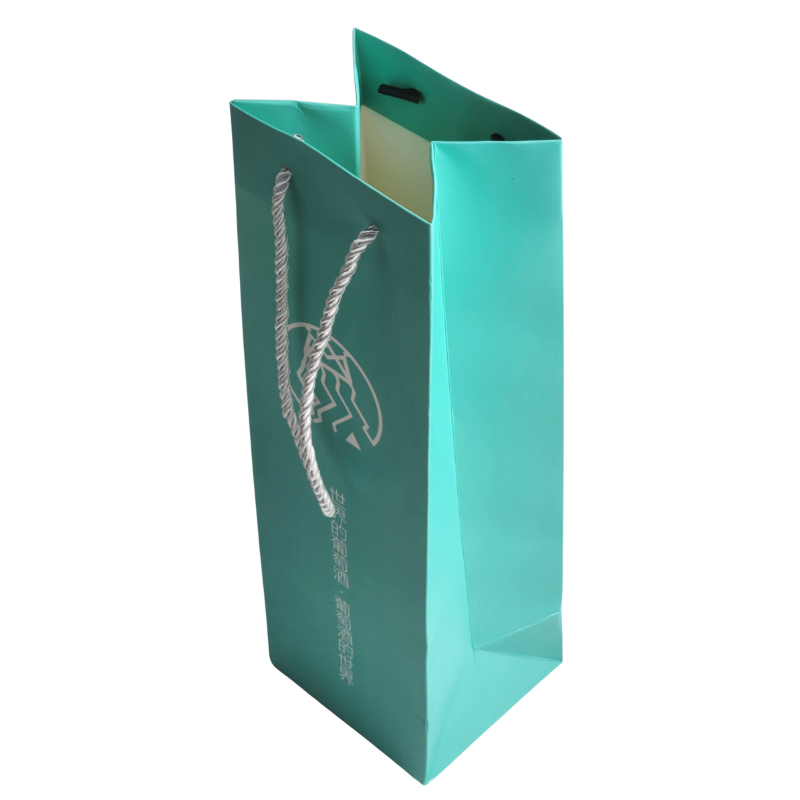
The photographed sample states the recipe plainly. A teal coated face panel with a round metallic emblem centred under the rim; a column of display type balancing the lower corner; a pale inner wall that flashes at the mouth; white twisted rope threaded over the top edge and looping free. Every graphic element on it is one customer’s brand, not ours: on your order, the same zones carry your emblem, your wordmark, your colour. The silhouette itself — narrow, vertical, gift-shaped at first glance — is what sells this format at weddings, cellar-door counters, tasting launches, hotel gifting desks and corporate year-end allocations.
Reference format fits one standard 750 ml wine bottle; every dimension recut to your bottle.
What You Decide Before a Die Is Cut
Send the bottle itself or its technical drawing, and we draft the dieline around the footprint: shoulder angle, base diameter, body height, capsule clearance at the neck, and how much air the bag keeps around any filler, divider or tasting glass going in beside the bottle. That drawing — not a dropdown of stock sizes — is the real deliverable of round one, and iterating it on paper costs nothing before steel touches board.
- Body fit – Bordeaux, Burgundy, sparkling, spirits or sake formats; single-bottle depth adjusted millimetre by millimetre, with twin-bottle bodies quoted as a separate die on the same design file.
- Paper – 250 gsm ivory board as standard; kraft and specialty textured stocks quoted on request when the brand wants visible fibre at retail.
- Colour – CMYK printing with PMS matching, so the teal on the foil capsule and the teal on the bag read as one brand under shop lighting.
- Surface work – matt or gloss lamination over the print, plus hot foil stamping for the emblem, spot UV on the wordmark, or an embossed crest where ink-free texture is enough.
- Rope – white twisted cord exactly as photographed; black, natural-tone or brand-dyed cord as swaps, satin ribbon available on request for wedding colour schemes.
- Inner wall – the pale lining shown is printed on the inner faces, not a separate insert; specify contrast, tonal or fully covered interiors at the same one-job price.
- Logo placement – emblem up top like the sample, wordmark centred, or full-panel artwork; free design support returns a digital mock-up mapping your label onto this silhouette before any tooling starts.
Buyers comparing suppliers on this format should ask one question above the rest: who draws the fit? A factory offering three fixed sizes will load your bottle into whichever is closest and still call the job custom. We quote from your footprint precisely because a stock measurement is a gamble taken after delivery, not a decision taken before it.
What the Second Angle Proves
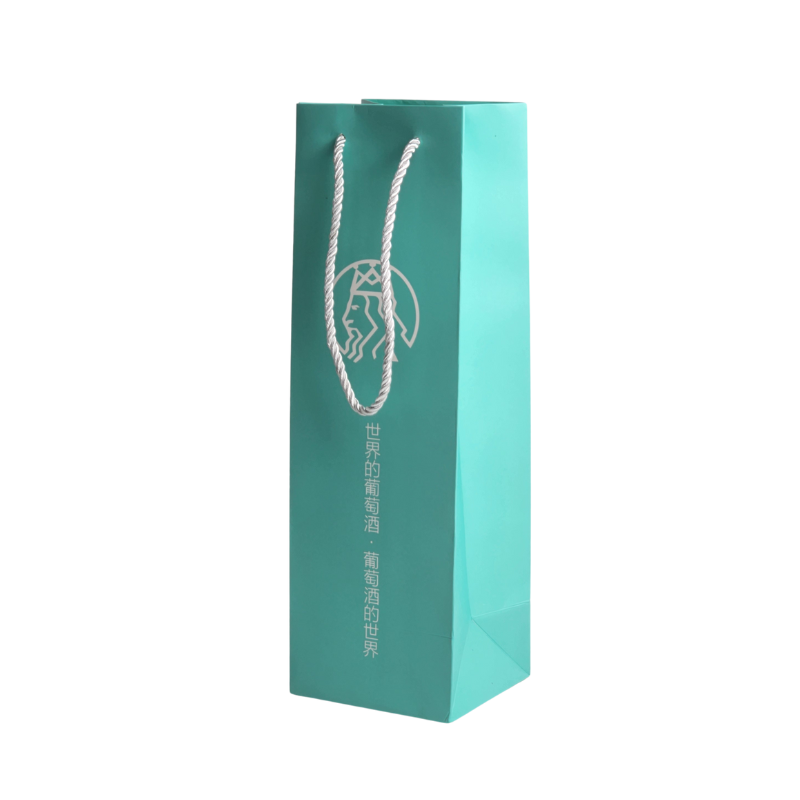
The three-quarter view matters for a reason beyond styling. It exposes the folded side gusset — the narrow depth that lets a round bottle sit inside a flat-fronted body without the panel bowing outward. Depth is the dimension shoppers never measure and always feel: too shallow and the bag strains around the shoulder; too deep and the bottle swims sideways whenever the bag stands upright. On the sample the gusset fold is crisp, the rope loops fall clear of the crease, and the bag holds its vertical line even unloaded.
That upright posture is a shelf-life asset for retail. Liquor shops display one-bottle carriers on hooks and counter edges where a slouching bag reads cheap at arm’s length. Weighted board, a glued flat base, and a mouth opening narrow enough that the cord pulls the panels gently closed all contribute to a column-straight silhouette from stockroom to checkout — and each of those variables is adjustable on your spec sheet, not inherited from ours.
Watch the way the white cord falls in this second view: the loops stand proud of the rim instead of flattening against the panel, which is what a correctly gauged twisted rope does under its own memory. Buyers photograph bags for their own catalogues and marketplaces, and a handle that kinks or folds flat in every shot quietly costs listings. The three-quarter angle is also where a bad gusset crease shows up — paper that whitens along the fold, a corner that puffs, glue bleed at the base seam. Our samples ship with both this angle and the straight-on view for that reason: you need to approve what the camera sees, not only what the bottle feels.
Specification Table for This Carrier
| Item | Custom Single-Bottle Paper Wine Gift Bag |
| Construction | Tall straight-sided body, glued flat base, folded side gussets, rope over the rim |
| Size | Custom dieline; reference format fits one standard 750 ml wine bottle; every dimension recut to your bottle |
| Paper | 250 gsm ivory board standard; kraft and specialty stocks on request |
| Printing | CMYK; PMS colour matching available |
| Finish | Matt or gloss lamination; hot foil, spot UV, embossed or debossed logo |
| Handles | White twisted rope as shown; colour and material swaps |
| Packing | 100 pcs per poly bag or inner box, then export cartons |
| MOQ | 100 pcs per design |
| Sample time | 3-5 days |
| Lead time | 7-15 days after artwork approval |
| Capacity | 1,000,000 pcs per month across our bag lines |
Proof, Press and the Two Tests That End Disputes
Two physical checks settle almost every argument before it starts. First, the fit test: slip the real bottle into the real sample bag, lift it by the rope, set it on a table, and watch where the label sightline lands when the cord pulls taut against the rim. If the mouth folds across the emblem, the die gets adjusted — a ten-minute change on paper, an expensive one after fifty thousand sheets have run. Second, the colour test: the teal in this photograph is a press-checked match, not a screen value, and phone displays around your buying committee will disagree with each other long before the proof lands in the mail.
Quote the packed weight with your enquiry, too. A filled bottle plus foil capsule is roughly 1.3 kg at retail, but a gift set carrying a stemmed glass or a corkscrew changes the load on the cord anchors completely. Rope gauge, anchor spacing and internal reinforcement all get sized at proofing stage against your number, never guessed later from a generic chart. Larger liquor formats in particular deserve a weight note in the first email, not in the final revision round.
Wineries, distillers and gifting teams are the natural repeat buyers on this line: a wedding run in spring, an anniversary release mid-year, a corporate allocation before the holidays, all cut on the same die with fresh artwork each round. Mix label variants freely — each design opens its own 100-piece line, so three seasonal artworks mean three design counts, not one inflated minimum. Shared-die economics keep reorders cheaper than first orders because the tooling already lives in the rack.
Board Grades We Actually Cut
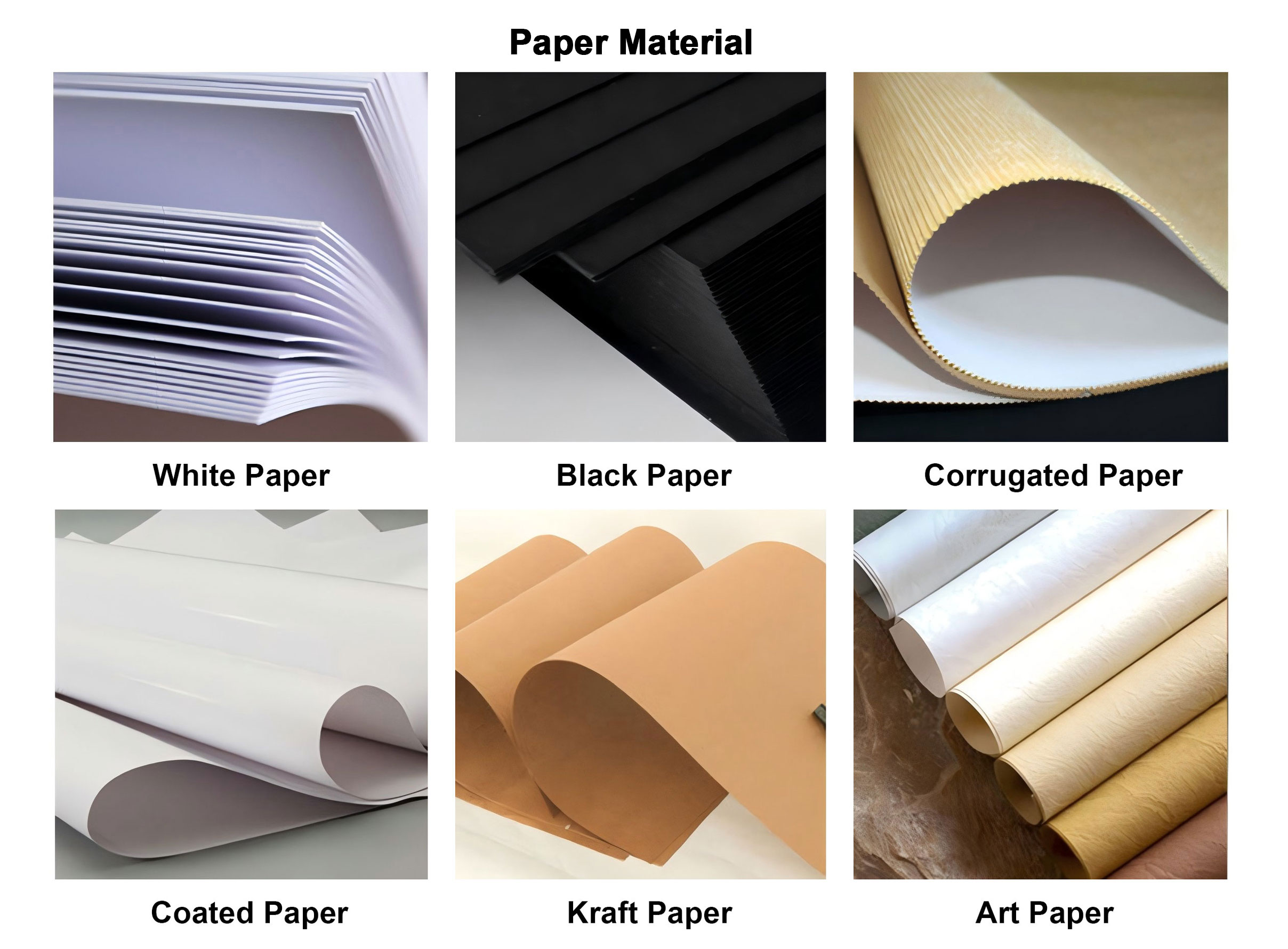
The reference chart below is cutting-room reality rather than a datasheet: coated white boards that take saturated print, uncoated boards for a matte tactile read, kraft in natural and brown tones, and textured specialty faces that trade print sharpness for hand feel. For bottle carriers specifically, the board does two jobs at once — it carries the ink and it acts as the shock layer between the glass and the world outside. 250 gsm ivory board handles both at normal gift quantities; heavier boards or a laminated duplex build get quoted when the format grows toward magnum dimensions or the fillers go inside the bag instead of beside it.
Cord, Rope and Load Behaviour at the Rim
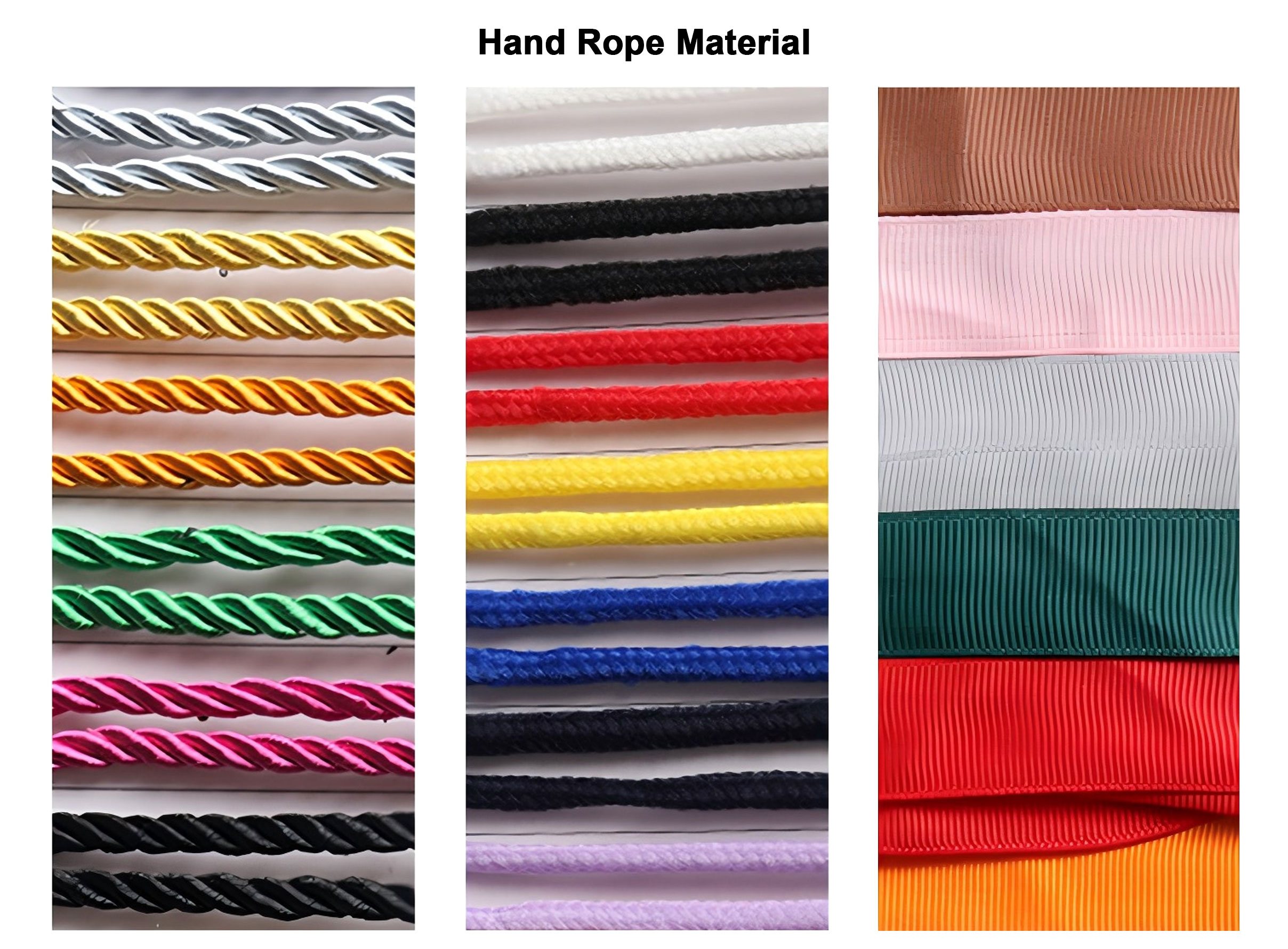
A wine bag handle fails in one of two places: the cord itself, or the paper the cord pulls against. The first is a material choice; the second is a construction question most quotes skip entirely. Twisted polycore cord like the white pair photographed gives diameter and grip without stretching, which matters when a bottle’s full weight sits on two short loops at carry height. Braided rope reads more nautical and trades a fraction of strength for sheen; satin ribbon looks luxurious at a wedding but should never be specced for anything heavier than a single light bottle; flat printed cord is the cheapest option right up to the moment it cuts into fingers under load.
We match cord gauge to your packed weight at proofing, and thread every handle so the bearing surface is the folded lip of the board rather than a single paper ply. Inside the mouth, each cord ends in a knot pressed against the inner wall, bedded into glue, parked well below the rim line so nothing rubs the foil capsule on the way in or out. That anchoring pattern is standard across the bag line, and it is exactly what the sample photographs demonstrate when the loops hang slack: the load path runs from the cord, into the folded lip, down both walls — never onto a glued seam at the gusset fold. Bags that fail at trade shows fail there, not in the rope.
Two more rim details decide whether the carrier survives a gift-wrapping season intact. First, the folded lip itself: a doubled-over edge distributes the cord’s pinch across a wider band of board, and it is the difference between a bag you can lift twice a day for a year and one that tears at the eyelets by December. Second, thread length: cord cut too short pulls the mouth into a pinched grin when the bag hangs, which looks careless in wedding photography and lets the bottle lip sit at an angle; cord cut too long drags on the floor when the bag is set down. Both get resolved at proofing with the actual bottle inside, which is precisely why the 3-5 day sample step exists and why skipping it to save a week before a launch date usually costs the launch anyway.
Consider also what the cord does on the carrying arm. A thicker twisted rope spreads the same 1.3 kg over more of the hand than a thin ribbon concentrates into a single cutting line, and that ergonomic difference is felt at the second bottle on a market run, not the first. Corporate gifting buyers who hand carriers out at conferences routinely spec up one rope gauge for exactly this reason: the cost per bag is trivial, and the impression the bag leaves on the walk from the venue is not. The same logic applies in reverse for light formats, where a slim satin ribbon reads more elegant than a heavy rope would ever look on a 375 ml half-bottle.
The chart below lays the families out side by side: twisted cords in a full colour run, braided ropes at two diameters, and flat ribbons for light-duty gift work. If a wedding package pairs the carrier with matching ribbon on the place cards, that same ribbon can trim the handle without changing anything structural, since the knot sits under the rim either way. Cosmetic cord swaps never move the sample timeline; the structural ones — heavier gauge, doubled anchors, a wider folded lip — get decided at the fit-test stage, before the approved mock-up becomes a plate.
Order Flow: Mock-up, Proof, Production
The path runs artwork or logo file → free digital mock-up mapped on the bottle-bag template → your sign-off on colour and dimension → physical sample in 3-5 days → bulk production in 7-15 days after artwork approval. The sample clock and the production clock are tracked as two numbers, never merged into one reassuring blur, so an event date keeps real working room between proof and pallet. Monthly output across the bag lines is 1,000,000 pcs, which means one client’s holiday surge does not queue behind another client’s launch.
The figure listed on this page is a reference rate at the 100-piece tier. Your exact unit price moves with size, board choice, cord type, foil coverage and total quantity; hand us those details and the quote lands as one document, with no separate artwork or set-up charge on standard customisation. Rush windows, split shipments and branded filler quotes all hang off that same line item, because the dieline is already drawn once you clear the first mock-up.
Packing, Freight and FBA Prep
Carriers ship assembled — bases formed, cord anchored at our end — then nested and counted at 100 pcs per poly bag or inner box inside export cartons matched to your pallet plan. Nothing arrives as a stack of flat blanks for store staff to fold before opening hours. Freight goes by sea for carton volume, by air for hard launch dates, or by express courier (DHL, UPS, FedEx, TNT) for samples and small replenishment runs. FBA labelling and prep are supported when stock should land inside an Amazon fulfilment centre rather than at your warehouse door, with carton counts and weights declared against your shipment plan so nothing gets refused at the gate.
Sourcing Questions on Single-Bottle Carriers
Will the bag fit Burgundy or sparkling bottles as well as Bordeaux?
Can one purchase cover three seasonal label designs?
Which handle cord colours can I choose besides white?
How fast can a physical sample reach my desk?
Is the price printed on this page what I pay for volume?
Do you deliver straight into Amazon fulfilment centres?
Related Bag Formats on the Same Line
Buying beyond the bottle size? The pastel boutique carrier with gold rope handles runs the same construction in a general retail format, character-led artwork prints cleanly on our full-colour cartoon shopping bag, and the wider custom luxury paper bags category collects every silhouette we cut, from die-cut handle carry bags to ribbon-top gift formats. Everyday retail shapes sit one level up in the printed paper bags range.
Price Your Bottle Format

Send bottle dimensions, packed weight, target quantity and the delivery date your event needs through the form below — or drop this carrier into the quote request list to combine several bag styles in one enquiry. You will hear back from the production team with unit pricing, a dated schedule and a digital mock-up showing your label on the bag. WhatsApp / Tel: +86-15967739086 | Email: [email protected]