Custom Removable Vinyl Stickers | Repositionable Decals
$1.20
Custom removable vinyl stickers built for surfaces you do not own: repositionable die-cut packs for shop windows, rented laptops, water bottles and campaign signage that must peel clean on teardown day. Photographed samples show low-tack behaviour in a fingers-off-the-pile close-up, a fourteen-design spec drawing with printed inch call-outs, lifestyle panels on surfboard, tumbler, suitcase and laptop lid, and a house feature graphic whose printed claims – repeat stick-down cycles, no residue – your signed sample verifies on your real substrate before bulk. Adhesive tiers and dwell expectations get matched to window, device or bottle use at mock-up stage. MOQ 100 pcs per design, free digital mock-up, samples 3-5 days, bulk 7-15 days after artwork approval, FBA prep and DHL, UPS, FedEx or TNT express freight available.
Custom removable vinyl stickers solve a problem permanent decals create: everything they touch. Renter-occupied laptop lids, leased shop windows, trade-show panels, campaign signage that must vanish after polling day – none of them want glue residue. This page is about the low-tack side of our decal line: die-cut pieces that stick today, reposition tomorrow, and lift clean when the promotion ends. The construction is provable from our own photos, including a supplier infographic that prints the handling claims directly on the artwork; we quote against it, confirm on a sample, and only then commit a bulk batch.
Three facts to carry into your RFQ before anything else. Low-tack stock is sold by dwell time: weeks behave differently from months, months from a full year on hot glass – so the removal date belongs in the brief as firmly as the quantity. The lifestyle photographs on this page show where these packs actually live: a surfboard nose crowded with overlapping die-cuts, two drink tumblers, a suitcase wearing stickers like badges, a laptop lid with no bare patch left. Every one of those surfaces is smooth, rigid and clean-release, which is precisely the environment removable adhesive is engineered for; textured or porous surfaces are a different conversation, and we will have it early instead of after pallet one. And repositionability is a repeatable behaviour, not a one-time trick: the adhesive graphic printed in this gallery says the pieces can be stuck repeatedly and lift without residue, which is the target your signed sample will verify on your window, your lid, your tumbler. Get those three straight at mock-up stage and the rest of this page is just factory paperwork.
The economics follow the same logic as any consumable print program. A campaign kit lives or dies on quantity spread rather than depth: four storefront messages at 100 pcs each is a smarter first order than one message at 400, because a campaign that gets extended reuses the winning artwork and a campaign that flops leaves you with nothing to return. The die-line that cut message one cuts message four, so multi-variant orders share tooling cost across the set. And because removable decals rarely survive teardown intact – curled corners, stretched vinyl – the adhesive tier is chosen assuming the piece dies at the bin, not at the surface. Plan your spare ratio accordingly: teams that expect to lose five percent to early peel-away order their opening minimum plus the buffer, and the buffer costs cartons, not commitments.
What “Removable” Means on Our Press, Piece by Piece
Removable is an adhesive decision, not a material sacrifice. The face film, ink and contour cutting match our standard decal line; the difference sits between the sticker and the surface. A low-tack adhesive grips smooth panels firmly enough for a product to travel in a bag or a window to survive a rainy week, then releases cleanly under a fingertip’s corner lift.
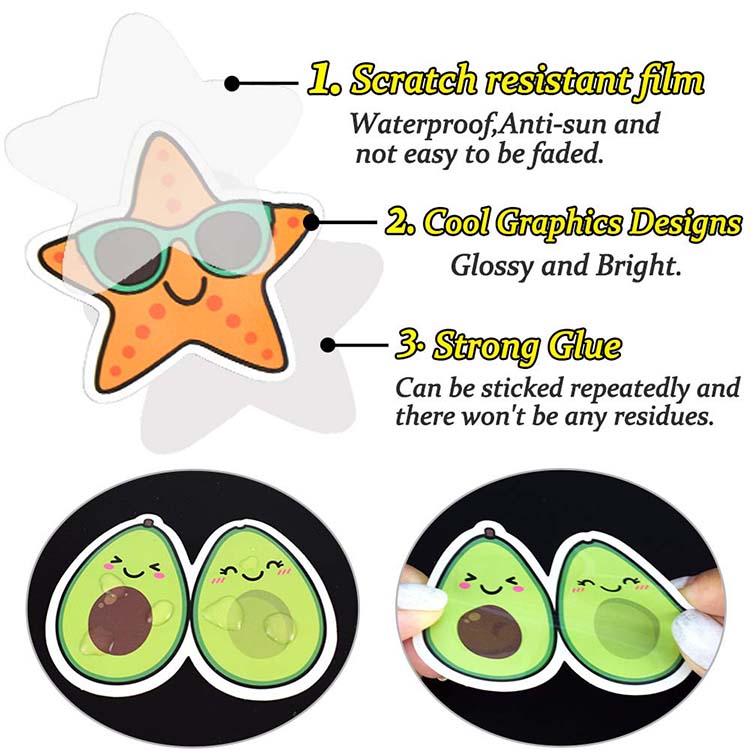
The Claims Our Own Artwork Already Prints
The feature graphic above is our house infographic, and it is unusually useful for a purchasing conversation because the supplier puts its claims in print where a buyer can photograph them: a scratch-resistant film over the graphics, waterproof and anti-sun behaviour with fade resistance, and a strong-but-clean glue that can be stuck repeatedly and leaves no residues behind. Read them the way a quality manager should. The laminate line is about the face: the print lives under a clear film, which is what keeps a laptop-cluster decal legible after a school year of sleeve friction. The sun line is about outdoor campaigns that outlive their poster week without turning pastel artwork into grey artwork. The glue line is the whole point of this page – repeat cycles, no ghost on the glass. Those photographed words describe the target behaviour of this line; the exact film and adhesive grade your job lands on gets confirmed on the signed sample before bulk, per surface.
The two example designs chosen for that infographic – a dotted starfish in sunglasses and a pair of blushing avocado halves held between two fingers to show the cut edge flexing – are themselves instructive. The avocado pair demonstrates why contour-cut vinyl can be bent across a fingertip without cracking the ink layer, which is the property that lets a decal wrap a tumbler’s gentle curve; the starfish demonstrates the laminate’s gloss, visible as a highlight streak across each sunglass lens in the photograph. When your artwork review arrives, ask us for the flex-and-wrap demonstration on your own file: same press, same film, your silhouette – the decision it settles is worth one extra sample sheet.
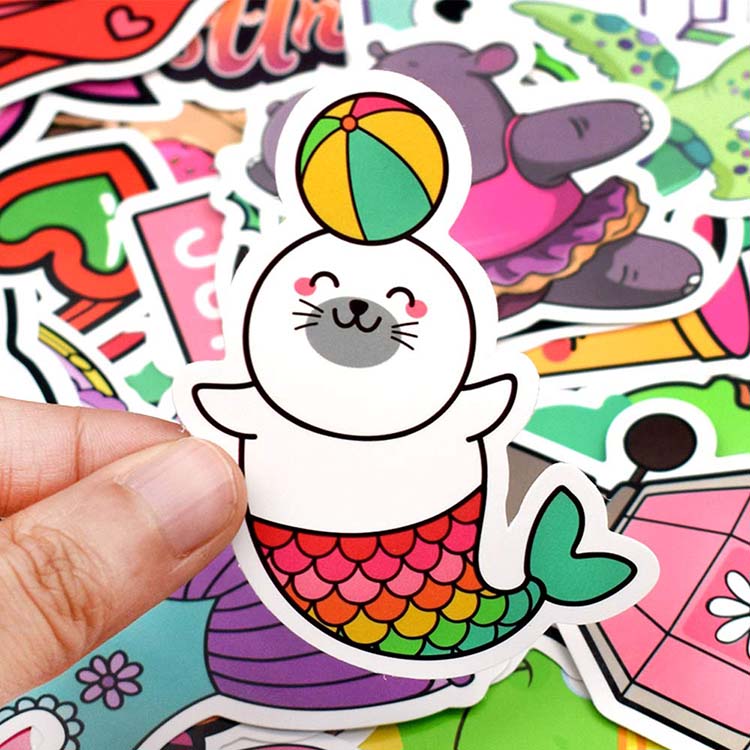
The pile photo opens this page for a reason: removable packs are bought as variety. Forty-odd cartoon shapes, every one a separate contour cut with a white keyline, so a customer can move a design from laptop to water bottle to planner cover in an afternoon without committing the surface. Resellers of laptop and bottle merch reorder this format constantly precisely because the peel-and-reposition behaviour keeps the artwork circulating on fresh devices instead of dying on one trade-in.
Two quality checks worth writing into your receiving notes before a removable order ever ships. First, peel a corner on five pieces from different corners of the carton: the release should feel even, not crumbly, and the piece should hold its shape while lifted. Second, stick a piece down, leave an hour, and try it on a second surface – repositionability is a two-cycle property, not a one-cycle promise. A pack that passes both tests has an adhesive window your end customers will describe in reviews without being prompted, and organic review language about clean peels is worth more than any listing bullet point a brand can write itself.
Expect these checks to be uneven, and plan for it: the release force of a low-tack adhesive varies a few percent batch to batch the way paper weight does. Our quality lane keeps a fixed dwell timer and a reference plate on smooth glass, so a run that releases too early gets caught at the reel, not in a customer’s window. If your program leans hard on long dwell times – a month on exterior glass, a season on a laptop lid – flag it at quotation and we grade the adhesive up inside the same removable family rather than letting a standard campaign stock do a permanent job’s shift.
Renter-Safe, Deposit-Safe: Where Low-Tack Decals Earn Their Keep
Three buyer types keep this line busy, and none of them is looking for a permanent decal. First, the short-run campaign pack: election volunteers, store-opening weeks, campus tours – signage that has an expiry date written into the brief and must come off shared tables, rented storefronts and school laptops without a scraping crew. Removable adhesive turns teardown from a damage bill into a fifteen-minute job.
Second, the retail gadget shopper. The lifestyle set on this page shows exactly the surfaces that matter: a surfboard nose plastered with a dense cluster, two insulated tumblers, a pink hard-shell suitcase, and a laptop lid covered edge to edge. On rented or resale-considerate equipment, buyers want the option to wipe the personality off before trading the device in. A removable die-cut gives that; a permanent one costs the deposit.
Third, window work. Interior-facing shop glass, mirror panels and glass-door coolers take printed promotions the same week they take them off, and a clean-peel decal means the pane returns to saleable condition without a razor blade. For anything sun-baked on exterior glass, tell us the exposure before quoting – we will steer that job to a different film grade rather than let a low-tack sticker cook.
One operational reality these three audiences share: teardown timing is unforgiving. A campaign pack that peels at 80 percent of its pieces is a win; a store window that still shows adhesive ghosts on opening morning is a disaster no discount repairs. That is why the removable line carries its own proofing ritual – the peel test described further down happens on your actual substrate, at the dwell time your real schedule needs, before a single bulk sheet prints. Event teams ordering after a bad rental-wall experience arrive sceptical; they leave with a signed sample and a repeat order, which is the only sequence that has ever worked for this product.
Teardown logistics deserve a sentence here because they decide pack design. A store-opening team of five applies decals in an hour; the same team removes them in fifteen minutes if the pieces were applied flat and cornered for lifting, and in three unhappy scraping hours if they were stretched around bezels and handles. We build campaign packs with removal in the artwork brief: keep contours simple near gaskets and seams, avoid layering five pieces on one spot, and photograph a “before” corner so the teardown crew can find the lift point in seconds. None of that is manufacturing – it is layout advice we give for free at mock-up, because the brands that plan their teardown sell their next campaign early.
Reading a Lifestyle Set Before You Commit an Adhesive
The four-panel application photo below does more work for a purchasing decision than most spec sheets. It shows the same decal family living on four very different substrates: a surfboard nose carrying a dense overlapping cluster, two insulated tumblers with single hero placements, a hard-shell suitcase with pieces scattered across the face, and a laptop lid finished edge to edge. Each surface tells the buyer something different. The board proves the artwork survives sun, salt and handling abuse without lifting. The tumblers prove small counts read as design rather than clutter. The suitcase proves loose placement stays put through airport belts and stacking. The full-coverage laptop proves a low-tack adhesive can still hold an entire lid under repeated bag friction.
Now translate that into procurement terms. If your campaign targets windows and rented laptops, this set is the proof of use-case. If your product is a retail bottle decal that rides a dishwasher, none of these panels is your argument – that belongs on the permanent-stock page. Buyers routinely misuse removable stock on high-abuse surfaces and blame the glue; matching the panel you are buying against the surface you actually own is the single cheapest quality-control step in an RFQ, and it happens before the plate, not after the pallet. The peel action itself is the second hero of this gallery: fingers lifting a single white cartoon seal off the pile, die-cut edge visible, backing flexing, nothing tearing. That one gesture is the product promise of the whole line.
Photographic proof has a legal cousin here too: when your marketplace listing claims “removable, no residue,” the listing is now a promise with your supplier’s sample behind it or in front of it. Keep the signed sample and its date logged against the listing copy. When a dispute arrives – and marketplace disputes arrive with screenshots – the batch that matches a documented peel test settles in one email instead of one removal notice.
For retail buyers, the four-panel set doubles as shelf photography, and it explains why removable packs are merchandised as lifestyle rather than as labels. Your own listing can borrow the same structure – device first, sticker second, scene third – without a factory test report anywhere in frame, because the surfaces themselves carry the credibility: a lid nobody is afraid to decorate, a suitcase that is going to travel, a tumbler that is going to sweat. When you request packaging design alongside the decals, we lay your header card out in exactly this visual grammar: hero device, four surfaces, one peel instruction line, and the removal date field left for the shop to write in with a marker. Campaign operations people love a blank they can hold a pen over; it tells them the supplier has thought about Tuesday, not just the invoice.

Confirmed Sizes, Because Removable Packs Are Bought to Fit
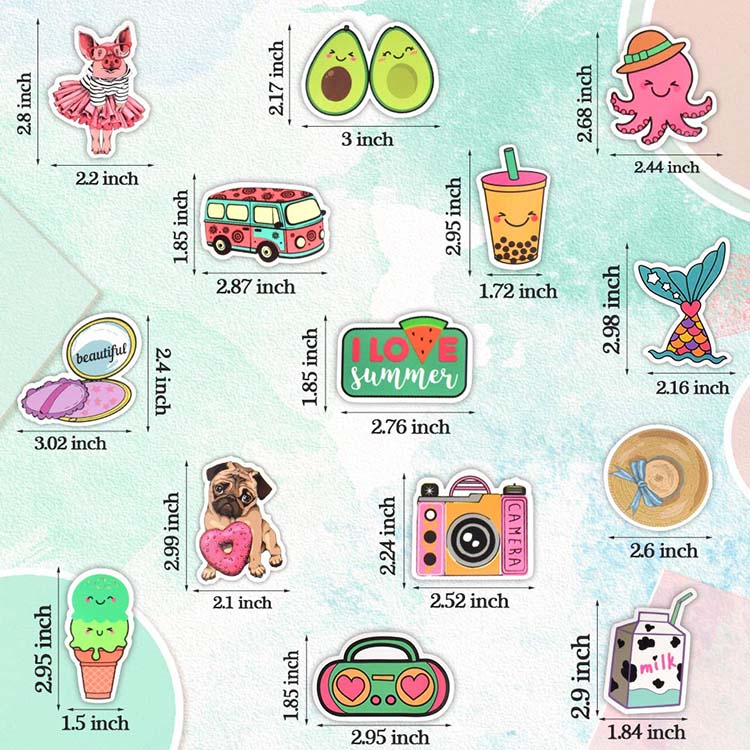
The specification drawing in this gallery is the most useful photo for procurement: fourteen cartoon layouts, each bracketed by printed dimension arrows with inch values. The call-outs on that sheet run from roughly 1.5″ on the narrowest cone shape to just over 3″ on the widest – a compact, tumbler-and-laptop-friendly range. That is the practical sweet spot for removable work: big enough to read at arm’s length, small enough to survive being tossed in a bag. Your own silhouette can be cut anywhere between a thumb-sized mini and a 6″ feature shape, priced from your file; the photographed sheet simply proves what this product family looks like when dimensions get specified honestly.
Dimension honesty is not a small cost topic for removable packs, because scale governs the failure modes. A two-inch decal on a tumbling water bottle rarely edges; a three-and-a-half-inch panel on the same curved wall has twice the shoulder geometry fighting its adhesive, and the removable tier – designed to release – is the first to oblige. If your artwork demands a large single piece, either flatten the surface it meets or move to the permanent line and accept the removal trade-off later. Conversely, campaign packs made of many small shapes cover a window visually while each individual piece stays inside the safe peel envelope. The spec drawing on this page exists because the brands who understand that relationship order their size sets deliberately, at the mock-up stage, instead of learning it at teardown.
Two handling notes worth knowing before you print. Kiss-cut sheets keep repositionable pieces indexed on their backing, which classroom and event-staff distribution prefers over loose piles. And if your removable pack targets cold-drink tumblers, mention condensation in the RFQ: the film and ink in these photos handle it, but the adhesive tier is the variable, and we would rather pick it deliberately than discover it in week three.
Roll formats change the math again for this family. Removable stock wound on a core suits window-installation crews who squeegee long banner strips; the same low-tack film in loose packs suits the laptop counter. One adhesive, two delivery shapes, two price curves: rolls carry winding and core cost per metre but cut handling time on big glass, packs carry hand-feel and shelf appeal but would be absurd for a six-metre storefront valance. The dimension drawing on this page is grid-sheet artwork, which is what most campaign buyers start with; once your mock-up is approved, ask what the same file costs in each of the three formats and let the install crew’s workflow, not the sticker, pick the SKU.
Build Your Removable Pack: What We Customise
- Artwork silhouette: any contour die-cut, plus circles, ovals, rounded rectangles and shields
- Size set: one scale per run, or mixed packs spanning pocket minis up to 6″ feature shapes, quoted from your artwork
- Format: loose packs, grid sheets, or roll winding for counter dispensers
- Adhesive: standard removable tack; a lower-tack window grade for glass that must stay scuff-free
- Face film: matte-to-satin as photographed; gloss and laminate options quoted on request
- Ink: CMYK plus white underprint for transparent zones on the artwork
- Finish extras: corner rounding on cards, header-card printing for retail shelf packs
- Artwork prep: vector files preferred; raster redraw and keyline setup at proof stage, included
Spec Snapshot: Low-Tack Removable Stock
| Parameter | Standard build on this line |
|---|---|
| Item | Custom removable die-cut vinyl stickers for laptops, bottles, windows and campaign signage |
| Size | From 1″ mini to 6″ wall decals quoted on request; a photographed spec sheet marks 1.5″-3″ shapes per design |
| Stock & Finish | Printed vinyl faces, matte-to-satin as photographed; gloss and laminate options quoted on request |
| Cutting | Contour dies and kiss-cut sheets; loose counts or roll winding |
| Printing & Artwork | Four-colour with white underprint; send clean vectors or we rebuild them at proof stage |
| Packing | Loose packs bagged, or sheets interleaved; counted into export cartons; retail header cards optional; FBA labelling done in-house |
| MOQ | 100 pcs per design |
| Sample time | 3-5 days |
| Lead time | 7-15 days after artwork approval |
| Capacity | 1,000,000 pcs per month across our gift lines |
Order Flow: Proof, Peel Test, Production
Start with artwork or a reference image; a free digital mock-up comes back showing scale, cut line and sheet layout against your stated surface. Physical samples follow in 3-5 days, and on this line we insist one extra step matters: the peel test. Stick the sample to your actual window, laptop shell or tumbler, leave it a week, lift a corner. If residue or edge-lift shows up, the adhesive tier gets changed before approval is signed – not after. Bulk production then closes in 7-15 days from artwork approval, and capacity across our gift lines reaches 1,000,000 pcs per month, so campaign reorders keep the same window as first runs.
Campaign buyers with five artwork versions and eleven days to launch: mix 100 pcs per design and the order is 500 pieces, not one deep bet. Short-run flexibility is the reason this format outlives printed flyers in event budgets.
Packing and Freight
Removable decal sheets ship in the same disciplined stack as every line here: individual packs or sheets bagged against abrasion, inner boxes counted to your pack-out, master cartons protected for palletised freight. Because campaign dates are unforgiving, this product ships express more often than the durable line: sea freight for restocks, air and DHL, UPS, FedEx or TNT for launch-critical cartons. Orders routed to Amazon get FBA labelling and prep in-house, so the cartons arrive checkable at the dock without a prep-center detour.

Removable-Line Questions, Answered Plainly
Will these leave residue on glass or painted walls?
How long can a removable sticker stay up before it stops peeling clean?
What is the minimum order, and does a multi-design pack raise it?
Can I get the same artwork on both removable and permanent stock?
How fast can a short campaign window get stock?
Related Lines on the Same Order Desk
Everything above prints inside our wider sticker catalog, which sits under the general printed items range alongside matching notebook, card and gift-packaging production. For jobs where the decal must outlive the product – bottles that see dishwashers, luggage that sees tarmac – the permanent-stock sibling, durable vinyl decals, owns that argument instead. Wedding and gift-wrap projects cross to metallic foil sheets, planner brands order weekly task-icon sheets, and kids retail leans on kawaii food die-cuts. When your spec list is ready, the quote form needs surface, quantity and campaign date – nothing else.
Party-programme add-ons print in the same building; browse the party items category before you split freight across two suppliers.
Send the peel-test surface photo with your first email. It shortens every answer that follows.