Custom No-Iron Fabric Labels | Clothing Name Sheets MOQ 100
$1.10
Custom no-iron fabric labels for clothing, built for daycare coat checks and school clothing lists: pressure-applied name label sheets with assorted ovals, rectangles and wide fields, writable blanks or printed names from a class roster, packaged as hang-top blister retail packs or flat polybag refills. The photographed retail sample prints washer, dryer and water-resistance icon captions; we ship a 3-5 day physical sample so you publish only what your own test proves. MOQ 100 pcs per design, free digital mock-up of the sheet grid, bulk 7-15 days after artwork approval, private-label header cards and FBA prep available, sea, air or express courier freight to your season gate.
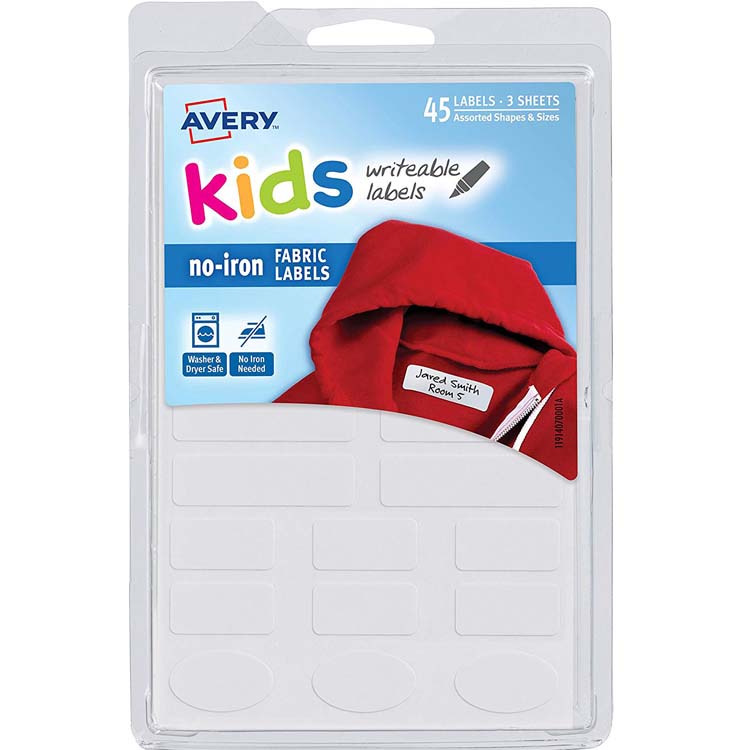
Custom no-iron fabric labels for clothing, built for the daycare and school clothing routine: every jacket, hoodie, backpack and spare shirt entering a shared wardrobe needs a name that survives the week. The photographed retail format is the one parents know – a hang-top blister pack of pressure-applied white labels in assorted shapes and sizes, rectangles in two widths plus ovals, all blank and ready for a marker or a printed name. No sewing, no iron, no heat press: the label sticks to the garment surface and stays. We produce your version of that SKU – private label, your shapes, your sheet count, your retail card – starting at 100 pcs per design.
Why Pressure-Applied Beats Sew-In and Iron-On
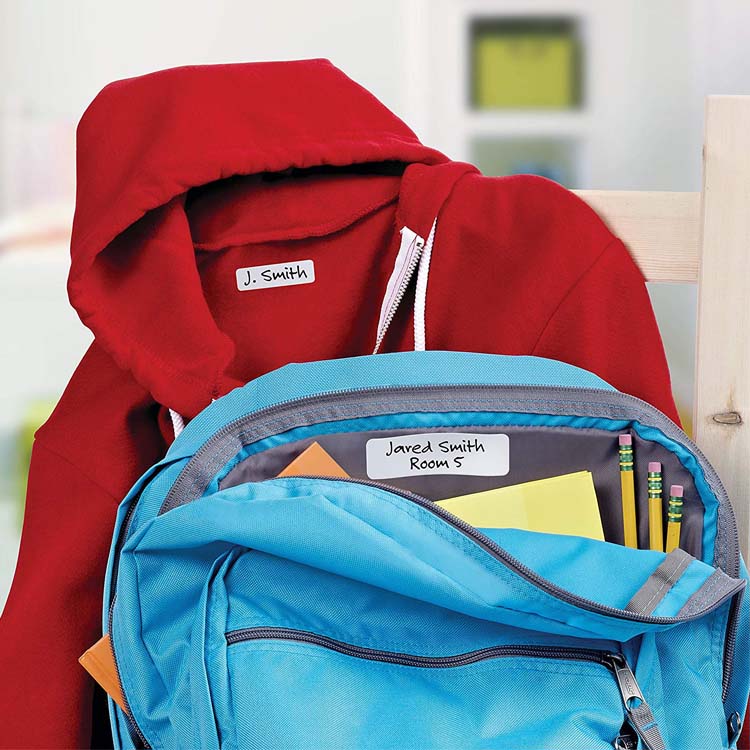
Three application methods exist for garment name labels, and each fails a different buyer. Sew-in labels need labour and a needle – a nursery cannot staff that per child. Iron-on transfers need a hot press or iron and a heat-tolerant fabric – wool jackets, fleece and nylon shells are exactly what a winter coat check receives. Pressure-applied fabric labels need neither: peel, press onto the inner seam allowance, care tag area or label pocket, done. The sample pack demonstrates the placement logic visually – a white label sitting flat in the inner collar of a red hooded fleece – which is the shot every retail listing for this category carries. For schools and daycare chains that issue uniform lists seasonally, the no-iron SKU also removes the compliance argument: nothing hot, nothing sharp, nothing sewn into a child’s clothing.
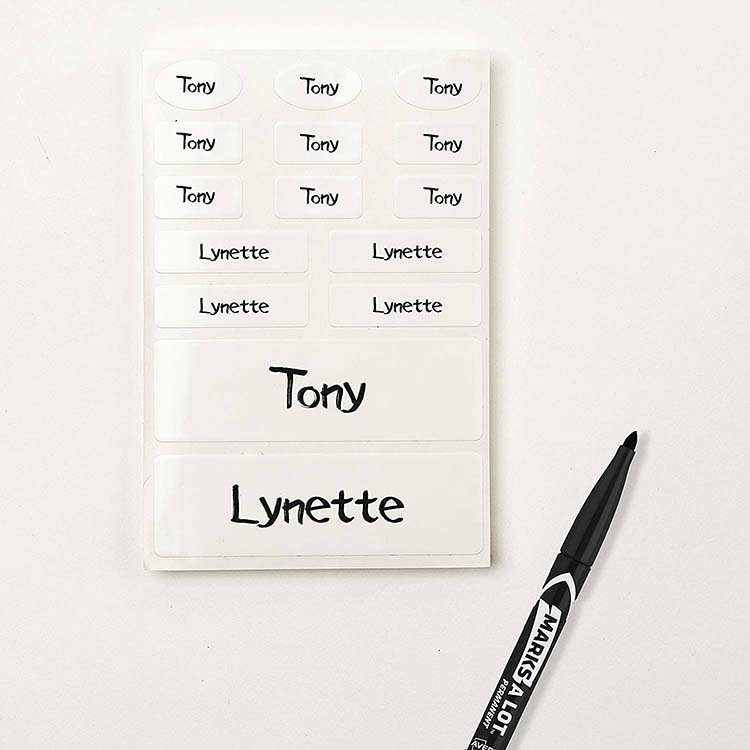
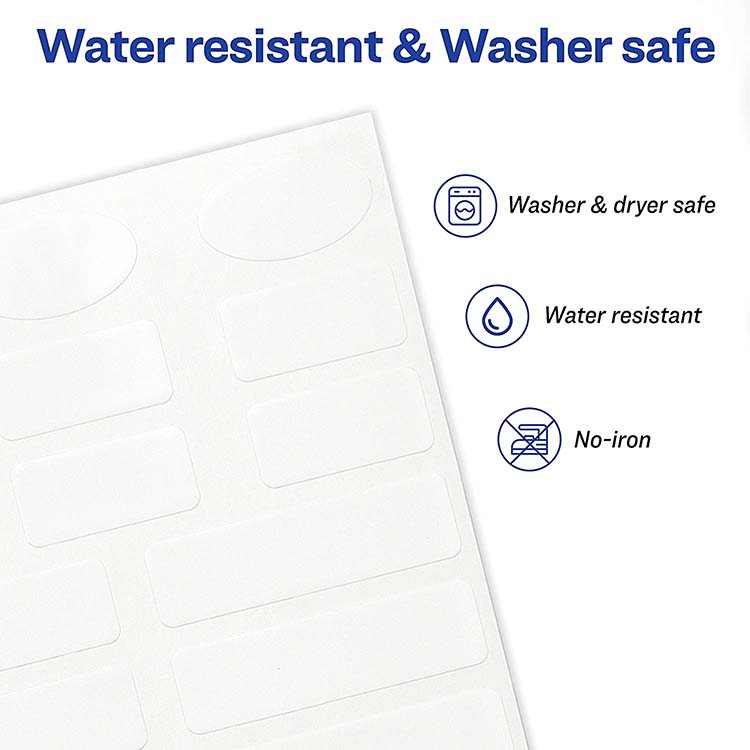
Sheet mechanics matter more than the pack looks like. The photographed sheet stacks fifteen labels in a tidy grid: an oval row, small rounded rectangles in two columns, wider fields, and full-width banners at the bottom – one name per garment, sized to where it lands. Collar tags take the small field; backpack panels and coat linings take the wide one. Assorted-shape sheets mean one SKU covers the whole wardrobe instead of three, which is what the parent on a school list actually wants.
Blister versus polybag is the other sheet-mechanic decision, and it changes your buyer. The hang-top blister reads as a single purchase at a school fair or supermarket aisle – visible label count through the shell, hang hole on a peg, no box to open. A flat polybag refill reads as stock: cheaper per carton slot, easier for a facility that orders ten at a time for its intake packets. Retail brands usually run both from one sheet die-line, swapping only the card, so the back-to-school window and the standing-order channel share artwork.
The daycare angle deserves its own paragraph because it changes the pack, not the print. A facility that runs a coat peg per child buys differently from a parent at a school fair: they want one sheet per enrolment packet, names printed at intake, and a spare-sheet slot for mid-year additions. Both routes run on the same die-line; the intake version simply swaps blank fields for roster-printed names, which is a spreadsheet, not new artwork. Uniform lists issued seasonally do the same thing on the retail side – a school can stamp its crest onto the pack header and sell the sheet as official kit without touching the label layout.
Wash-Cycle Claims: What the Photos Print vs What We Quote
On the photographed retail pack, two icon tiles print the claims shoppers scan for – a washer symbol captioned Washer & Dryer Safe, and an iron with a slash captioned No Iron Needed – and a companion feature card repeats the trio with a water-drop icon captioned Water resistant. Treat those exactly as what they are: claims printed on a sample of this label format, useful as the shelf-message category you are buying into. For production under your brand, we do not promise performance we have not tested together: face stock, adhesive package and wash behaviour are quoted on request with a physical sample, and your listing should state whatever your own test of that sample proves. The sheet shown with hand-written example names and a fine-tip permanent marker also demonstrates the writable surface – names can be added after the run, which keeps one blank sheet SKU flexible across a whole class roster. Printed-name personalisation is the alternative: send the roster, receive label sheets with names already printed, nothing to write.
What a proper sample test looks like, stated so your listing can survive scrutiny: wash the labelled fabric at the hottest temperature your target garments see, tumble-dry, repeat five cycles, photograph on day one and day five. Add one scrub against the laundry-soap lip. That half-week of evidence costs a 3-5 day sample and converts every icon on your card from a borrowed claim into your own measurement – the difference between a listing a marketplace flags and a listing that answers the review that asks.
Artwork files for the printed-name lane follow one rule: names as a clean column, one per cell, no merged cells and no honorifics, since a spreadsheet of 240 children becomes a proof grid we return page-by-page for a staff member to check at intake. Diacritics print correctly when your font choice carries them; if the roster includes characters the display font lacks, we switch the field font instead of dropping marks, because a misspelled name is the one error a parent notices instantly and a school cannot quietly reprint.
One practical warning from the writable format: pen choice is part of the product. A fine-tip permanent marker is what the photographed sheet demonstrates, and the surface shown accepts it cleanly – but stock and ink pairing is a per-batch variable, so the sample bundle we send should be tested with the exact pen your parents or staff will buy. Names written before application sit best; writing after the label is on fabric risks ink bleed into the weave. Both behaviours are settled in five minutes on a 3-5 day sample, and both belong in your FAQ before they belong in a return.
Build a Name-Label Line, Not a One-Off Pack
- Sheet layouts: assorted-shape grids (ovals, small rectangles, wide fields) or single-shape sheets per garment type
- Label sizes: quoted against placement – inner collar, waist tag, backpack panel; the samples print no dimensions
- Writable blank fields versus printed names, one-name-per-label or one-name-per-sheet roster runs
- Pack format: hang-top blister card like the photographed retail pack, or flat polybag refills for subscription mail
- Colour: white ground as photographed, or tinted stock and printed borders for colour-coded classes
- Private label: your logo, your care-marking icons, your language set on the header card
- Retail-ready extras: barcode-ready cards, shelf talkers, multipack cartons for school-store restock
- Format: sheet packs as photographed; roll format for labelling stations quoted on request
The commercial pattern that repeats: a stationery or gift brand launches the pack in the back-to-school window and the same SKU sells again through winter coat season and the spring uniform switch. Keeping one die-line across those three drops means one design cost, three shelf moments.
Assorted-shape versus single-shape is a distribution question dressed as a design question. Assorted sheets carry the whole wardrobe in one SKU, which suits consumer packs and fair-day sales. Single-shape sheets suit facilities that only ever label one garment type – PE kit shirts that take the small field, book bags that take the wide one – because they print more labels per sheet at lower cost per name, and the pack contents become predictable for a purchasing officer who reorders quarterly without looking at pictures.
A caution belongs beside the crest idea: school emblems and any sports-team marks are someone’s rights. Uniform-crest co-branding prints only against written authorisation from the school or its officer. Daycare logos are fine as your own customer’s artwork; third-party badges are not, and we will not open files that carry them.
How the three placements compare for grip: smooth inner-collar fabric, as photographed on the hoodie, is the reliable home for a pressure-applied label. Backpack nylon panels behave well when the surface is flat and dust-free; textured knits and coated shells are the risky ones, and a school kit that includes them should ship with a few spare labels rather than a promise. The wide full-width fields at the sheet bottom exist for the larger surfaces – a coat lining or a instrument case – which is why assorted-shape sheets outsell single-shape packs in this category.
Specifications at a Glance
| Item | Custom no-iron fabric name labels – assorted-shape writable or printed sheets |
| Size | Label sizes set by placement (collar, waist, bag panel); quoted from 1" name fields to 6" wide labels |
| Stock & Finish | Pressure-applied face with writable matte surface; face-stock and adhesive options quoted on request |
| Cutting | Kiss-cut sheets in oval, rounded-rectangle and wide-field grids as photographed |
| Printing & Artwork | Names printed from your roster file or left blank for markers; free digital mock-up of the sheet grid |
| Packing | Hang-top blister card, flat polybag or header-card retail pack; master carton; FBA prep on request |
| MOQ | 100 pcs per design |
| Sample time | 3-5 days |
| Lead time | 7-15 days after artwork approval |
| Capacity | 1,000,000 pcs per month across our gift lines |
Quote the 100-piece tier against your placement sizes and pack format; there is no fixed unit rate to publish.
Placement note from the photos: the printed-name demo shows labels inside a hoodie collar and on a backpack’s inner lining – the two surfaces buyers ask about first. Smooth inner fabric takes pressure-applied labels best; textured or coated-shell surfaces want the sample tested first.
Order Flow: Roster, Mock-Up, Bulk
Choose the lane before the artwork: blank writable sheets (one layout, endless names at the kitchen table) or printed roster runs (names supplied as a spreadsheet, each name a variant inside the layout). Both open with a free digital mock-up of the sheet grid and the retail card. Samples arrive in 3-5 days – run your own wash cycle on one before writing any claim into a listing. Production then takes 7-15 days from artwork approval, inside monthly output of 1,000,000 pcs across our gift lines. Peak window discipline: back-to-school shelf dates mean July-August arrival, so artwork freezes in late spring; printed roster runs add the roster-cleanup week, not a second production slot.
Packing, Freight and Retail Readiness
Label sheets ship flat between stiffeners; blister packs ship in counted bundles sized to the retail card so peg rows pack without crushing the hang hole. Cartons move ocean, air or courier – DHL, UPS, FedEx, TNT – chosen against the season gate, not the cheapest headline rate. Amazon sellers: FBA labelling, polybag suffocation warnings where required, and multipack prep happen here, so a five-pack listing can be prepped as shelf-ready units in the same run. Mixed-pallet consolidation with the other naming SKUs on this catalogue is quoted on request when a school group orders garments, bottles and reward sheets in one PO.

Questions Name-Label Buyers Ask
Do these fabric labels need an iron or a sewing kit?
Will the printed claims – washer, dryer, water – apply to my own listing?
Can parents write names on the labels after purchase?
How many labels fit one sheet, and how are shapes arranged?
What does a private-label blister pack need from me?
Which garment surfaces are risky?
Related Lines and Your Quote
Garment labels sit beside our other naming SKUs: baby bottle and nursery name labels for the feeding routine, school reward sticker sheets for the classroom, and month-grid planner stickers for the kitchen calendar wall. More garment-adjacent print lives in the sticker category and the wider printed items catalogue; seasonal school-store add-ons in party items; kids-room matching decor via removable wall decals. Start the spec on the quote page with your pack format and shelf date.