

Custom Photo Booth Glasses Props | Bulk Novelty Eyewear
$1.00
Glitter and holographic novelty eyewear props for New Year retail, caterer favors and photo booths: script wordmark brow bars, star and top-hat toppers, clock-face countdown numerals and clear-lens frames, built either as flat-pack paper fronts or with mounted temples for all-night wear. Sample years printed on our display boards are photographed artwork from past runs, never promised dates – your greeting, foil palette and frame width are set on a free digital mock-up first. The minimum order is 100 pcs per design, which keeps a three-style NYE assortment cheap to launch and every colorway reorderable on its own line. Samples in 3-5 days, bulk in 7-15 days after approval, courier and ocean lanes with full FBA prep.
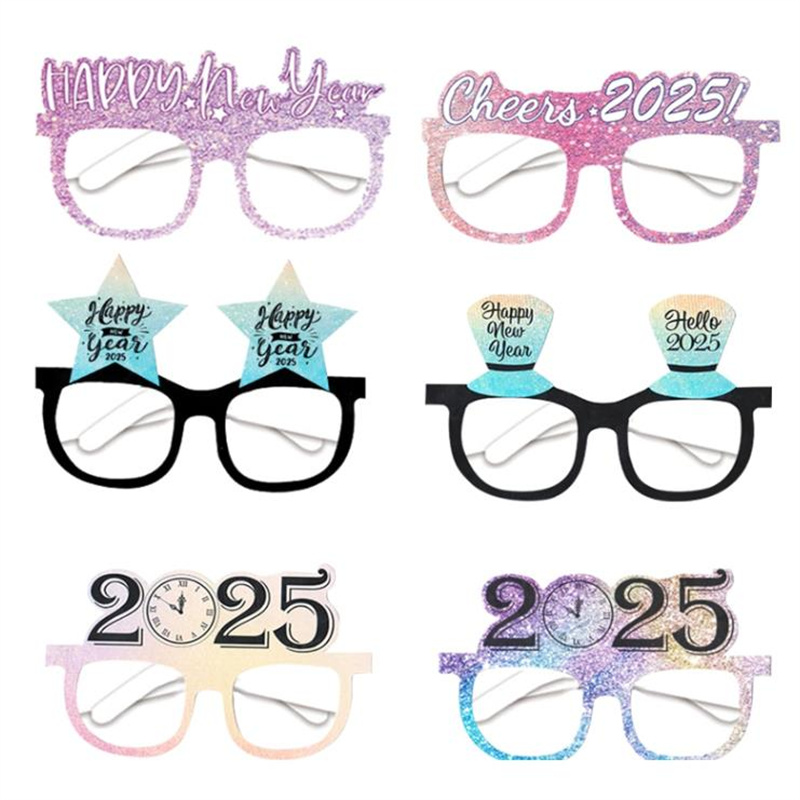
Custom photo booth glasses props are the one party item that markets itself on the customer’s face. A guest wearing glittered novelty eyewear through a doorway, across a checkout line and into six posted photos is doing your merchandising for free – which is why concession stands, party retailers, caterers and event-supply buyers keep these frames on the order list every December. The photographed lineup below runs six pairs of New Year eyewear in a 3×2 grid: black-glitter frames carrying gold-cut “Cheers 2025!” and “HAPPY NEW YEAR” toppers, a champagne-flute pair built from two lens bowls with cream foam caps, an all-gold pair with a tiara accent, and two holographic pairs whose toppers spell 2025 with clock faces standing in for the zeros. Every lens is clear plastic; every frame front is die-cut printed stock. The years on these boards are artwork photographed from prior samples – production follows your file, not theirs.

Construction you can verify from the flat-lay
Zoom past the styling and the build sheet reads plainly. The frame fronts are flat die-cut paper or cardstock shapes coated with glitter or holographic foil – pink-to-lilac gradients, saturated rose, iridescent silver-blue – with raised topper elements cut into words and icons above the brow line. The lens openings carry clear plastic inserts, and thin temple arms extend behind so the piece actually sits on a face rather than in front of it as a handheld mask. Some pairs print the temple arms as grey line-art behind the lens (the paperboard-wall construction visible in the second board below); others mount real arms on a spectacle base. Neither construction is better in the abstract: printed-arm paper fronts cost less per piece and pack flatter, while mounted arms survive a longer night at a bar. Tell us the channel – single-use favor versus venue stock that returns to a bin – and the quote matches the build.
No size marking appears anywhere on the photographed frames, so lens width, total frame width and topper height are quoted against your target, from compact kids’ fits up to oversized statement fronts for stage photos. There are no printed performance claims on these samples either, which is deliberate: finish, coating and lens material are stock options quoted on request, not catalog promises.
The single-unit economics of wearable props
A stick prop is borrowed; a pair of glasses is worn, photographed with and kept. That behavioral difference is the entire business case for eyewear in a favor program. Caterers and planners buy per headcount because one frame per guest is the honest fill – a fifty-cover NYE gala needs fifty-plus units with breakage cover, not fifty guests sharing one board. Retail buyers see the same effect on shelf: novelty glasses sell as an add-on at the point of a second purchase (sparklers, noisemakers, champagne flutes), where a prop board needs a staffed table to move at all. Concession operators count the same SKU a third way: a frame bought at the door walks through the venue, so every unit is also wayfinding for the bar. Three channels, one purchase behavior – the unit goes home on someone’s face.
Because the minimum is 100 pcs per design, the smart single-unit strategy is narrow and deep: three to five frame styles at 300-1,000 pieces each, rather than twelve styles scraping the floor. A narrow lineup keeps shelf tags consistent, simplifies the assortment you ship to stores, and concentrates your artwork budget on toppers that photograph well. When a chain wants a regional-exclusive colorway, that design carries its own 100-piece line without disturbing the core SKUs – the same foil file, one color break, one new order line.
What the second board adds: topper families
The six-piece sample board above shows the shape vocabulary that fills a glasses lineup. Script-lettered brow bars in pink glitter and rose glitter carry the greeting itself as the frame. Solid black frames get toppers clipped above each lens – twin five-point stars, twin pastel top hats – so the wording repeats twice per face and reads from any angle. The bottom row runs the countdown trick twice: a raised numeral banner over the lenses with a printed clock face replacing one zero, hands parked at midnight, Roman numerals legible on the dial. Same die architecture, different foil – pastel gradient on one, holographic rainbow on the other – which is how you stretch one approved layout into four shelf SKUs without four artwork fees.
Each family answers a different buyer. Script frames go to gift shops. Star and hat toppers go to children’s programs because the silhouette reads from across a room. Clock-numeral frames anchor any countdown display, and the holographic variant is the piece customers pick up twice. When you assemble your assortment, mix two families deep rather than six thin, and the reorder cycle keeps working.
Seasonal calendar math
New Year eyewear lives in a seven-week corridor from mid-November shelf set to December 31, and the ordering calendar is brutal about it. Retail replenishment windows close when carriers cap volume for the holiday, so the serious NYE buy is placed like a graduation buy – in the opposite season. Samples in 3-5 days let you verify a foil color against a competitor’s shelf pack fast; bulk production takes 7-15 days after artwork approval; ocean transit then needs the buffer that courier lanes – DHL, UPS, FedEx, TNT – are there to replace when a re-order surfaces in late November. Capacity of 1,000,000 pcs per month across our gift lines means a December catch-up wave runs without cutting earlier customers, but the lead-time honesty still starts with your shelf date, not our factory date.
The photographed year strings double as proof of this rhythm: one sample set was printed as a countdown board, and customers who reorder the identical layout with their own year simply swap the numeral file. The die-lines survive the season; only the artwork refreshes.
Customizable elements
- Greeting wording and typeface on brow bars and toppers – your brand line, venue name or countdown numeral
- Foil palette: black, gold, rose, pastel gradient or holographic as photographed, or your color break
- Frame size from kids’ fits to oversized statement fronts, quoted against your target width
- Construction: printed-arm paper front, or mounted temples on a spectacle base with clear lenses
- Assortment split: single-style depth or multi-style boards, with pieces-per-carton set to your SKU plan
- Opp bagging, header cards or loose bulk pack for display jars
- FBA prep: unit barcodes, polybag compliance, shelf-ready carton counts
Specification summary
| Item | Novelty photo-booth glasses props, wearable eyewear line |
| Size | No dimensions printed on samples; frame width and topper height quoted against your target |
| Stock & Finish | Die-cut card fronts with glitter or holographic foil print, clear plastic lenses as photographed; stock options quoted on request |
| Cutting | Die-cut frame silhouette with raised wordmark or icon toppers |
| Printing & Artwork | Full-color print with metallic-look foil effects; free digital mock-up before production |
| Packing | Loose in cartons, opp-bagged singles or header-card retail packs; pallets for full container loads |
| MOQ | 100 pcs per design |
| Sample time | 3-5 days |
| Lead time | 7-15 days after artwork approval |
| Capacity | 1,000,000 pcs per month across our gift lines |
Artwork logistics stay simple on this line. A vector greeting, a Pantone reference and your size target are enough to start; the studio returns a free mock-up showing the foil break and topper proportions on the actual frame die. Two revision rounds are normal before a physical sample, and that sample – not the screen proof – is what a buyer should sign, because holographic foil shifts hue under store lighting in ways no render captures.
Tooling questions have the same flat answer. The brow-bar and topper shapes on these boards are cut per design, but a new wording file inside an existing silhouette reuses the die entirely, so season-two orders on a proven shape carry no tooling line at all. Buyers comparing quotes across suppliers should ask specifically which parts of the cost are per-design die work and which are per-piece print area, because a glitter topper covering sixty square centimeters prices differently from a thin wordmark strip, and that difference decides whether a wide assortment or a deep single style wins your margin math.
Reading the third board: eyewear inside a dressed assortment
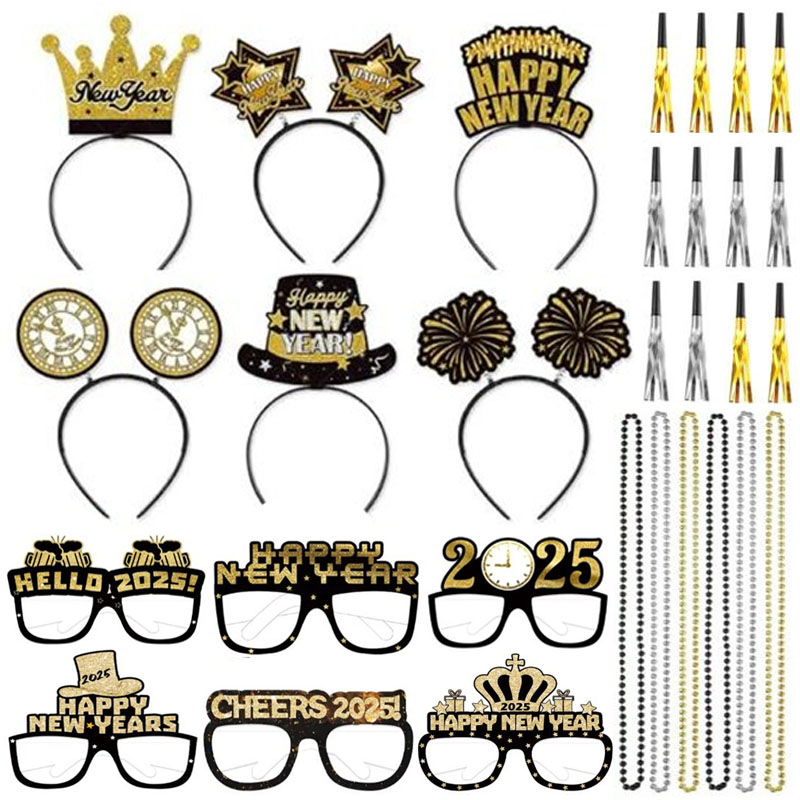
The black-and-gold display above is a useful merchandising lesson rather than a component list. Two rows of glasses sit at the bottom of the board – hello-year numerals, plain HAPPY NEW YEAR wordmarks, a clock-for-zero pair, top-hat and crown accents – and they share the frame with what the sample styled around them: wire headbands carrying crowns, twin stars, twin clock faces and a gold top hat; clip-in tinsel strands in gold and silver; faceted beaded strands. For a caterer building a per-head tray or a retailer filling a seasonal endcap, the pattern is the point: eyewear is the anchor SKU, and the neighboring wearable items exist to lift basket size off the same artwork palette. Quote the glasses first, then ask what else the same black-and-gold file system can produce for the display.
Read the grid itself for stocking hints. The board shows two distinct glasses constructions side by side – frames where the glitter front sits on a real spectacle base with molded temples, and frames where the arm detail is printed behind the clear lens insert. A shelf program that mixes one deep mounted-arm style with one flat-pack paper style covers both price points without doubling your SKU count, and the flat-pack unit is the one that survives a jar display because it ships and stacks like card stock. Sample boards photograph best when every unit is fanned for visibility; your actual packout can be denser, and the carton plan follows your retail fixture, not the marketing shot.
The photo-frame add-on and late-night touchpoints
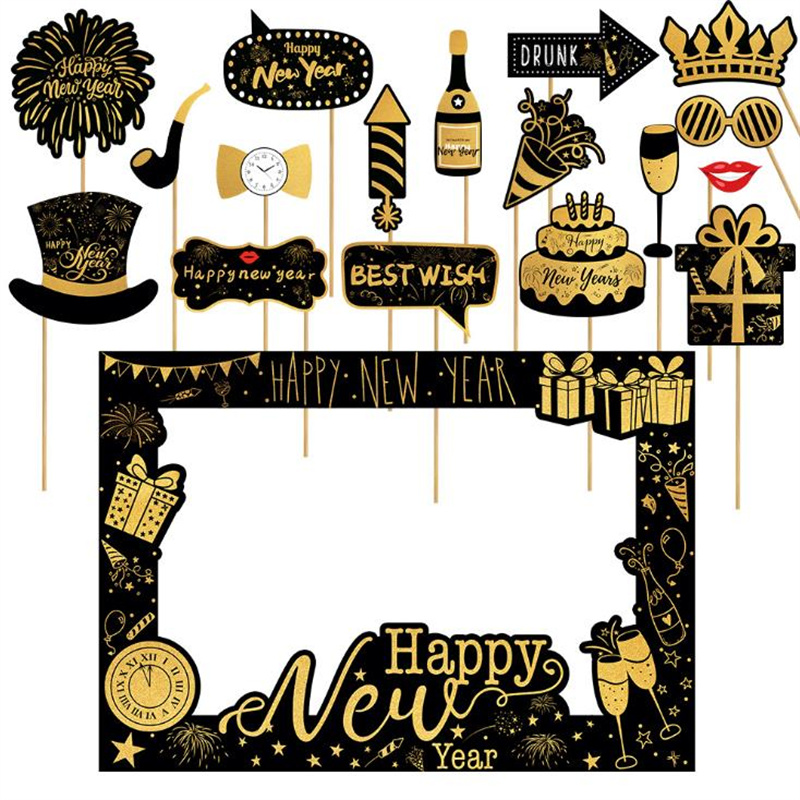
The final sample board pairs skewered bubble props and a decorated square selfie frame with the eyewear families – the black-and-gold countdown set with marquee bubbles, a firework roundel, a champagne bottle, and a frame whose border carries bunting, gift boxes, balloons and a Roman-numeral clock. The frame is the interesting commercial object: guests hold it around a face the way a paper photo frame surrounds a postcard, and it makes the pair’s best single photograph of the night. Operators who rent corner setups sell that photo – print, share, tag – which is why frame-and-eyewear bundles recur in January repeat orders, right after customers discover the December pictures. Note that this board’s small props return to the stick format covered on our photo-booth prop page, so a single venue order can mix wearable frames, skewered bubbles and one selfie frame off one artwork system without three separate proofs. One photographed arrow sign in that set carries a drinking joke; we treat it as a sample caption, and your board gets your own wording.
For buyers whose season is not a countdown, the same construction moves occasions easily: anniversary numerals for a venue’s anniversary gala, a school mascot silhouette instead of a tiara, a corporate wordmark replacing the greeting on the brow bar. The tooling conversation is identical because the die architecture – brow bar, toppers, lens windows, temple method – is what you approve once and reuse every year. Caterers who run a calendar of events rather than a single December night should think in palette rotations: one gold-foil program for NYE, one neutral black-frame program with interchangeable topper wording for birthdays and retirements, one brand-color program that a corporate client reorders quarterly for product launches. The frame is the constant; the topper file is the consumable. That structure keeps a small event-supply account ordering every month instead of twice a year, and because each program clears the 100-piece-per-design floor independently, nothing ties up cash in a shape that only sells in December.
Packing and shipping
Novelty eyewear ships flat by default: loose singles stacked in cartons with divider sheets so foil edges do not abrade, opp-bagged units for retail jars, or header cards on peg strips for shelf display. Glass-front boards and framed sets pack the same way with the frames nested in design blocks. Glitter and holographic finishes are the reason for the divider detail: loose-packed foil fronts rub against each other in transit and the abraded specks read as used merchandise on arrival, which is a return, not a cosmetic complaint. Cartons go on pallets for ocean containers and straight onto courier pallets for DHL, UPS, FedEx or TNT air moves when the corridor is closing. FBA programs get unit barcodes and polybagged counts configured to the referral plan before the carton seals, and every channel shares one carton-mark standard so a distribution center does not have to open a box to know what is inside.
Ask about mixed-carton ratios early. A forty-glasses-per-carton baseline with your assortment split printed on the label beats re-sorting at your end, and we pack the same ratio for a 100-piece trial as for a full-season order so receiving never changes. Seasonal retailers doing a December reset typically want one outer per store drop – the same six-style mix in every box, sized to the fixture – so a route driver can leave cartons without opening them. Build that split into the production plan at approval, not after palletization, and the packing list mirrors your store list one to one.

Buyer questions answered directly
Are these wearable glasses or handheld signs?
Can we keep the sample layouts but change the year or greeting?
How small can a first assortment be?
What is the cut-off for getting NYE eyewear on shelves in December?
Do you prep these for Amazon FBA as individual units?
Where these frames fit in the catalog
Wearable eyewear is one lane in the novelty booth aisle. The stick-prop family at photo booth props with sticks covers handheld signs for shared booths, and curated prop set boards bundle families together when a client wants the whole table dressed. Birthday programs buy from the decoration sets line instead. Browse the party items category or the full printed items range to see adjacent formats, and send specs to the quote desk – a frame width, a greeting and a target date is a complete RFQ.
Approve a mock-up this week and your countdown assortment is in samples before the first competitor reorders theirs.


