Custom Hinged Cosmetics Kit Box With Die-Cut Foam Insert
$5.50
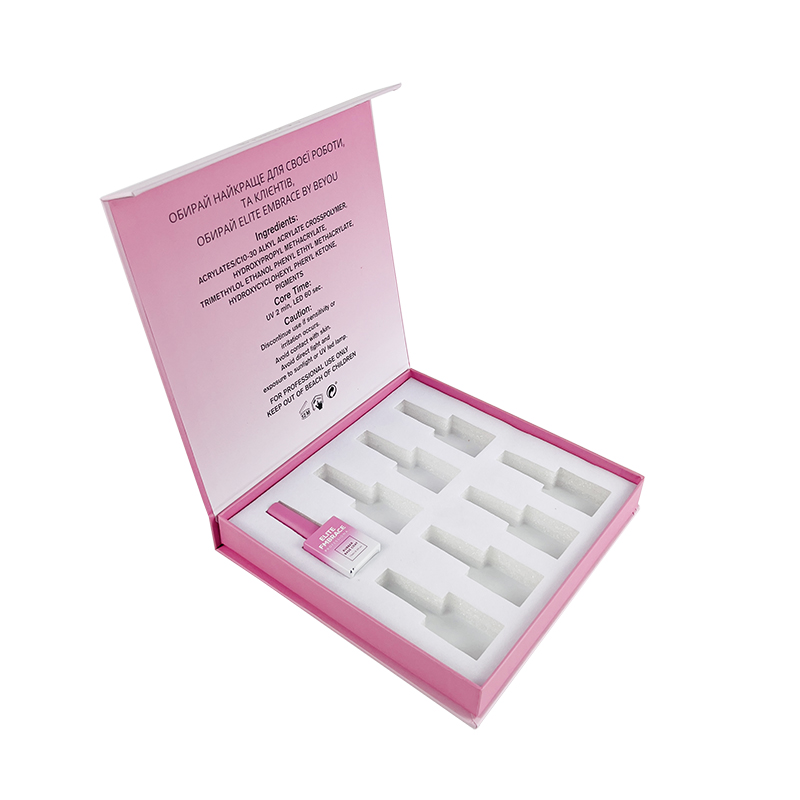
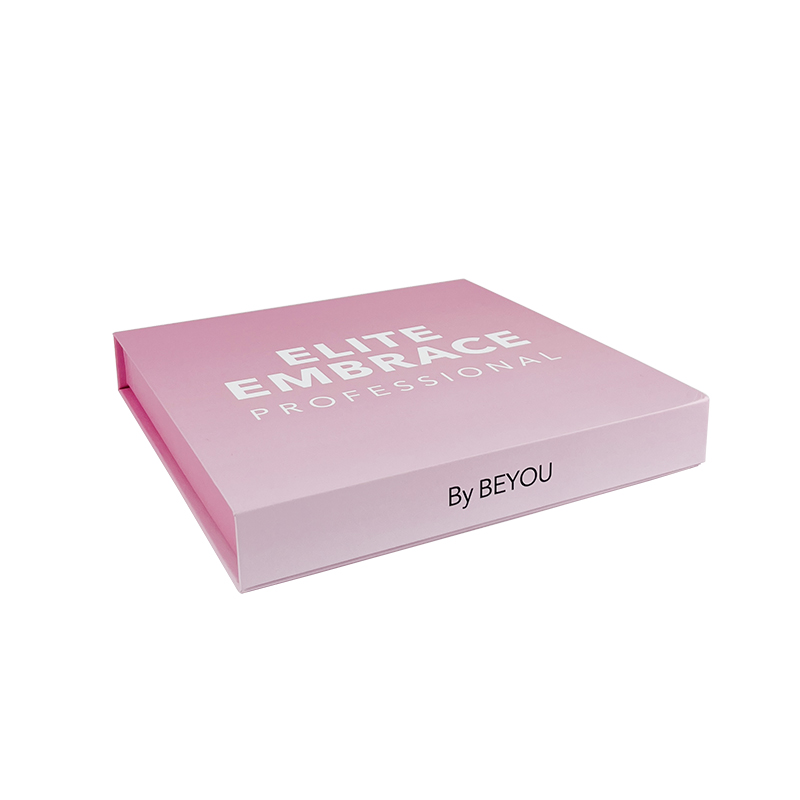
A hinged-lid rigid kit box for multi-bottle cosmetic and tool sets: rose-pink wrapped chipboard shells, a lid that stands open on its own hinges and carries a full print panel on its interior face, and a white die-cut foam cradle with one milled cavity per SKU. The sample shown holds eight bottle slots in a 2×4 grid; we cut the layout around your actual kit bill-of-materials so glass stays seated and nothing rattles through an ocean leg. Offset print with Pantone references, gradient smoothing at pre-press, white knockout type over colour, and matte or gloss lamination on the cover paper. MOQ 100 pcs per design, physical samples in 3-5 days, bulk 7-15 days after artwork approval, production capacity 1,000,000 pcs monthly, and FBA labelling plus sea, air or express freight supported.
This is a hinged-lid rigid kit box for multi-piece cosmetic and tool sets: rose-pink wrapped shells, a lid that stands open on its own hinges, and a white die-cut foam cradle with one cavity per SKU. The photographed sample holds eight bottle-shaped slots in a two-by-four grid with one product seated, but the layout is cut around your kit bill-of-materials, not around our stock tooling. Pro beauty brands and tools brands specify this construction for launch kits, refill sets, gift-with-purchase bundles and counter packs where several items must travel in one box without rattling, scratching or shifting.
What A Multi-Bottle Kit Actually Needs
A kit box fails in three predictable places: bottles knocking together in transit, a lid that flops forward on the shelf, and lid-interior space that goes unused once the box opens. This build answers all three, and it is worth spelling out why each failure happens before you commit to a construction, because each fix changes the quote.
Rattling is a cavity problem, not a padding problem. Loose tissue and card dividers still let glass travel a few millimetres inside the outer carton during the worst part of an ocean leg, which is when chips and scuffed shoulders actually occur. A die-cut cradle removes that travel: each bottle sits in a pocket milled to its own silhouette, held on three or four faces, with a fraction of a millimetre of clearance so it lifts out without suction. That is the single most common reason a set brand moves from a generic gift box to a kit-specific cradle.
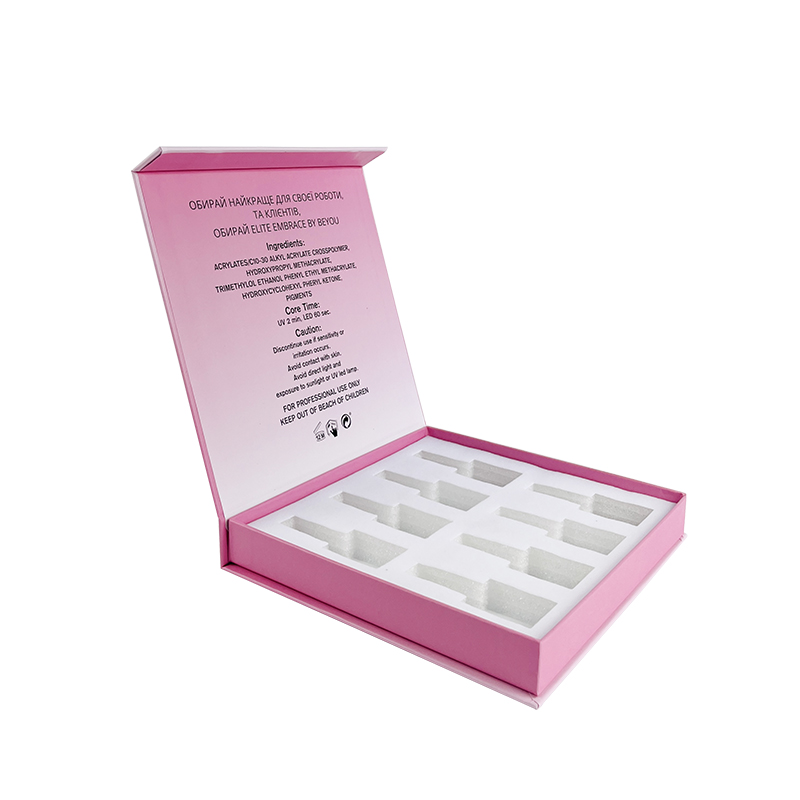
A flopping lid is a hinge problem. Two-piece lid-and-base boxes photograph beautifully but have no way to stay open; on a counter display the lid gets set aside and the product row loses its backdrop. A connected lid stands behind the open base like a hanger, holds its shape under its own weight because the shell is rigid board rather than carton, and gives the display a branded back wall for free. On the sample in the first photo the lid stands fully open with its interior print facing the customer.
Wasted lid space is an artwork problem, and it is the cheapest win available. The inside face of the lid is a full print surface before the box ships. Brands typically run a gradient, an application-step layout or a brand story panel there, because that surface is the first thing a buyer reads when the box opens at home, at a salon station or on camera during an unboxing. Treat it as a second front panel at design time and it costs nothing extra, since a lining paper is already required to finish the hinge side of the wrap.
There is a fourth failure mode worth naming before the photos below: the box that dents in transit. A hand-made rigid shell takes a corner ding differently from a folded carton, and a crushed hinge corner kills a premium kit on the counter. We set boxes per export carton against wall thickness, corner-protect the stack, and agree the packing plan with you before the first bulk run rather than discovering it in a receiving report. Your transit profile, courier parcel versus container, decides that count; a parcel-routed programme gets a tighter carton and more void filler, a container programme gets the opposite trade.
What You Set, What We Cut
- Exterior wrap paper, colour and gradient artwork on the cover sheet
- Lid-interior lining print as a full-bleed panel or plain lining
- Box footprint built from your kit bill-of-materials, no stock size
- Cavity layout: slot count, outline per SKU, mixed bottle-tool- sachet grids
- Insert board: EVA or PU, laminate-faced option, cut depth per item weight
- Finish: matte or gloss film, optional foil or embossed marks on the lid face
- Hinge position and open-path clearance against your tallest bottle
- Packing: assembled units, carton count and FBA prep to your transit profile
Hinge, Lid And Base: How The Shell Is Built
Both shells are chipboard core wrapped in printed cover paper, made up by hand one box at a time rather than folded from a single sheet like a carton. The cover paper turns over the edges onto the inner face, where the lining print carries across the hinge, so there is no exposed cut edge on the lid step or the base rim. That wrapped edge is what a rigid box feels like in the hand: dense walls, sharp corners, no spring-back when you press a face flat. If your price ceiling cannot absorb hand-made shells, the folding-carton tier on this site carries the same artwork instead.
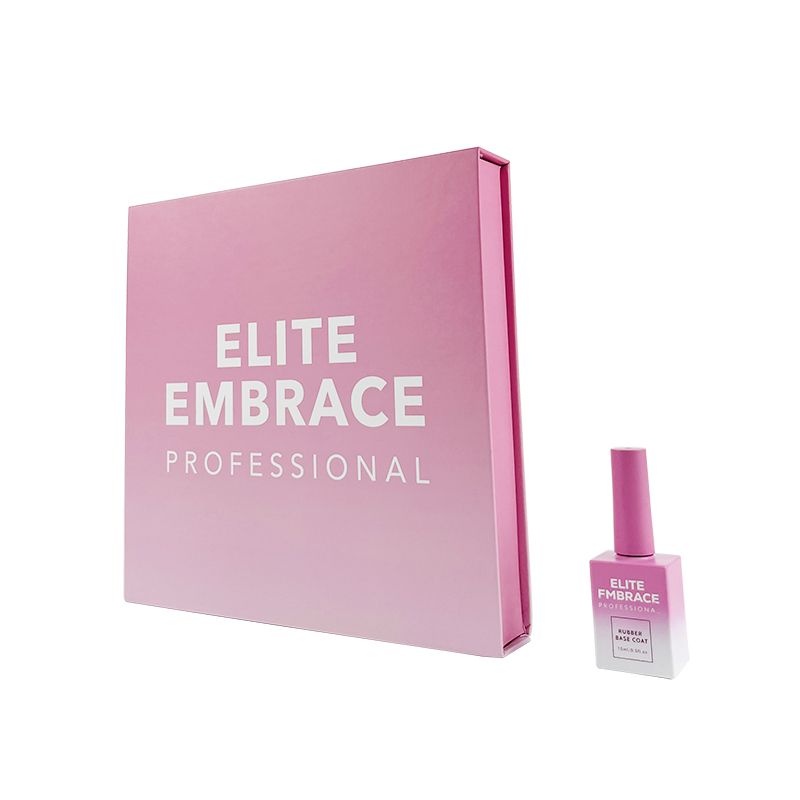
The lid connects to the base at two side hinge points, and the hinge line is set so the lid clears the tallest bottle when it swings open. This matters on deep cradles: a lid that fouls on a flacon cap will crease its own lining over time. We check open-path clearance on the physical sample against your real bottles, not on a screen. Closed, the box presents a single clean step where the lid overlaps the base wall, visible at the short side in the fourth product photo, which keeps the silhouette flat enough for shelf stacking and mailer packing.
Corner sharpness and wrap tension are what separate a good rigid box from a cheap one at the same price point, and both are hand operations. Our make-up team folds each corner to a consistent radius and tensions the wrap so gradients run true across the corner rather than drifting at the turn. You judge exactly this on the 3-5 day sample, which is the right time to send corrections.
Cavity Layouts Cut Around Your SKU List
Send the actual items, or drawings with diameter, height and weight for every SKU in the kit, and we cut the cradle around them. The photographed sample is a simple eight-up grid of round slots, but real kit layouts are usually mixed: two tall bottles, four vials, a flat brush well, a narrow tool slot, sometimes a small rectangle for a folded insert card or a sachet. Every one of those is a single cut from one foam sheet, so a mixed layout costs no more to produce than a uniform grid. What drives the price is total foam thickness and depth of cut, which we set per product rather than from a catalog insert.
Insert material is either EVA or PU foam, die-cut with clean edge faces. White foam under a pastel gradient kit is where material choice shows: laminate-faced PU keeps a smoother, sealed surface that does not shed crumbs into bottle necks, while raw EVA is the sensible pick when budget rules and the cradle will be hidden under a paper overlay. Tell us cavity depth and whether the foam stays visible, and we recommend one with the quote rather than let you discover the difference at receiving.
For glass kits we mill pockets deep enough that the center of gravity sits under the foam line, so a knocked box stays seated instead of tipping inside its own cavity. For lightweight PET bottles the opposite applies: shallow recesses with side grips, because a deep well turns a light bottle into a fishing expedition for the customer’s fingers. Both adjustments happen at artwork stage, not as production-stage surprises.
The Lid Interior As A Second Front Panel
Once the hinge holds the lid open, the interior becomes display space, and display space needs hierarchy. What works: a full-bleed gradient or colour field as the ground, one block of type for the application sequence, a second block for the range list, and your marks near the hinge line where they read without the lid being handled. The sample in the photos runs exactly this pattern, gradient ground plus a dense print block across the full inner face. What we avoid recommending: small-body text crammed corner to corner, which reads as noise at arm’s length and photographs badly in user content.
Bring us the layout problem and we will set it. Content panels are typeset in-house at no charge from your copy file, checked against your brand font list where licensing allows, and proofed on paper that matches the lining stock so the colour temperature you approve is the temperature that ships. If your kit needs a removable card instead, a printed card tucked into its own cradle slot is also an option; some brands prefer that because the card changes more often than the box.
Practical file notes before artwork lock: build the lid-interior panel as its own artboard sized to the inner face we confirm with your dieline, keep live text away from the hinge fold line, and send outlined type or your licensed font files. Bleed on the interior print is trimmed by the wrap operation, so anything within a few millimetres of the inner edge gets cut into; we mark the safe zone on the dieline we return, and your designer lays out against that sheet rather than a flat screenshot. If your legal block genuinely must be on the lid, fine print at a legible size beats a wall of six-point type, and putting the full ingredient list on a card instead is the layout we recommend in that case.
Printing Gradients Without Banding
Soft pink-to-nude transitions are exactly where offset shows its worst habits: visible steps through the mid-tones, muddy shift in the shadows, and colour drift between batches months apart. Three controls handle it. First, pre-press: gradient files are inspected for step artifacts and resmoothed before plating, because a banded PDF never prints as a smooth sheet. Second, references: colour runs against Pantone targets you approve on a printed proof, and your signed proof is retained as the batch reference for every later reorder, so batch three is matched against physical evidence rather than a screen. Third, the press check itself: a pulled sheet is verified against the proof before the run commits, including any knockout white type sitting directly on the gradient, where weak white ink reads grey.
White ink over colour is its own craft item. The sample set carries knocked-out capital lettering on both box and bottle; on board that means opaque white laid down under the dark type, registered tightly enough that the letters stay crisp at arm’s length. We confirm white coverage on the sample stage, where it belongs, not in a photo emailed after production.
Specs For This Build
Read the table as a configuration sheet, not a catalog entry. The rows that matter on this construction are Construction, Insert and Size: they are where your kit list gets translated into tooling. Two lines usually move the unit price more than everything else combined: foam thickness against cavity depth, and whether the lid-interior panel runs full-bleed gradient or a plain lining. If your current supplier quote is high, send it with your BOM and we will show you which of those two lines you are actually paying for, and where a different layout drops cost without dropping the feel in the hand. Everything below the dotted line, MOQ upward, is fixed policy and identical for every buyer of this page.
| Item | Hinged-lid rigid kit box with die-cut foam insert, custom printed |
| Construction | Chipboard core, wrapped cover paper; lid and base joined by side hinges at the factory |
| Material | Greyboard core with printed outer wrap and printed lining paper; die-cut EVA or PU foam cradle |
| Size | Custom; exterior footprint and cavity grid quoted to your product dimensions and kit bill-of-materials, no standard size carried |
| Printing | Offset CMYK or Pantone spot colours; white knockout available for type over dark grounds; exterior plus lid-interior panels printed |
| Insert | Die-cut EVA / PU foam, cavity count and layout per your SKUs; laminate-faced PU option where the cradle stays visible |
| Finish | Matte or gloss film lamination on the cover paper; foil stamping or embossing optional |
| Packing | Ships assembled in inner poly and five-ply export cartons; FBA labelling and prep supported |
| MOQ | 100 pcs per design |
| Sample time | 3-5 days |
| Lead time | Bulk 7-15 days after artwork approval |
| Capacity | 1,000,000 pcs per month across our printed box lines |
Board grade, wrap paper and foam thickness are matched to your product weight and dieline at quotation. Nothing on this page fixes a grammage that has not been checked against your bottles first.
Ordering Path And The Sample Stage
The path is short and the sample is where the decisions get made. You send a kit contents list with dimensions, weights and photos of each item, your lid-interior copy, and target quantities. We return a cavity sketch plus a digital mock-up of the exterior at no charge, refine both with you, then cut a physical sample in 3-5 days with the cradle in place so every SKU can actually be seated and shaken, literally. Artwork signs off against that approved sample, and production follows in 7-15 days.
Reorders, Mixed Kits And Version Changes
Running two or three kit variants is normal and the 100-piece floor applies per design, not per purchase order: split an order across your variants as long as each clears its own minimum, and later top-ups reorder only the variant that sold through. When a formulation partner swaps bottle suppliers and the new flacon is a few millimetres wider, you do not rebuy the whole box: the wrap tooling carries unchanged and we re-cut the foam die against the new item, confirmed on a fresh fit sample before the run. Send changed dimensions early and it costs a die, not a redesign.

Packing Pallets And Freight
Assembled kit boxes ride in inner poly bags inside five-ply export cartons, strapped and palletised for ocean, air, DHL, UPS, FedEx or TNT. We label and prep single units for Amazon FBA so cartons go straight from our pallet to the receiving dock, or drop bulk to your 3PL for your own kitting line. Mixed loads work: kit boxes with matching cartons or carrier bags on one shipment, as long as the carton mix is agreed before the packing list is cut.
Kit Box Questions From Purchasing Teams
What is the minimum order for the hinged kit box?
How quickly can we hold a sample with our own foam layout?
Our kit mixes bottles, a brush and a sachet – can one insert hold all of it?
How is a pastel gradient kept consistent across reorders?
Does loose foam end up in bottle necks on delivery?
Can you deliver finished boxes ready for Amazon fulfilment?
Related Packaging On The Same Programme
Most kit programmes wrap this box together with retail-level outer cartons or counter bags. On the premium single-piece side, the matte black two-piece box with gold-lined interior runs the reveal your kit lid cannot; for the individual bottles that sit on shelf beside the kit, the white folding cartons line carries the same artwork to retail tier. For shelf-facing singles and gift sets in the same artwork, the drawer-style cosmetic boxes keep the gradient family consistent. Counter and gift-with-purchase programmes match the printed paper shopping bags and the windowed trapezoidal carrier bags. When your kit list is final, request a quote and we price box, cradle and freight as one line.
Start A Kit Quote
Send the bill-of-materials, quantities and your lid-interior copy, and we return a cavity sketch, a digital mock-up and a landed figure. Email [email protected] or WhatsApp +86-15967739086. The form below routes straight to the box desk; a specialist replies with a dieline proposal for your set.