Black Two-Piece Rigid Gift Box With Gold Lining
$5.50
A two-piece lid-and-base rigid gift box: matte black wrapped shells outside, a gold-lined base wall that shows as a metallic frame through the reveal gap when closed, and a die-cut bed with one or two cavities milled to your product outlines, foam as photographed or flocked board on request. Built for single-hero premium sets, flask plus accessory, bottle plus applicator. Scratch-resistant matte lamination holds the black clean in hand, the gold liner edge is gauge-checked at make-up, and lid friction gets set on the fit sample before artwork locks. MOQ 100 pcs per design, samples in 3-5 days, bulk 7-15 days after artwork approval. Ships assembled and interleaved in five-ply export cartons, with FBA labelling and sea, air or express freight.
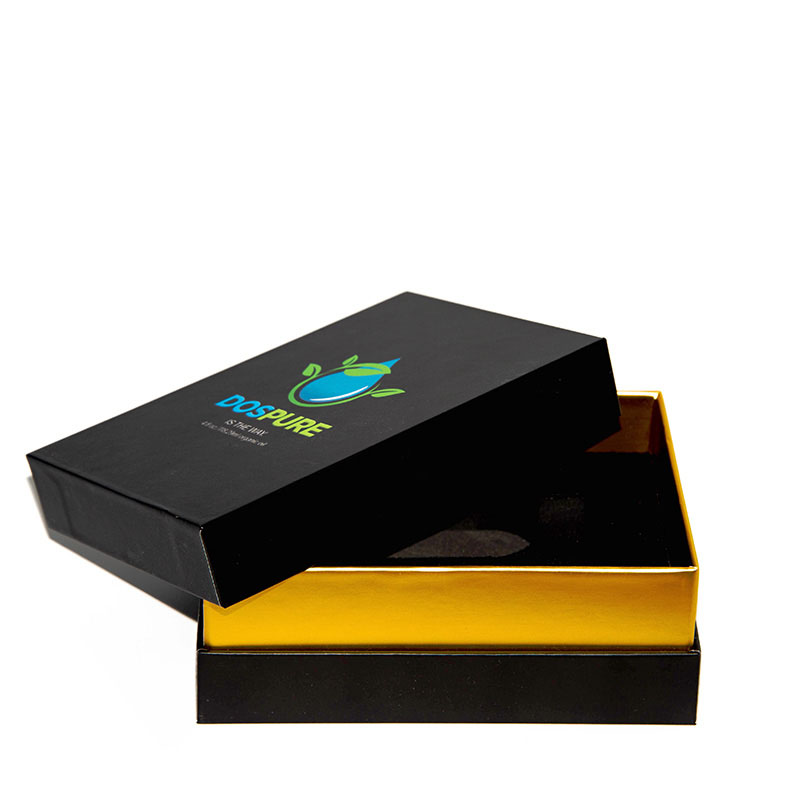
A two-piece lid-and-base rigid setup box, wrapped matte black outside and lined metallic gold inside. The photographed sample is a square shell: the slip lid seats over the base walls and leaves a narrow reveal gap around the top edge, so a band of the gold inner wall reads as a frame even while the box is closed. Lift the lid and the whole interior changes register, black foam cradle below, gold wall above. Single flacon with a companion tool, one bottle with an applicator, a flask with a slim accessory: this construction exists to make one or two objects feel staged rather than stored, and buyers order it when the moment the lid comes off is the marketing asset.
Why The Two-Piece Format Does The Revealing
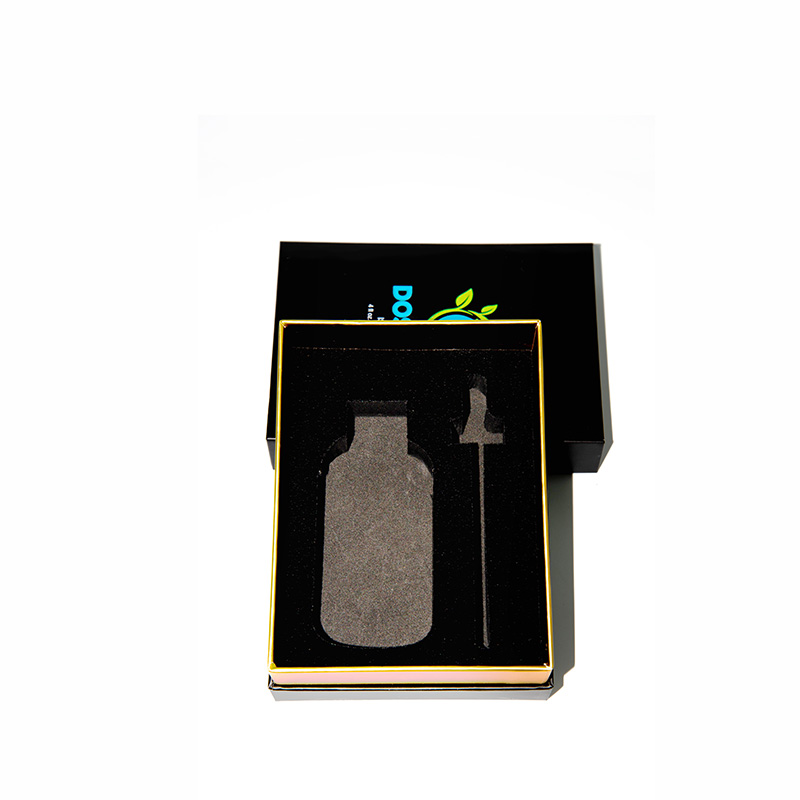
A lid-and-base box opens in one motion and leaves nothing to manage: nothing to unfold, nothing to unknot, nothing left flopping on the counter. The customer lifts the top shell off, sets it down, and the base presents the product level and alone. That is a different experience from a kit case that stands its contents up in a wall, and it is the right one when you have one hero item and a single companion piece to place beside it. On the sample the base holds two cavities, a flask well and a narrow channel for a slim tool; the second photo shows the same shell with a single deep well instead.
The format also survives freight well: two separate shells stacked in a carton take compression on their walls, and anything that does mark up, a scuffed base wall, a lid set down at an angle, is easy to re-seat and invisible once nested in the set. Reorders of premium single-item gift boxes are overwhelmingly two-piece for exactly this freight reason.
There is a staging upside too. Because the lid is off and face-up during use, its interior can carry a second message, and customers photograph the open base beside the lid as a pair. Design both faces as one spread at artwork time and your unboxing content gets composed for you.
Sizing runs from your object outward, never the reverse. Tell us the flask height and shoulder diameter, the accessory length, and how much air you want under the fingers when the item lifts, and the shell grows around that instead of you shrinking the product story to fit a stock box. The reveal gap itself is a design variable: a deeper overlap shows more gold band and reads dressier but takes more force to lift; a shallow overlap is effortless and subtler. Most premium single-item programs land in the middle and adjust once on the sample, which is exactly the kind of decision that should happen against a physical box on a desk, not in a spec sheet.
The same logic applies to the lid crown. Flat-lid shells stack neatly and photograph as a plinth under the product; a slightly domed or stepped lid catches light along its edge and signals weight before anyone opens it. Both wrap from the same black stock with the same lamination, so the choice is presentation grammar, not cost, and we show both profiles on the dieline sketch so your team picks with the drawing in hand.
Quantity culture matters here too. A launch that clears in six weeks usually starts at a few hundred shells, restocks monthly, and keeps one artwork file frozen across the year so batch four looks like batch one. The setup-box route rewards that rhythm: plates, liner chip and die all live in your file, and a reorder is a date, not a re-quote conversation. If you are building a gift-with-purchase that ships with a partner, split the 100-piece floor across two liner tones or two lid prints instead of splitting the launch, and both halves still clear the same minimum.
Custom Items On This Shell
- Exterior wrap: solid matte black cover paper, scratch-resistant film over it
- Lid-face art: foil emblem, heavy-white underprint or plain black
- Reveal depth between lid head and base wall, set at sample stage
- Inner wall liner: warm, pale or greenish gold coated stock
- Bed: die-cut black foam or flocked board, single or dual cavity
- Shell footprint and well depth from your product drawings or physical items
- Lid-interior panel print for the staged second message
- Packing: made-up shells nested and interleaved, FBA prep on request
Matte Black That Stays Matte In Hand
Everyone knows the complaint: soft-touch black shows every fingerprint and silvers at the scuffs, and a box meant to feel expensive arrives feeling handled. Three production choices decide which side of that line your order lands on. The cover wrap gets a scratch-resistant matte lamination applied at the film stage rather than a varnish-only finish, so nails and cardboard-on-cardboard contact during packing do not shine the surface patchy. The wrap is turned and tucked at proper tension so corners hold black to the edge instead of pulling thin and showing grey board at the apex, the classic tell of a rushed make-up. And the boxes are stacked with interleaving in the carton, faces not rubbing faces, which is where most of the silvers actually come from, on the truck, not on the press.
Black also swallows print. Pale type over it needs full white coverage, and fine detail in a dark ground needs the plate checked at density, so we proof black-ground artwork on the actual wrapped sheet, not on a colour-calibrated screen, before anything is approved.
Emblem work on black deserves a note, because the front of the sample box is exactly that case: a centered mark with small pale caption lines under it. Two routes survive black grounds. The first is foil, which sits proud of the paper, catches light at an angle and never sinks into the matte field the way process ink can; the second is heavy white ink underprint with a laminate over the top for the softer look. They age differently too, foil holds its edge through years on a shelf, ink-on-matte can dull at the high-wear center of the panel. Quote both against your artwork and decide with real proofs; we include either route in the sample run rather than letting the choice surface after production.
Worth stating plainly: nothing on this construction is a closure system. The shells shown here have no hardware built into the walls, which keeps the profile clean and the freight cheap, and if your brief genuinely needs a closure, that is a different page in the boxes category and priced differently. This page is about the lift-off.
Where the black-and-gold grammar earns its keep: limited editions, award and recognition sets, travel-size launches, founder-signed batches, any program where the object leaves the store in someone’s hand as a present. A shelf carton cannot do that job, and a stand-up display case does a different, busier one. When the brief is a single premium object plus its companion, dark outside and metallic inside remains the shortest path to a box that photographs itself.
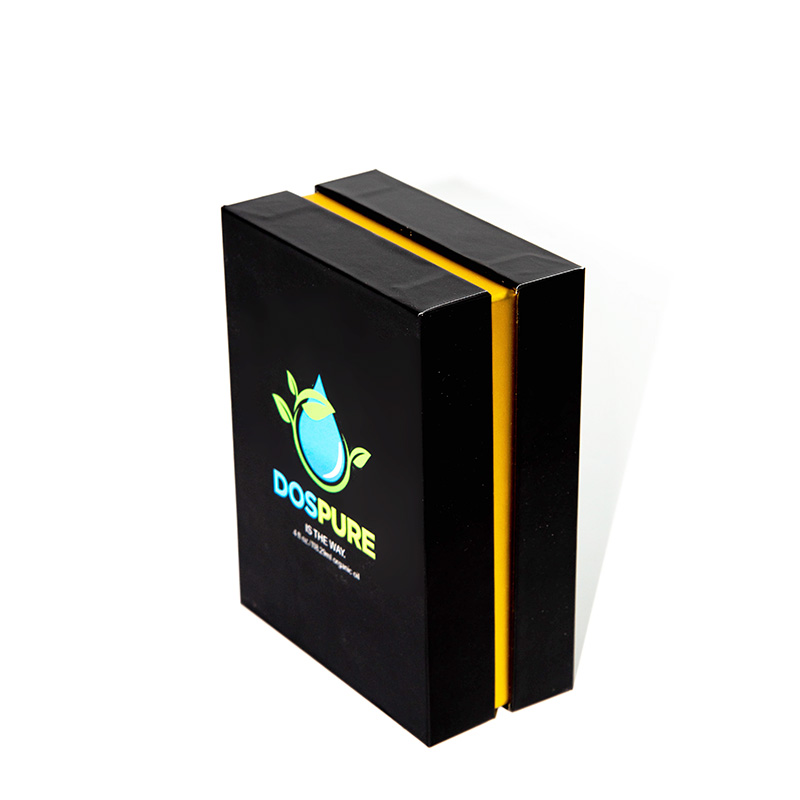
The Gold Wall, And Its Edge
The interior of the base wall is lined in metallic stock, and the whole drama of this box lives on the one millimetre where gold meets black at the top edge of the wall. The complaint that kills black-and-gold launches is edge bleed: the lining showing past the lip, or the outer wrap folding unevenly inside so the gold line wanders in width around the perimeter. Our control is the turn-in. The outer wrap is folded over the wall head to a registered depth, the lining is butt-set against that fold rather than overlapped, and the make-up station checks all four runs with a gauge edge, not by eye, before the shell leaves the bench. Ask for the lined wall to sit below the reveal by a fixed margin and it ships that way on every batch.
Metallic liners come in a run of gold tones, warm, greenish and pale champagne, and they photograph very differently under ring lights. Choose against your product photography early; we send liner chips with the sample so the decision happens with a lamp on it, not against a swatch PDF.
One more detail buyers ask about before they trust a black-and-gold quote: what the gold actually is. On this build the inner wall is a lined paper with a metallic cast coating, applied as a sheet, not a sprayed film and not foil stamped panel by panel. That matters for three practical reasons: it survives the turn-in at the wall head without cracking the way brittle foils do, it takes the glue chemistry of hand make-up without lifting, and a re-run matches from the same coated stock instead of chasing a plating batch. If your brand system does demand true hot foil on the interior instead, say so early; it is a different cost curve and a different failure list, and you should be quoting it consciously, not discovering it at receiving.
The base floor under the insert gets the same treatment people forget: a black board floor reads invisible under dark foam, a gold or white floor flashes at the cavity edges when a bottle is removed. It is a one-line spec at dieline stage and it changes how the empty box photographs mid-use, when the hero item is out on the counter and the shell is showing its bed to the room.
Assembly economics round out the picture. Hand-wrapped shells cost more per unit than folded cartons and far less per unit than anything you would build twice in your own warehouse, because nesting a lid, seating a liner and turning a wrap are bench operations we repeat at scale with fixed gauges. For an annual program that means one file, one die, one liner reference and a predictable unit from month three onward, with the surprise costs already burned off at the sample stage where they belong.
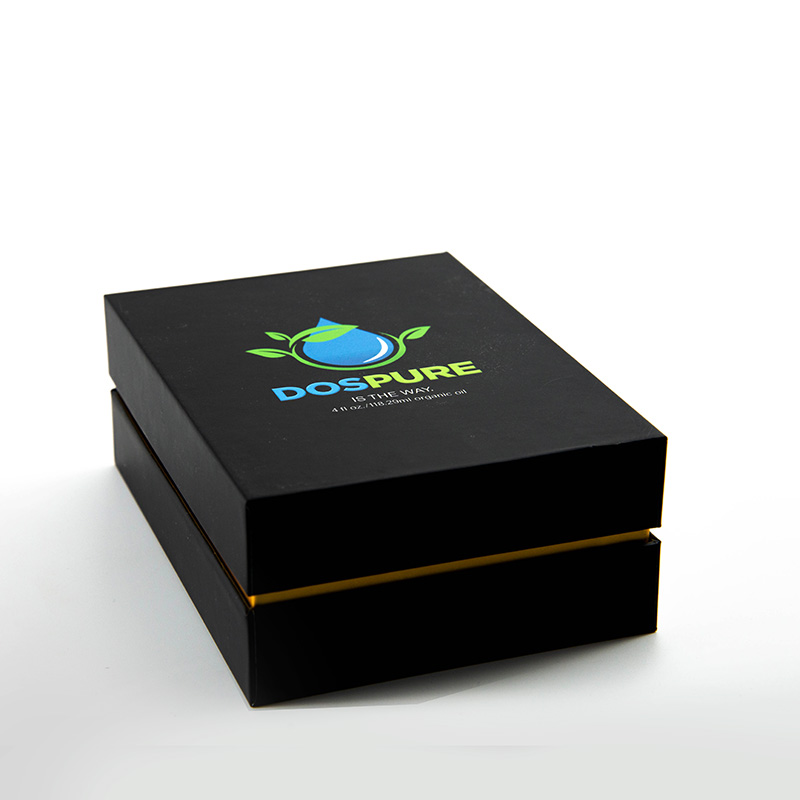
Inserts: One Well Or Two, Cut To The Object
The bed is a die-cut insert: black foam as photographed, or flocked board when you want the product to sit on pile instead of on a cut face. Foam is the workhorse, cut to the traced outline of each item with a little wall clearance so the object lifts out without a battle; flock carries a softer read for glass and works better when the well is shallow. Send the actual pieces and we mill the well depth against their center of gravity, so a top-heavy flask does not rock on its shoulder when the carton is carried upright.
Loft matters as much as outline. A light bottle in a deep well floats and knocks the walls; a heavy item on thin board telegraphs every drop through the base to the shelf below. Depth, board and any under-well packing get set against the real product weights at sample stage, and the fit sample is the moment to drop-test your own judgment on it. Two-cavity beds for a bottle plus accessory come off the same single sheet and the same one die as a one-cavity bed, so adding a slim channel for a comb, applicator or key costs die length, not tooling generations.
Spec Sheet For The Black-and-Gold Build
| Item | Two-piece lid-and-base rigid gift box, matte black exterior, metallic lined interior |
| Construction | Rigid setup shells, chipboard core wrapped in printed or solid cover paper; slip lid over base wall, factory made-up |
| Material | Greyboard core; black wrap paper with matte lamination; gold-tone lined base wall; foam or flocked bed |
| Size | Custom; shell and well dimensions quoted to your product drawings or physical items, no stock footprint carried |
| Printing | Offset with Pantone references; white underprint for light type on black grounds; foil and embossing optional on the lid face |
| Insert | Die-cut black EVA/PU foam or flocked board; single or dual cavity cut to traced product outlines |
| Finish | Scratch-resistant matte film outside; metallic liner inside; ribbon pull and closure hardware are separate constructions, not this page |
| Packing | Lid and base nested in inner poly inside five-ply export cartons; FBA labelling and prep supported |
| MOQ | 100 pcs per design |
| Sample time | 3-5 days |
| Lead time | Bulk 7-15 days after artwork approval |
| Capacity | 1,000,000 pcs per month across our printed box lines |
Getting From Brief To Signed Sample
Send photographs of the product with its accessory, rough dimensions and weights, plus your target quantity, and the first reply is a dieline sketch and a free digital mock-up showing lid art, base wall and reveal band in one view. Then the physical run: a made-up sample in 3-5 days with the real liner and the cut bed, seated with your items or accurate 3D-printed stands if the bottles are still at your supplier. Everything you want changed, tighter lid, deeper well, a different gold, gets decided against that object in your hands; approval of it locks the batch reference, and the order ships 7-15 days later.
Shipping Black Shells Without Scuffs

Which is mostly a stacking question: nested pairs interleaved face-to-face, inner poly at the unit, corner boards in the carton, and carton counts held down against the wall height so nothing crushes the lid head flat. Assembled or flat-assembled? This box ships made up, because a rigid shell folded back up at your end reads second-hand; the freight trade-off is volume, and it is priced transparently against a drop shipment. Sea, air, DHL, UPS, FedEx, TNT, and FBA-prep with FNSKU labels on request.
How does the lid stay on – held, or just resting?
How do you stop the matte black showing fingerprints?
Can the lid open easily with one hand but still not fall off?
Flocked bed or foam – which should I quote?
What is the gold tone matching process?
Minimum order and timing for the black-and-gold box?
Matching Boxes And Bags For The Same Launch
If the launch needs a standing display case beside this single-hero box, the cosmetics stand-up set box is the sibling construction; the ribbon closure gift boxes cover the hardware variant, and the white folding cartons put the same artwork at shelf tier under the gift piece, and the sliding drawer boxes cover the sleeve format for smaller companions. Counter delivery uses the printed paper shopping bags, windowed carriers from the trapezoidal window bag line round out gifting sets. Send the launch list to the quote desk and the whole family prices together.
Send The Flask, Get The Fit
Photographs, weights and quantities start a dieline sketch and mock-up the same week; physical samples follow in 3-5 days. Email [email protected] or reach the box desk on WhatsApp +86-15967739086. The form below routes straight in, and a specialist answers with structure options before you commit artwork.