Custom Double Layer Sherpa Plush Blanket
$7.60
Bulk homeware and seasonal capsules run on this construction: a custom sherpa blanket double layer pairing a matte sublimated plush face — photographic detail, typographic capsules, full-bleed pattern — with a looped white sherpa backing photographed at turned corners and folded stacks on this page. Two fabrics bond before cutting, so the panel hangs heavier, holds fold lines in a bin display and traps still air between layers; the sewn-edge station binds both into one perimeter, the quality gate that survives retail handling and month-three laundering. Sizes come from our own printed chart — 70*100 cm, 130*150 cm, 150*200 cm with inch pairs — and pack tiers run from a banded roll or zipper-bag bin presentation through light and flat vacuum compression, chosen against your landing-to-opening calendar so loop pile recovers before the shelf set. No gram weight is claimed from a photograph: gsm ladders quote against physical samples. MOQ 100 pcs per design across one size ladder; samples 3-5 days; bulk 7-15 days after artwork approval; capacity 1,000,000 pcs per month across our gift lines; sea, air, DHL, UPS, FedEx or TNT with FBA prep at line end. Sample artwork in our photos is never reproduced — your capsule file replaces it position for position, and the displayed figure anchors the 100-piece tier only.
A Custom Sherpa Blanket Double Layer For The Homeware Aisle
Shelf space in bedding and homeware is rented, not owned, and a custom sherpa blanket double layer earns rent the way the aisle actually works: two fabrics that do different jobs — a printed plush face carrying the design, a looped sherpa backing carrying the warmth — bonded into one panel that folds, hangs and stacks like a real bed product instead of a promo giveaway with a print stuck on it. This page speaks to importers, big-box seasonal buyers, bed-in-a-bag assemblers and home brands running their own print capsules. Every construction claim below is pinned to a photograph on our own line: the turned corners that expose the sherpa reverse, the folded stacks that show bonded thickness, the macro pile detail, and the process chart that explains where two fabrics become one panel.
The lane division is clean and deliberate. Our light printed throw line handles corporate gift runs in small cartons; this page is the heavier two-fabric homeware build sold in retail quantities and seasonal capsules; and the wearable hooded cut lives on its own page again. Quote the wrong lane and you get the wrong carton math, so the numbers up front: MOQ 100 pcs per design, samples in 3-5 days, bulk 7-15 days after artwork approval, capacity 1,000,000 pcs per month across our gift lines. If your calendar says shelf-set in autumn, this is the page that survives that conversation.
What The First Photo Proves About Two Fabrics
The frame above is the construction argument in one image, staged the way a homeware buyer needs it. The face lies flat: a deep red field scattered with snowflake graphics, a cartoon gift-bringer-and-reindeer scene centred, block-letter pun typography running across it, and a greeting-card-style wordmark that belongs to whoever supplied that sample artwork — your file replaces every element, and the sample art is not offered for reproduction. That face is smooth and matte, the low-pile sublimation surface that carries photographic detail without nap distortion. Then look where the fabric does the talking: the upper corner turned back and the folded stack at the lower right both expose a thick white sherpa reverse, looped and high-loft, clearly a different fabric from the printed face. Two materials, one panel, visible at three separate fold points.
This matters because single-ply throws and double-layer sherpa panels behave differently on a shelf in ways customers feel without being able to name. The bonded panel hangs heavier from a bed-end, holds its fold lines in a bin display, and traps still air between face and backing — that trapped layer, not fibre mass alone, is where the warmth tier comes from. The folded stack in the photo communicates all of that at once: the sherpa wraps around the fold edges rather than the printed face stretching over them, which is how you can tell a laminated build from two fabrics merely stitched together at the perimeter.
The scene also stages the seasonal-capsule business honestly. Holiday artwork on a sherpa back is the single strongest homeware print combination of the fourth quarter — the face gives the gift shop its graphic, the backing gives the bed-in-a-bag buyer his warmth story, and one bonded panel serves both without two products in inventory. We will not quote gram weights from a photograph; nothing printed on this image declares gsm, so weight tiers, loft height and any flame-standard documentation go on request against a physical sample, and we ship that sample fast enough to fit your plan-o-gram meeting.
And note the hem behaviour at the turned corner: the bond holds flat through the fold, no delamination ridge, no face peeling away from backing at the stress point. That is the quality gate our line inspects on every bonded run, because a homeware return in month two always starts at the corner fold. Category managers sometimes call it the three-fold test — corner, stack, drape — and a panel that passes all three in one photograph is a panel that rarely comes back. The same fold points are what your own inspection guide should check at receiving: three opened cartons, three corners turned, zero delamination sound when the fabric is flexed — that is the whole incoming-quality routine, and it takes a receiving clerk under a minute per pallet.
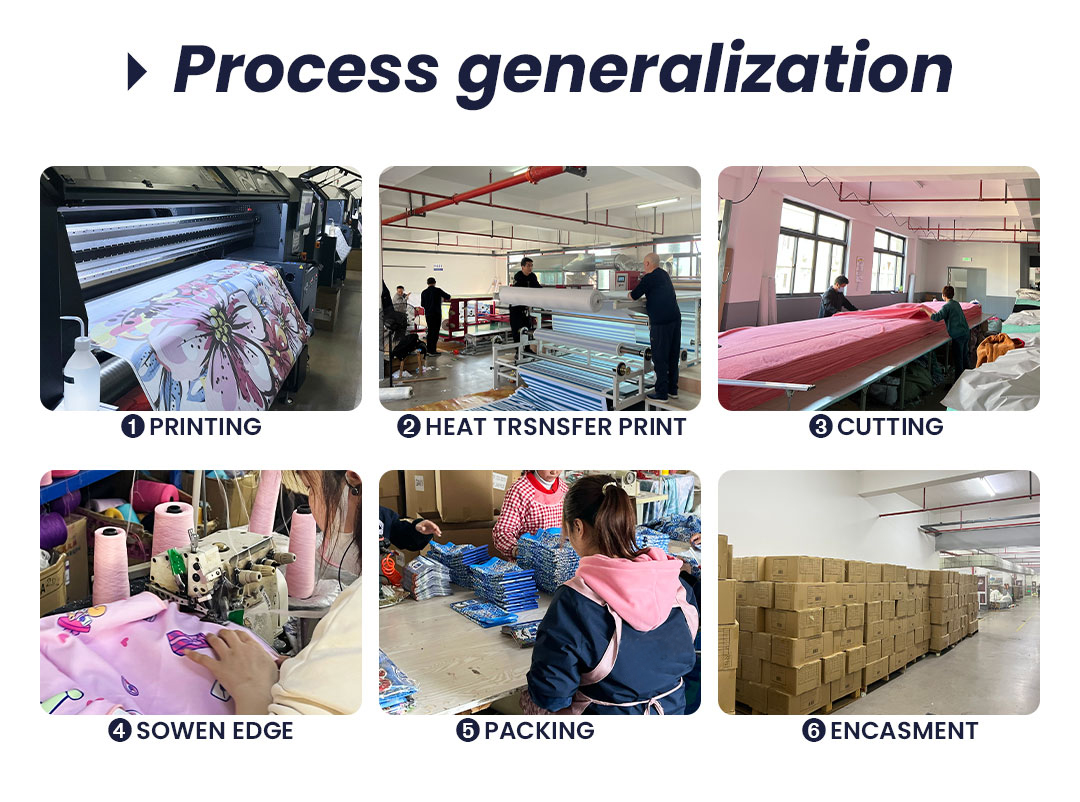
The Process Chart, From A Bonding Point Of View
Same six stations as our other blanket pages, entirely different physics, because a double-layer sherpa panel has to be printed before the second fabric ever enters the line — and that order of operations is the whole engineering story of this aisle. Station one, artwork printing: the plush face is printed as a single roll, flat and unsupported, before any backing exists. You cannot sublimate through sherpa — the loop pile scatters heat and the backing fabric would scorch at transfer temperature — so on a bonded build the print pass happens while the panel is still one fabric, which is why your artwork is locked at the face-roll stage, not the cut stage.
Station two, heat transfer, does double duty here. It fixes the dye into the face pile, and it pre-shrinks the same roll that will meet the backing. Homeware panels live through laundering cycles that promo throws never see, so a face roll that transfers under-spec will shrink after bonding and the panel will cup at the edges on a customer’s bed. Our transfer windows for this lane run to the bonded-panel tolerance, not the single-ply one, and the difference is invisible on a photo but obvious in month three of a retail warranty.
Station three, cutting, is where two rolls become matched panels — face and backing laid up together and cut as one stack so registration never drifts between the fabrics. Station four, sewn edge finishing, binds the two layers into a single perimeter; the folded-corner evidence in the first photo is exactly what a correctly bonded and bound edge survives. The chart’s final pair, packing and encasement, gets its own treatment further down, because a thick sherpa panel compresses very differently from a light throw and the wrong bag turns a homeware carton into a puffing, springing freight problem at the pallet builder.
Read the chart again as a buyer and it answers the three questions that separate real bonded product from stacked lookalikes: was the face printed before bonding, was the transfer run to bond tolerance, and were the layers cut as one lay-up? Our line photographs every station because those three answers are the audit. When an importer’s QC agent stands on our floor, the numbered panels above are the checklist he walks. Print, transfer, lay-up, bind — four decisions a single-ply supplier never has to make, and a homeware buyer cannot afford to leave implicit in a sample. When your QC writes an AQL plan for this SKU, station numbers beat adjectives: transfer temperature logs live with station two, lay-up registration with station three, stitch density with station four, and every defect class maps to exactly one of them.
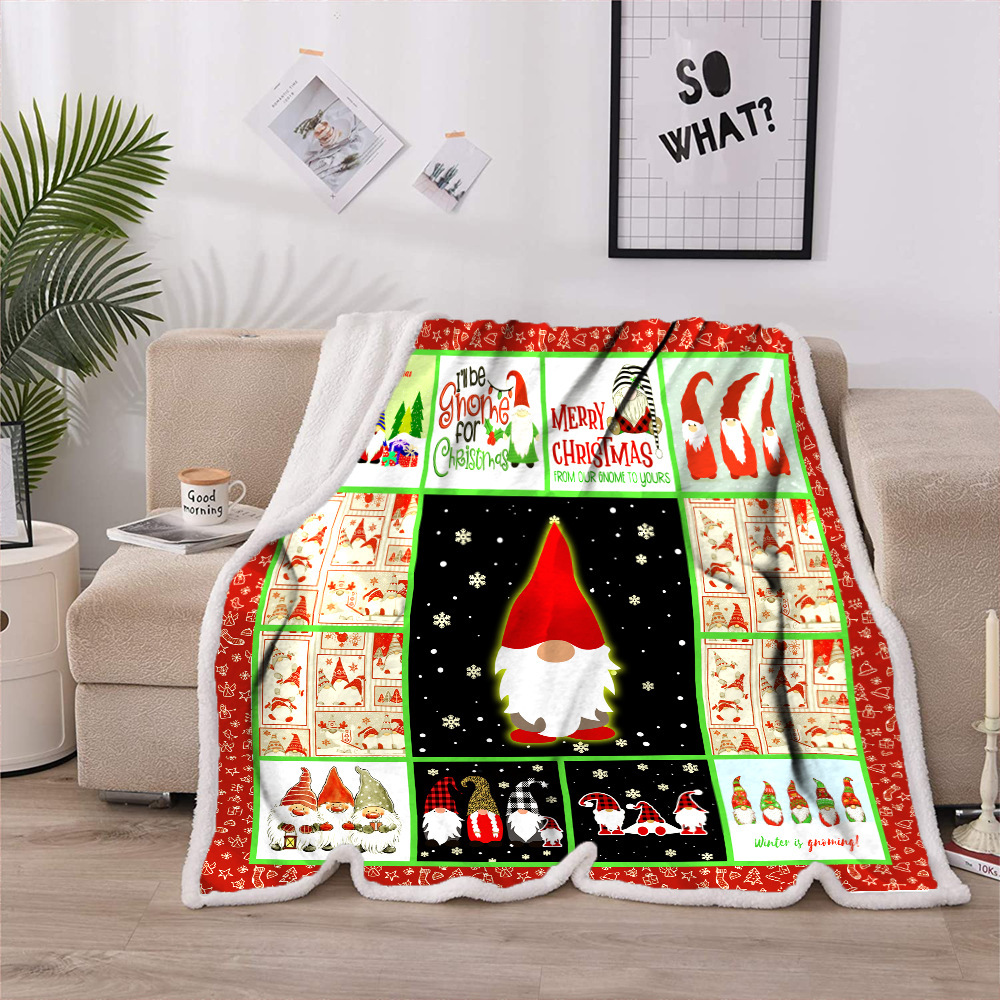
The Sofa Shot: How Bonded Panels Drape In A Real Room
Drag a sherpa panel across a sofa arm and it falls differently from a single-ply throw — heavier shoulders, rounder crests, fewer sharp creases — and this living-room frame exists because homeware buyers sell on exactly that drape. The printed field here is a faux-patchwork holiday layout: quilt-block panels separated by printed sashing lines, a gnome-motif cast of characters across the squares, green script and block pun text, an outer border of white line-art festive icons — sample artwork for a seasonal capsule, described by motif class because none of that art is ours to license or reproduce. What is ours is the fabric behaviour around it: the top-left corner turned back showing the white sherpa reverse against the flat printed face, and along the bottom edge the backing wrapping the perimeter in the same plush band that the bonded construction produces.
Shadows in the frame matter more than they look. Plant-frond shade falls across the upper right of the panel, and it reads as a shadow on fabric rather than a stain — because a matte sublimated face under plush keeps its colour fidelity when rooms light them unevenly. Shelf lights in a home store are no kinder than living-room windows, and a face that turns blotchy under side lighting returns by the pallet. This is the photo merchandising teams ask us for: not a render, not a flat-lay, but the panel behaving like an object in a room where people actually use it.
For capsule planning the sofa scene maps to placement in the store. A graphic holiday panel like this hangs at bed-end in the bedding aisle, folds into the throw bin, or rides a demo sofa in the homeware department — one bonded SKU covering three fixtures, which is precisely why seasonal capsules in this construction beat single-ply prints for Q4 floor space. The gnome-motif sample shown proves the print handles small detail across a patchwork grid without nap bleed; your capsule artwork — snowflakes, characters, patterns or straight type — inherits that behaviour unchanged.
The dressing in the frame is honest set furniture: taped prints on the wall, a mug, a magazine. None of it implies a feature. What the room implies is a use case, and use cases are what seasonal buyers plan shelf sets around. Drape weight is also a display decision: bonded panels stay where a store puts them — folded on a table, half-hanging off a bed form — while single-ply throws slide and need clips, so fixture plans written for this fabric cost fewer restocking labour hours across a store day.
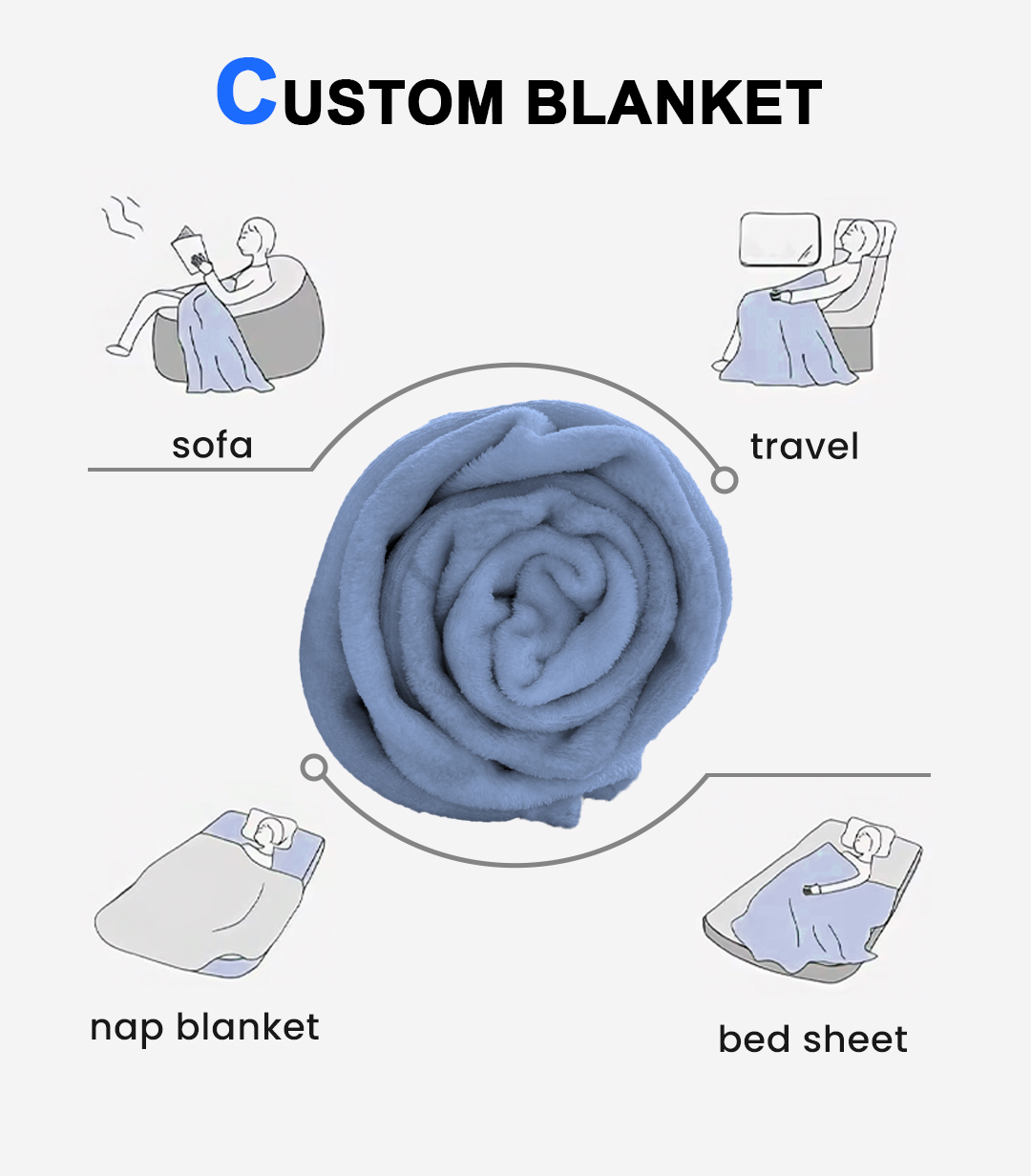
The Use-Case Wheel Read As A Bedding Assortment
On the light-throw page the wheel diagram argues occasions; on this page it argues assortment width, because a bonded sherpa panel crosses four homeware subcategories that merchandisers usually buy from four different vendors. The sofa quadrant is the throw bin in a home store — the medium size step on our printed chart, sold flat-folded in a clear bag. The bed-layering quadrant is the real homeware volume: a large panel used as a top layer over a duvet, where the sherpa side faces the sleeper and the printed side faces the room, which is exactly how a double-layer construction flips one product into two selling points. The nap quadrant sells to nursery and children’s departments, and the travel quadrant — smaller, rolled, boxed — covers the car-travel and airline-gift sub-bin.
A bed-in-a-bag assembler reads the wheel differently again: the four scenes are four insert strategies on one SKU card. Ship the same bonded panel with a coordinating sheet set and the throw becomes the set’s hero piece; sell it alone and it stands as seasonal floor stock; bundle it into gift-with-purchase and it drives basket size in November. The construction carries all three because the bonding survives being merchandised hard — the edge band from station four keeps the panel reading new on a bin after twenty handling cycles.
Buyers planning a first sherpa assortment consistently over-rotate on novelty prints and under-rotate on bed scale; the wheel is the antidote we send in the deck, because each quadrant comes with its own size step, its own carton count, and its own freight profile. Send your plan-o-gram and the desk maps the quadrants onto the three printed sizes plus the pack styles further down, in one tier sheet, before you commit anything.
The rolled centre sample is the same argument in one object: plush wound tight with the backing showing at the spiral edges — a bonded panel rolls denser than a single-ply throw and holds the roll, which is what makes the bin display and the vacuum carton both work without the product springing open on the shelf.
Vendor consolidation is the quiet half of this purchase. A homeware department sourcing bin throws, bed-top layers and nursery pieces currently pays three MOQs, three freight minimums and three inspection protocols; the wheel’s four quadrants off one bonded blank collapse that into one factory conversation with one stored colour reference. When the category review asks why the assortment got wider while the PO count went down, the diagram is the slide that answers it without adjectives.
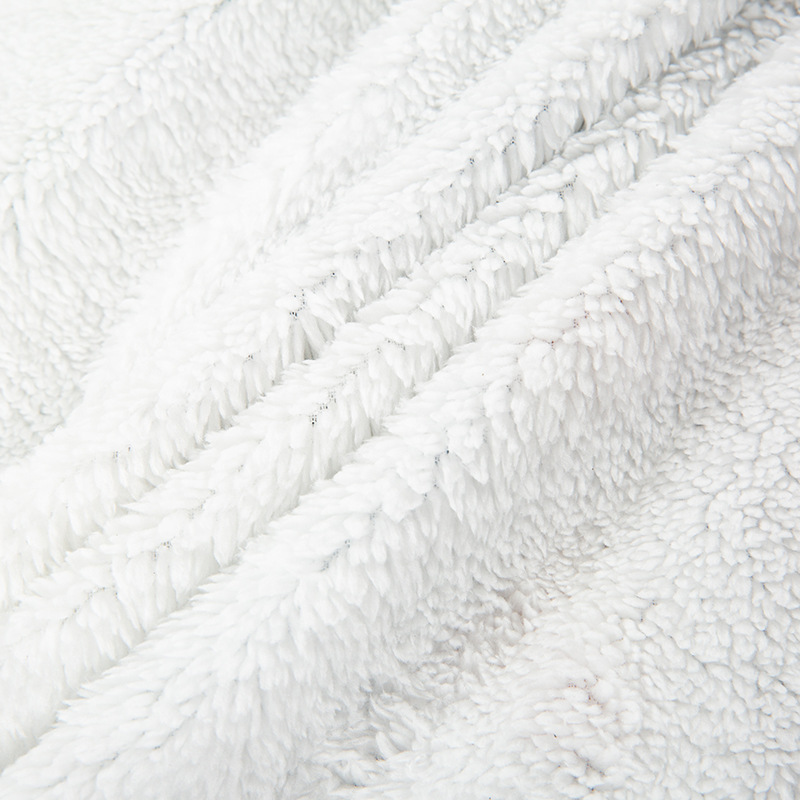
Under The Microscope: What The Pile Macro Is And Is Not
Frame-filled, diagonal folds, no props, no label: this is a swatch photograph, and it is on the page for the one question homeware buyers always ask second — not how it prints, but how it feels when your own hand forgets you are evaluating. The nap reads dense and slightly curled, catching light as near-white crests and cool grey valleys along each fold line; that ridged, corded appearance is what deep plush does under diffuse studio light, and it is the visual signature of pile that has enough body to recover after compression rather than matting flat by March.
Be precise about what this frame does not show, because precision is the product claim. Only one fabric face appears here; the reverse is hidden inside the folds, so this image proves pile depth and hand, not construction. The bonded build is proven by the turned corners and folded stacks elsewhere on the page. No print is visible because the swatch shows the unprinted base fabric — the blank that your artwork rolls over before station one touches it. Gram weight is not printed anywhere in frame, so any gsm ladder a competitor quotes from a macro shot is decoration, not data; ours comes from the sample you request, and we will match it to the warmth tier your price point needs.
Quality control reads this photo as a spec sheet, though. The fold shadows tell an experienced QC the pile’s recovery behaviour; the even crest line along each fold says the nap direction is consistent across the roll — an inconsistency that shows up on printed panels as directional colour shift, worst on dark faces. When your capsule goes dark-ground, that is the single risk worth sample-checking, and this macro is why the physical sample exists before three thousand units inherit a nap problem.
The white colourway shown is also the production baseline: every print run starts from this undyed face, so shade-of-white between fabric batches is the governance point we log against your stored reference, order to order, exactly because a capsule that lands lighter than last season’s reads as a different product on the same shelf tag.
Care behaviour belongs in this section because it starts here, in the pile. Domestic laundering at moderate temperature with no fabric softener keeps loop structure open; softener coats fibres and the sherpa side loses loft permanently within a handful of washes, which is a shelf-review problem dressed as a laundry problem. Your care label artwork can say that in your brand voice at mock-up stage — the construction on this page supports the honest instruction instead of hiding from it.
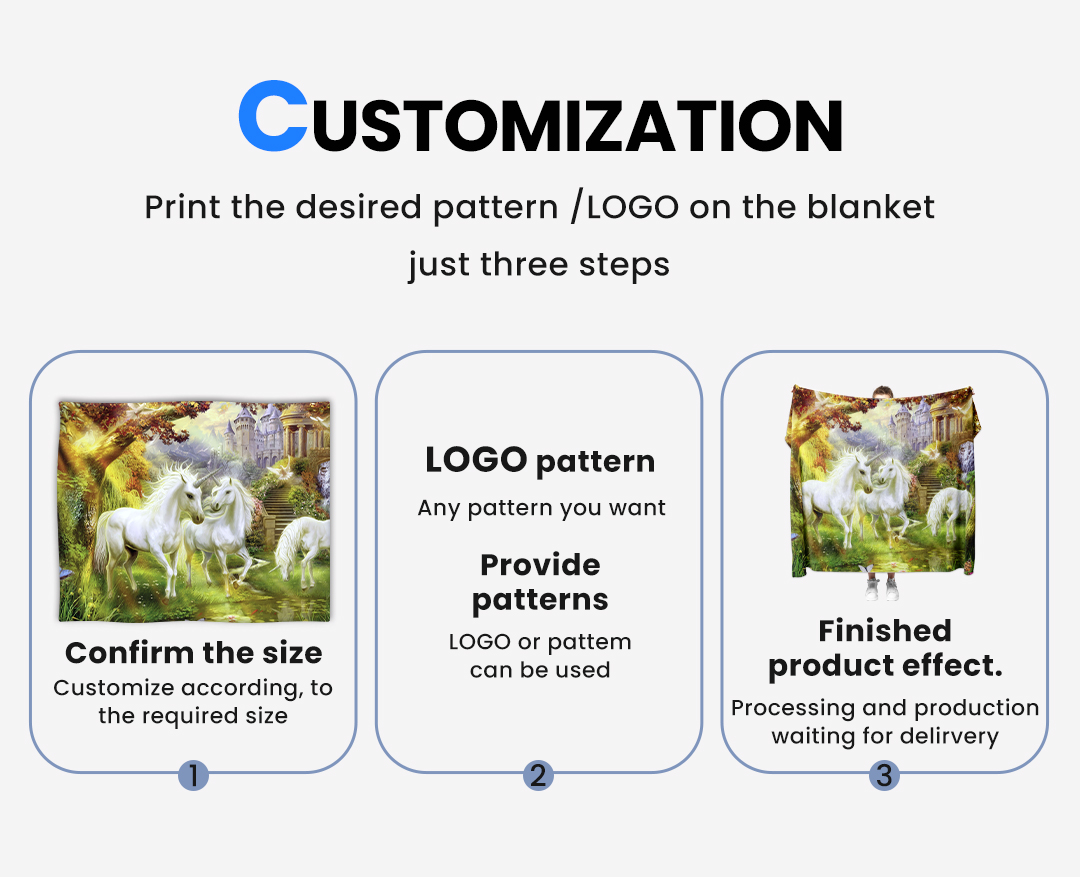
Placement Steps For A Homeware Panel, Not A Souvenir
The three-step customisation diagram — size confirmation, artwork drop-in, finished effect — repeats across our blanket pages, but a homeware buyer works it backwards from the room. Size first, because shelf geometry comes before graphic ambition: a bed-top layer is planned from the mattress, a sofa-bin piece from the arm height, and the diagram’s first card is where your team decides which rectangle the capsule lives in. Artwork second, and on this lane the commercial question is not where the logo goes but whether a logo belongs there at all: homeware retail buys pattern-forward panels — repeating motifs, patchwork grids, full scenic fields — where the brand mark of the home label shrinks to a woven-corner whisper or disappears into the design. The diagram’s third card, the finished effect waiting for delivery, is the stage where the desk checks that decision against your sales channel rather than our taste.
For capsule collections the placement conversation gets a second dimension: series consistency. A twelve-print holiday capsule on one bonded blank must share layout coordinates across all twelve faces — border width, safe area, motif grid — so the bin of twelve reads as a family on shelf. The diagram exists to freeze those coordinates once, at mock-up, before the twelfth artwork file surprises anyone. Home brands that run a corner wordmark across the whole series also lock its position here; one offset crest between drop one and drop five is a shelf-recognition leak nobody can invoice.
What changes versus the gift-throw lane: on a homeware panel the fold is engineered around merchandising, not the other way around. Bed-layering displays half-fold at the pillow, throw-bin units fold to their printed face, and the placement you approve here is the placement those two folds show. Send your display intent — bin, bed-end, boxed bundle — with the file, and the mock-up composites your artwork already folded that way, because approving a graphic nobody will ever see laid flat is how capsules die.
Artwork ownership rules hold at every zone: we print what your paper covers. Public-domain pattern libraries, your licensed characters, your own studio art — the mock-up sheet records the source claim in writing, and the factory floor never sees a file that isn’t on that record. Reorders that swap artwork but keep the blank and the coordinates skip straight past re-proofing of position, which is why drop six of a capsule costs less attention than drop one.
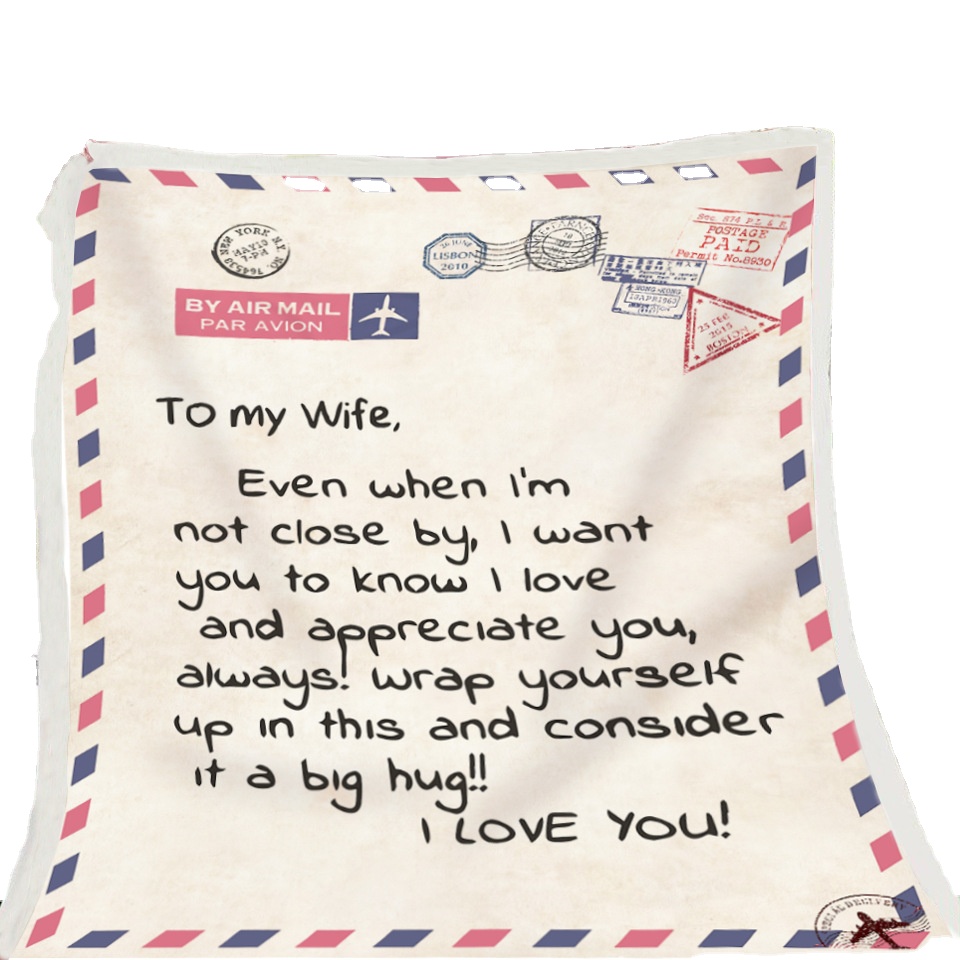
The Keepsake Print: Full-Field Graphics On A Bonded Base
Not every homeware panel is an all-over pattern, and this photo carries the other brief: a full-field novelty graphic printed edge-to-edge on the same bonded blank. The design is a vintage postal-envelope composition — the classic red-and-blue diagonal airmail border running all four sides, simulated stamps and cancellation circles scattered across a cream aged-paper field, a red permit-box corner, and a long handwritten-style note block filling the centre. It demonstrates exactly what the sublimated face layer is built for: typography, paper texture simulation, tiny stamp details and a message paragraph that would shatter on a screen-printed single-ply product and reads crisply at 150+ dots here.
Every letter on that panel belongs to whoever commissioned the demo artwork — an addressee line, a love-note body, faux postmark city names, a date in the 1940s — and none of it is offered as your template. The commercial truth the frame proves is capacity, not content: full-bleed text-dense artwork holds its edges, its simulated foxing looks like paper rather than dirt, and the border stripes register square to the panel through the cut-and-bind passes. Your version is a family recipe card set in handwriting, a wedding-day note, a brand origin story, a postcard print of a city you own photography for — and it will print exactly as this one did, on the same face roll, with the same sherpa reverse hidden behind the fold.
This is also the gift-aisle crossover where homeware and gifting meet at shelf: a keepsake print on a bonded panel sells in the November-January window as a boxed present rather than a bedding accessory, at a higher ticket, on the same blank. Buyers running both channels split one production across two pack styles — the retail bag for the bin, the ribbon or band presentation for the gift end-cap — and the packing grid two photos down prices both off one artwork run.
One construction note the frame carries quietly: the print stops short of the perimeter into a narrow plain hem margin, which is how a bound edge on a bonded panel is designed to look — intentional, not unfinished — and why your safe-area spec from the placement diagram keeps every letter inside it. Keepsake prints also teach the retail lesson of this lane: the same bonded blank sells as bedding in September and as sentiment in December, at a different price point, from the same fabric order — only the face file and the bag change.
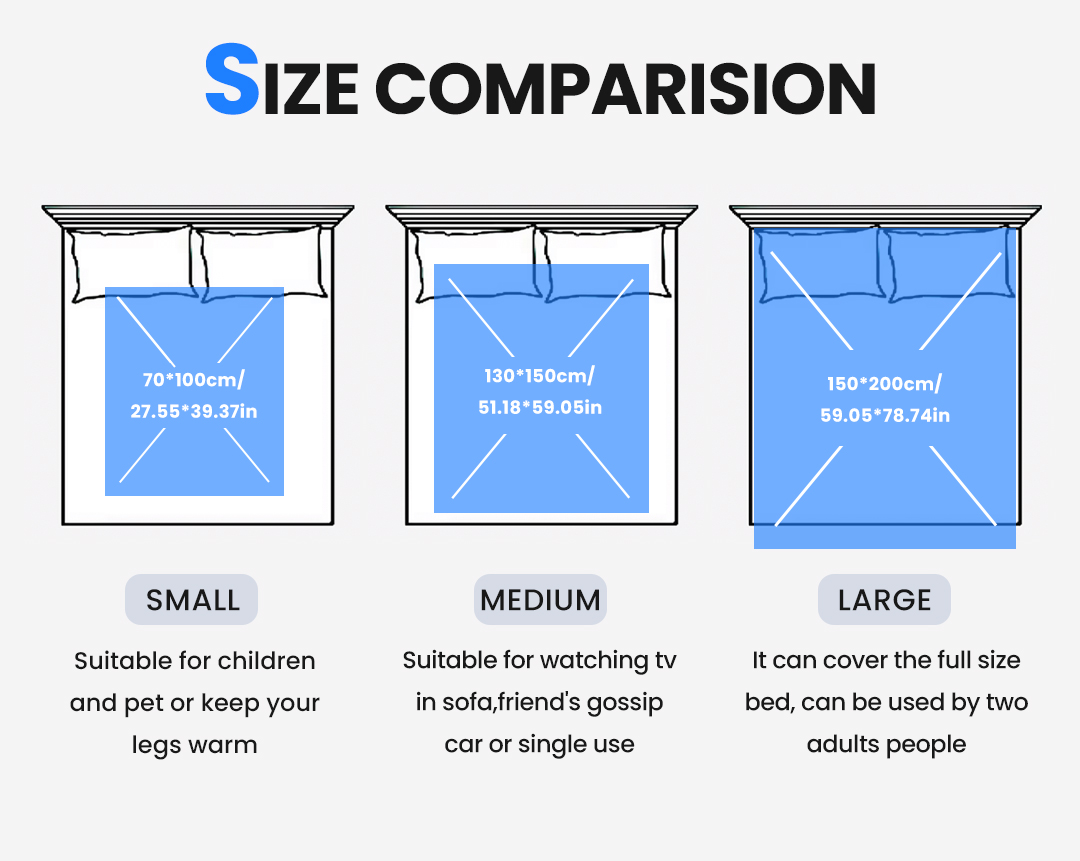
Our Printed Size Ladder, And How Homeware Buys It
Three rectangles, three printed statements, lifted from our own chart so they are spec rather than poetry. The board’s small cell reads 70*100 cm — 27.55*39.37 in — and sketches it on a bed drawing sitting low on the mattress, clear of the head end, captioned for kids, pets and leg warmth. Its middle cell reads 130*150 cm (51.18*59.05 in), a panel the drawing lets climb halfway up the sleeping surface, captioned around sofa viewing and solo overnight use. The large cell reads 150*200 cm (59.05*78.74 in), drawn swallowing the full outline and draping the foot rail, captioned for shared coverage across a full bed. On the homeware lane those steps are assortment slots: the medium is the throw-bin SKU, the large is the bed-top layer that drives bedding-adjacent traffic, and the small is the nursery and pet sub-bin.
A merchandiser assembling a sherpa line weights these differently from single-ply throws because bonded panels sell by apparent mass: the same medium reads visibly thicker in a bin than a light throw of identical footprint, which is the entire margin story of the aisle. The large step moves best when the capsule artwork is composed to be seen half-folded at the pillow — plan the layout from the fold, not from the flat file — and the small step converts seasonal print into an impulse end-cap without any freight penalty worth arguing about.
One artwork file can cover all three steps in one run, because the face roll prints first and the cutter splits sizes later; MOQ stays 100 pcs per design, so a ladder of one-hundred small, two-hundred medium and one-hundred large on a single capsule artwork is one design line in the quote rather than four. Size tolerance and the finished bonded-stack thickness are confirmed on your physical sample; the chart does not print either figure, so neither appears in our copy.
Anything outside the printed ladder — a wider bed cut, a custom carton footprint, an oversized nursery panel — opens a new tooling conversation instead of stretching a size claim, and the desk will price it against your cut map before a plan-o-gram depends on it.
Bin capacity math belongs with the ladder, because shelf planning is ultimately arithmetic. The medium step stacks in a standard throw bin at a fixed face count; the large sells from bed forms one per fixture and reorders weekly, not monthly; the small lives on a shelf strip beside the checkout where units-per-linear-foot does the selling. Our own store-service clients order the three steps at a rough four-to-three-to-one ratio through Q4 and reverse the small-to-large weighting after the holidays, when the ladder’s bottom step becomes a Valentine’s impulse piece on the same blank. Those swing numbers are yours to plan with — the file, the bond and the edge do not change when the season does.
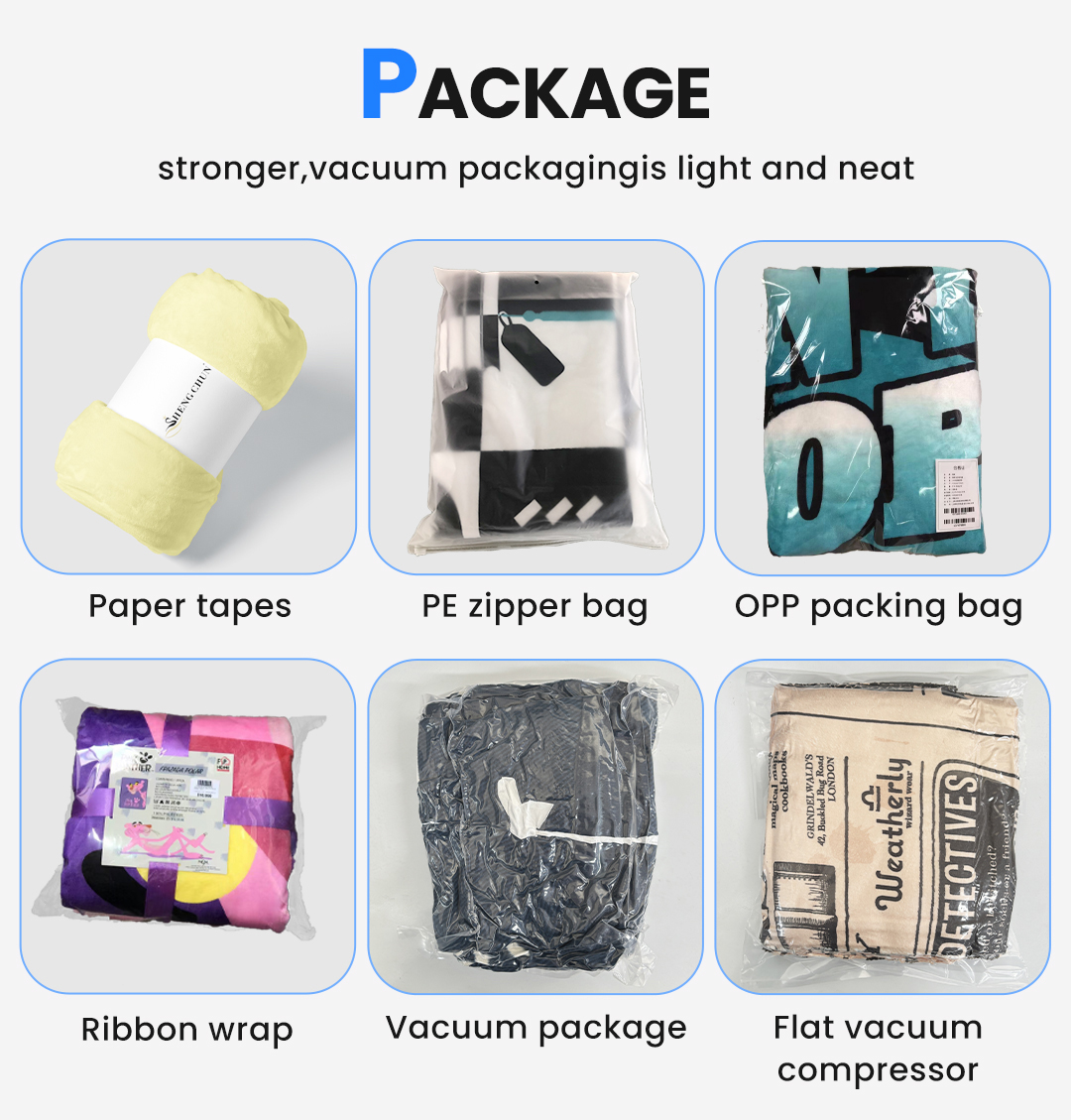
Compressing Sherpa: The Packing Grid Is A Freight Decision
A light throw squashes without complaining; a bonded sherpa panel pushes back, and every bag on this grid negotiates that push differently. That single physical fact turns packaging from a cosmetic choice into the freight decision your margin actually loses or wins, and the six photographed options are the negotiating table. Read them as engineering, not decoration.
Every pack style on this grid ships for this line — banded roll, zipper bag, labelled cellophane bag, ribbon-and-card, standard vacuum and the flat brick, exactly as captioned in the graphic — but a bonded sherpa panel interacts with each one differently from a light throw, and that difference is where your carton cost lives. The retail cells first: PE zipper with an internal tag and OPP bag with an external label are the bin-ready presentations, sized for the medium step, reclosing for home storage. The band roll carries a printed belly band and shows the spiral that the bonded build holds better than single-ply; ribbon wrap turns the keepsake print into a gift-aisle unit without a rigid box.
The vacuum cells are where homeware importers get educated, because sherpa is bulk with memory. Light vacuuming shrinks a bonded panel for the parcel and the loop pile recovers within days of opening; deep flat-compression bricks the same panel for ocean freight, cutting cube dramatically — the carton math that decides whether four pallets become three — but holding loop pile under full compression for months slows recovery and, done badly with heat and humidity in the container, can set a crease line a customer sees on day one. The rule we ship by: retail shelf goods vacuum at the light tier so the bin display reads fresh; warehouse-stored or FBA-buffered goods take the flat brick and get an unpack-and-rest period built into the receiving calendar, not an apology email.
Tell the desk three numbers and the pack tier picks itself: weeks between landing and opening, container or courier, and whether the goods sit sealed in a 3PL before your shelf set. Master-carton counts, inner-pack ratios and label placement all follow that answer, and the same grid serves both channels of one artwork run — a capsule split across bin bags and gift bands prints once.
Because nothing here is decoration: the packing station is process-chart step five, photographed from the line that packs your order, and its options are quoted per piece in writing on the same tier sheet as the fabric. Carton construction sits underneath all six styles: double-wall export cartons with the size split printed on the end flap, so a mixed ladder arrives pre-sorted to store rather than pre-sorted for you to sort. When a buyer changes pack tier mid-programme — say, band roll to zipper bag after a store feedback round — the switch re-runs on the same fabric stock with no new approval cycle, which is exactly the flexibility a long season asks a supplier to hold.

Bulk Timelines: Plan-O-Gram Math In Numbers
The frame above closes the argument with dates. Seasonal homeware is bought backwards from a set week, and a Halloween capsule that lands in the aisle at Halloween is a failure even when the fabric is perfect. The line rhythm: samples 3-5 days from a settled file, bulk production 7-15 days after artwork approval, MOQ 100 pcs per design holding across a size ladder, and capacity of 1,000,000 pcs per month across our gift lines so a full container of bed-layering panels never queues behind someone’s novelty run. For a Q4 shelf set that means artwork in August, approval inside the sample window in September, sea freight landing before the set week, with courier lanes — DHL, UPS, FedEx, TNT — reserved for top-ups and store-opening kits, and FBA prep or your 3PL’s routing sheet done at line end so receiving is a scan.
Capsule drops repeat the same calendar in miniature: a Christmas line that sold out gets a re-run quoted as a part number against its stored reference, and a second wave ordered in December ships courier-direct against the same signed spec. The stored-record discipline is what keeps drop five matching drop one on the shelf tag — same base white, same bond tolerance, same fold — and it is the difference between a home brand’s series and a supplier’s coincidences.
We hold no fixed unit price on this page: the displayed figure on the listing anchors the 100-piece tier, and your quotation — sizes, pack style, capsule count, freight mode — rebuilds it per mix. Certifications and flammability documentation follow destination-market rules; we make no claims on this listing beyond what the photographs show, and any document a market authority asks for gets addressed in writing before the order signs, not after the container books. One working rule saves everyone a bad quarter: treat the plan-o-gram date as the order’s birthday, and every number above falls out of it automatically.
Reference Specifications
| Construction | Double layer: sublimated plush face roll bonded to loop-pile sherpa backing, cut as one lay-up (fold evidence photographed on this page) |
| Face | Low-pile matte sublimation surface; photographic, typographic and all-over artwork behaviour shown in frames above |
| Backing | White looped sherpa pile, visible at turned corners, folded stacks and wrapped perimeter |
| Edge | Bonded-and-bound perimeter from the sewn-edge station; no fringe, no exposed cut stack |
| Sizes from our printed chart | 70 × 100, 130 × 150 and 150 × 200 centimetres; the chart’s own inch conversions ride every order file |
| Weight tiers | No gsm printed in any photograph — quoted on request against a physical sample |
| Roll-to-roll sublimation before bonding; one file may span the full size ladder in one run | |
| Seasonal capsules | Series layout coordinates frozen at mock-up; artwork source recorded per file before production |
| Packing | Compression tiers from light retail vacuum to flat brick for ocean cube; band, zipper, cellophane-bag and ribbon presentations quoted per piece |
| MOQ | 100 pcs per design |
| Sample | 3-5 days |
| Production | 7-15 days after artwork approval |
| Capacity | 1,000,000 pcs per month across our gift lines |
| Freight | Sea · air · DHL · UPS · FedEx · TNT; FBA prep and carton splits against your routing sheet |
What Homeware Buyers Ask Before The Set Week
Is the sherpa backing printed too, or only the face?
Can you quote a gsm ladder across warmth tiers?
How late can a holiday capsule artwork change happen?
Will deep vacuum packing damage a bonded sherpa panel?
Do the sample artworks in your photos come with the order?
What documentation supports a homeware listing in our market?
Sibling Lines On The Same Face Roll
Most sherpa programmes get compared against the family before they are approved. The light printed-throw build for corporate gifting and boxed giveaways is on the custom fleece throw blanket page, and the wearable hooded cut of the same double-layer idea — kangaroo pocket, oversized hood — sits on the hooded blanket page; both share our textile floor, so artwork files often cross-quote cleanly. Category context, including the cushion-cover side of a coordinated home display, lives in the blankets listing under the textiles hub.
Start A Capsule Calendar
Send the set week, the size ladder, the compression tier and where your artwork rights sit, and the sales desk answers with a composite proof on the actual bonded panel, a per-mix sheet built from the 100 pcs per design floor, and a physical sample in hand inside the week. Sales desk: +86-15967739086, [email protected], or the request-quote form online; the form below reaches that desk as well.