Custom Kids Aprons for Craft, Class & Family Fun
$0.99
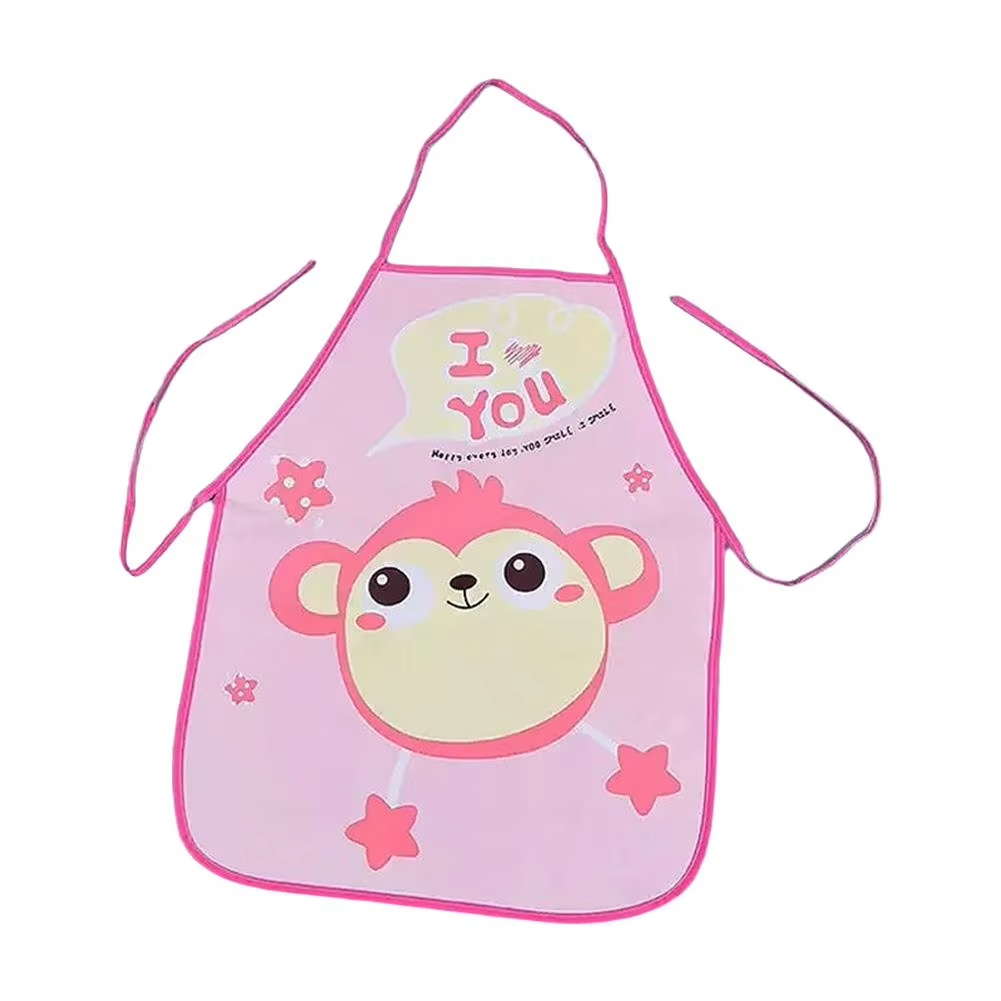
Custom kids aprons with cartoon print, built for classrooms, summer camps, baking clubs and family event favours. The glossy coated-film bibs wipe down between paint and batter sessions, bind edges in contrast trim, and offer fixed pullover loops or tie-cord halters with side waist ties exactly as photographed — chick, monkey, owl and blob-creature sample art shows the print lane, and your school crest, mascot or club mark replaces it across the same front zone. Matching elastic-cuff oversleeves and headpieces print from the same artwork program. Yellow, pink and blue colourways; kid-scale block with graded sizes quoted against samples. MOQ 100 pcs per design across mixed colours, samples in 3-5 days, bulk 7-15 days after artwork approval, 1,000,000 pcs per month capacity.
The Apron That Saves the Artwork — and the Good Shirt
Custom kids aprons with cartoon print buy themselves back in laundered T-shirts. A school art teacher, a summer-camp lead and a bakery-party host all run the same daily arithmetic: twenty small painters, one glaze station, and clothing that either gets covered or gets written off. The coated-film bibs on this page exist for that arithmetic. They wipe down between sessions, they shrug off poster paint, glue and batter, and the big front surface carries your logo, your mascot or your club emblem at a size a child actually volunteers to wear.
Everything claimed below is anchored to the four product photographs: yellow, pink and blue colourways, glossy wipeable film bodies, cartoon-animal sample art, fixed neck loops or tie-cord halters with side waist ties exactly as photographed, and a matching oversleeve accessory shown in one frame. Pocket counts, hardware grades beyond what is photographed, and age sizing are quoted per production run — stated honestly rather than guessed.
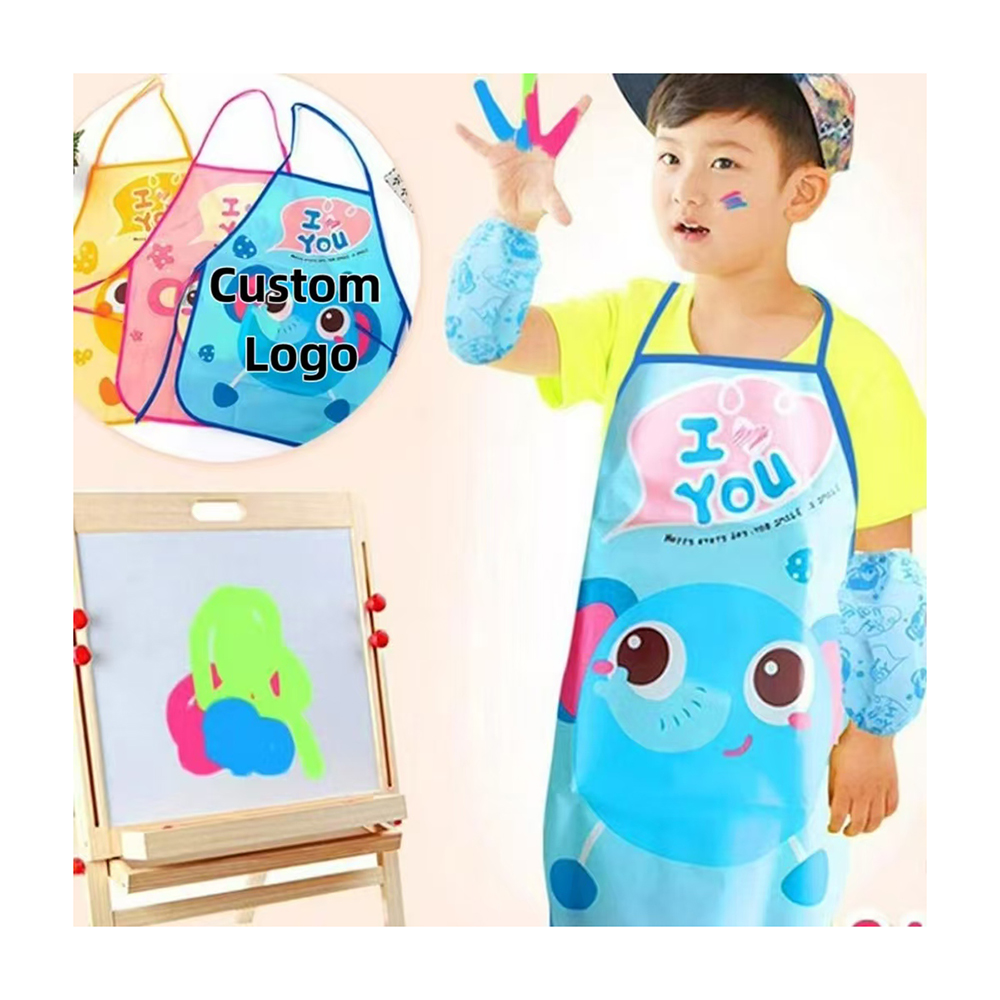
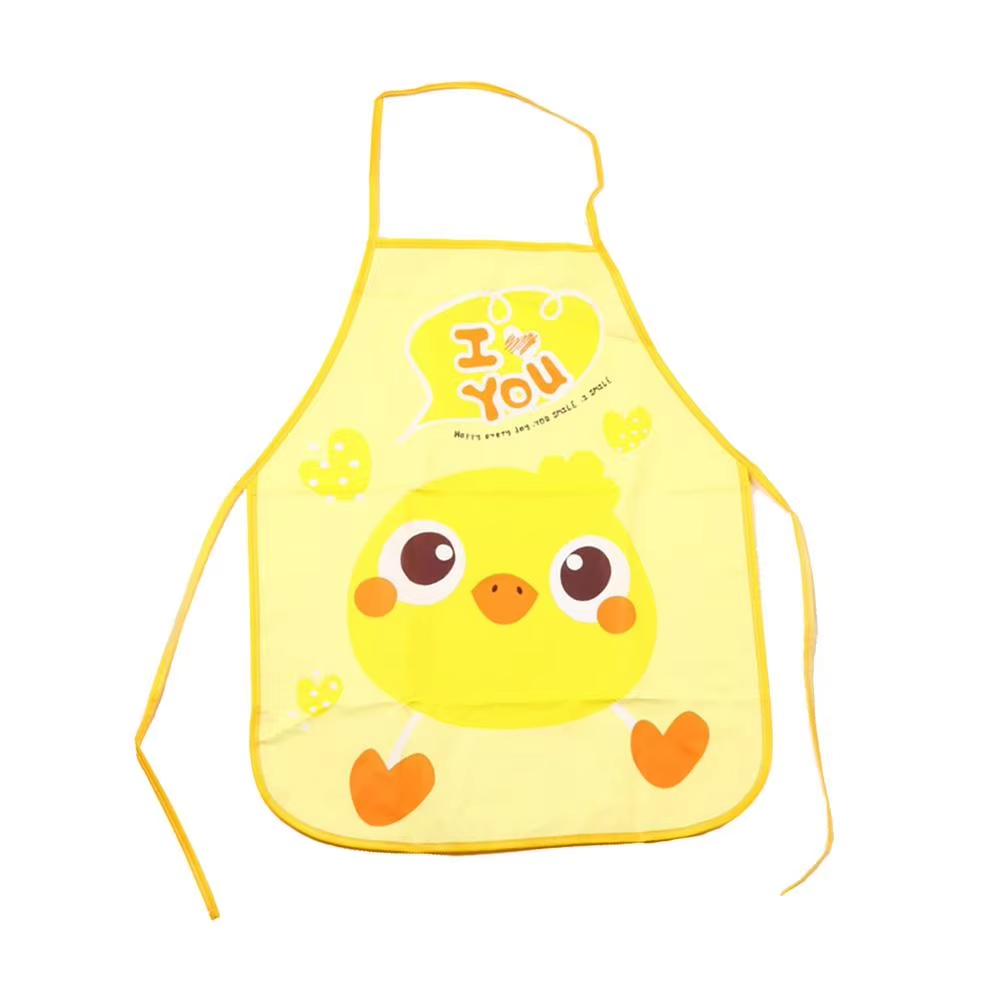
The photo set is deliberately plain: two flat-lay single aprons on white backgrounds, one coordinated set shot with accessories, one promotional composite with a child modelling the bib beside a paint easel. There are no staged clean-up miracles and no lab equipment in frame, which matches how these actually behave on a craft table: the sheet flexes, the trim holds, the print stays bright, and the whole bib rolls into a cubby drawer between sessions. What the camera does not show — film thickness, exact head-opening measurements, wash-cycle lifetimes — stays in the quotation column instead of pretending to be a feature list.
Glossy Coated Film: The Wipe-Down Surface
Every photographed unit shares one body material: a thin, smooth, lightly glossy coated film that reads as water-shedding on its face — no woven texture pokes through, and the sheets hold a soft fold line instead of a textile crease. That surface is why a dried acrylic streak lifts off with a damp cloth between class periods, and why the bib survives being stuffed into a cubby hook after a baking party.
Because the film is the product, the edge treatment is too: perimeter edges are finished with a contrasting bound trim on the yellow and pink flat-lay aprons, and the modelled blue apron shows bonded, piped edges — a heat-welded and tape-bound build rather than thread sewing through the sheet. The pink colourway in the second photograph is semi-translucent enough that the white backdrop shadows faintly through it, which is what the lighter film stock looks like off the press. Film thickness, backing options and wash-cycle survival data travel with your quotation and get proven on the physical sample, not asserted here.
Two consequences of the film build matter to program buyers. The first is storage: a wipe-down surface means classroom bibs don’t need a drying rack between sessions — the stack-in-a-drawer routine that textile smocks fail survives on film because paint lifts off instead of soaking in. The second is graphics behaviour: ink sits on top of a coated sheet rather than sinking into fibre, which is why the sample prints read with poster saturation and crisp small shapes — the polka-dot fills inside the hearts and the thin white limb lines survive at sizes a textile print would bleed away. If your program pairs these bibs with laundered cotton garments, the artwork file can carry over to the woven clothes range later in the same season, printed from the same master, without redesigning for a different substrate.
Buyers comparing film against a cotton canvas smock should also weigh the carton economics, because that is where the decision is usually made in writing. Film bibs fold to roughly a paperback’s thickness and weigh a fraction of the woven alternative, so a sixty-piece classroom set travels in half the cube of cloth smocks — one carton instead of two on the freight quote. Nothing in the photographs can measure that for you, but the flat-lay frames show why it is true: the sheets hold a crisp fold line rather than puffing at a seam. The trade-off goes the other way at retail — a folded film apron on a shelf reads utilitarian, so programs that sell the bib as part of the experience typically add a printed header card or move the artwork to the gift-packaging lane, both of which quote as packing line items rather than product changes.
Neck and Waist: Three Fastening Styles on Camera
Children’s apron returns start and end with the closure, and the photos show three honest configurations.
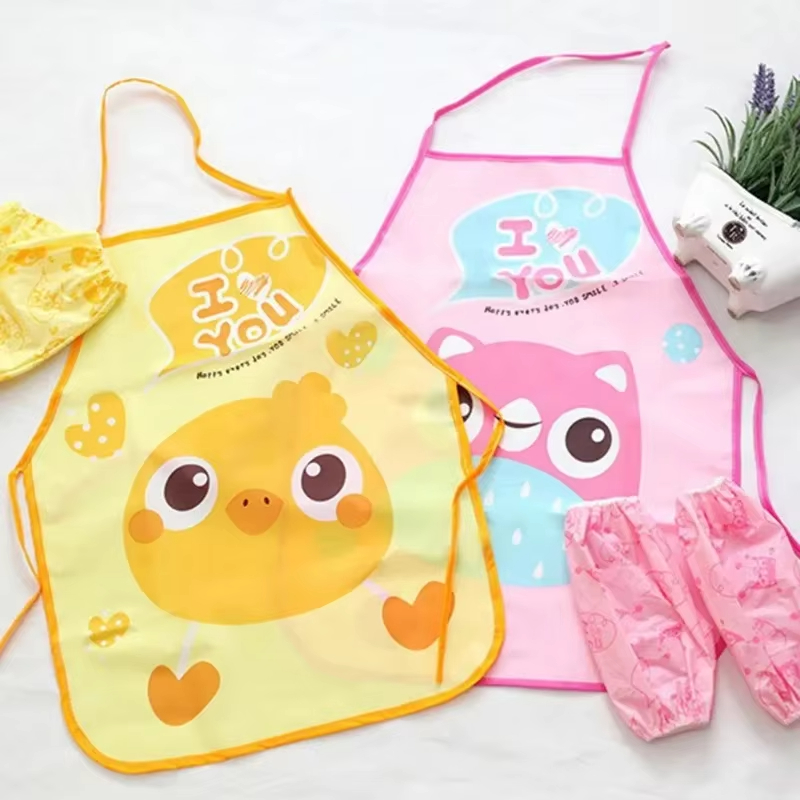
The yellow and pink flat-lay bibs use a fixed sewn neck loop — a pullover ring sized for small heads — with two long fabric waist ties at the side seams, so the fit tightens at the hips while the head opening stays constant. The two-apron set shot goes the other way: thin halter cords tied at the neck plus side ties, a fully knot-based system with zero hardware. The modelled blue apron returns to the fixed loop, worn open over a neon tee with its paired sleeve protectors in place.
Why does this matter more on a kids’ bib than an adult apron? Because children’s clothing gets put on by children, mostly unsupervised, mostly in a line of twenty. A system with a knot is a system with a failure point that shows up as a wet collar and a frustrated five-year-old; a pullover loop either goes on or it doesn’t, and the adult intervenes exactly once. That is the same logic that makes the photographed loop-and-tie build popular with daycare chains and grandparent gift buyers — not durability, but autonomy. The waist ties double as the growth allowance: a bib knotted high on the ribs reads toddler-sized this term and re-ties lower next year on the same unit, which is one more reason these get handed down instead of written off.
No snaps, sliders or buckles appear anywhere on the photographed units. That is deliberate procurement information: tie-and-loop builds have nothing to lose in a classroom drawer and nothing to scratch a table top. If your program specifies adjustable slide hardware, quote it as a modified closure and see it on a sample before signing — this page does not promise hardware the camera does not show.
The pullover-loop version carries one more practical advantage worth stating for camp and club buyers: a fixed loop sized for small heads goes on and comes off without adult help, which changes the classroom logistics of twenty five-year-olds getting aprons on before paint time. Tie cords teach a useful knot but slow the line down; programs that run three sessions a day consistently pick the loop and keep the ties simple. Whichever closure family you choose, the waist tie length on the photographed samples is generous — enough to double-wrap a small torso and stay knotted through a full craft session — and tie length is one of the few dimensions you can adjust at quotation without retooling the bib itself.
What the Sample Art Tells You About Your Print
The four frames carry stock cartoon artwork — a big-eyed chick face, a monkey, a winking owl and a round blob creature, each with heart accents and a speech-bubble motif above it. Their job is not the characters themselves; those samples will ship under your artwork, not anyone else’s. Their job is to demonstrate the print lane: full-front placement, saturated spot colour over the whole bib, fine line work (whisker-thin limb strokes, polka-dot fills) holding clean edges on a coated sheet.
Your club name, school crest, sponsor mark or original mascot prints across the same zone the chick occupies — roughly the central three-quarters of the bib, with the speech-bubble band reserved for a tagline. For band-side details, one folded headpiece and a pair of elastic-cuffed oversleeves ride along with the set in the third photograph, showing that matching print programs can extend onto accessory pieces from one plate set. Print method for film substrates and PMS matching are confirmed on the digital mock-up before tooling.
Colourways, Sizing and What Stays Quoted
Photographed bodies run in bright yellow, light pink and sky blue, with trim contrast in orange, magenta and darker blue; the set frame adds pink-on-blue oversleeves. The chick, monkey, owl and blob artwork sit on top of the base colour, so the same character can run across a mixed three-colour classroom carton while still reading as one design family.
Proportion is kid-scale: these are short bibs cut for small frames, shown modelled on a preschool-age child. No size tag, age grade or measurement marking is visible on any photographed apron, so height-based sizing (toddler, junior, school-age) is quoted per run against a physical sample. Parent and teacher requests for a deeper skirt or longer waist ties are modification line items on the quotation, priced before artwork approval rather than discovered after.
Who Buys in Bulk: Classrooms, Camps, Clubs and Retail Endcaps
The reorder pattern splits four ways. Art-department and after-school programs order classroom sets — ten, thirty, sixty bibs on one artwork file, colour-split at packing, printed with the school mark so supplies don’t walk home. Birthday studios and family venues run parenting-event favours with the child’s name or event date where the blob creature sits. Summer-camp and scouting operators like the wipe-and-stack economics: film bibs rotate between water-table, paint and kitchen sessions without a laundry cycle. And gift retailers shelve them as cartoon-print add-on pieces against an endcap.
Season planning works backward from the term calendar: camp orders need artwork signed by early spring to land before June intake; classroom restocks ride the new-term window; holiday-season favours and retail drops clear production fastest when the mock-up is approved before the autumn quote freeze. The 7-15-day production window comfortably covers all four lanes when artwork isn’t still moving.
Each lane writes its purchase order differently, and the differences are worth pre-empting. The art-department buyer orders in size-blind quantities — thirty identical bibs, one colour mix, one crest — and asks almost exclusively about wipe routine and how many wash cycles the print survives. The party-studio buyer orders seasonally in bursts of five to ten for weekend slots and cares about the photo-readiness of the front print, because parents post the apron before they post the cake. The camp operator buys in bulk with a split-into-cabin packing requirement, which per-carton colour counts solve without repricing. And the retail gift shop buys the smallest runs with the strictest barcoding needs — that is the lane where FBA-style prep and poly-bag compliance on the packing side earns the repeat, because their receiving clerk is one person with a scanner. All four lanes share the same artwork file on the mock-up stage, which is what makes the hundred-piece floor work as a single design rather than four separate minimums.
Specification Table
| Item on this page | Children’s coated-film craft apron, full-front cartoon/club print |
| Body surface | Glossy coated film sheet, wipeable; pink sample shows semi-translucent lighter stock |
| Edge finish | Contrast bound trim (flat-lay units) or bonded piped edge (modelled unit) |
| Neck options shown | Fixed sewn loop; tie-cord halter — both photographed; slide hardware quoted as modification |
| Waist closure | Paired fabric side ties on all photographed units |
| Pockets | None on any photographed apron — add-on quoted per run |
| Colourways shown | Yellow, pink, blue bodies; orange/magenta/blue contrast trims |
| Sample artwork | Chick, monkey, owl and blob-creature stock cartoons with speech-bubble band — replaced by your logo/mascot file |
| Matching extras shown | Elastic-cuff oversleeves and folded headpiece printed from the same artwork program |
| Sizing | Kid-scale block; graded sizes and measurements quoted on request against a sample |
| MOQ | 100 pcs per design |
| Sample time | 3-5 days |
| Lead time | 7-15 days after artwork approval |
| Capacity | 1,000,000 pcs per month across our gift lines |
Sampling and Bulk Runs
Samples return in 3-5 days so a teacher or event buyer can put a real bib on a real child before the PO. The MOQ is 100 pcs per design — one artwork file can run across mixed colourways inside the floor, split yellow/pink/blue at packing without repricing the design. Production completes 7-15 days after artwork approval within a monthly throughput of 1,000,000 pcs across our gift lines, which is how a sixty-bib classroom order and a six-thousand-unit retail drop fit the same calendar. The displayed price anchors the 100-piece tier; volume brackets step down on the quotation. A free digital mock-up maps your logo onto the bib and the oversleeve zones before anything gets tooled — and for venues that dress the grown-ups too, the adult workwear apron line carries the same chest-print approval process on a woven shell.
Packing and Global Delivery
Each apron folds flat into an individual poly bag, and cartons pack to agreed colour splits with per-carton counts on the packing list — receiving a classroom set should take one clerk, not a committee. Oversleeves and headpieces bag with their paired apron or ship as separate carton lines, your call on the PI. Sea, air, DHL, UPS, FedEx and TNT all run from the same artwork and carton plan, and FBA labelling with per-unit barcodes is a standard prep for the retail-lane buyers. Consolidated orders can add Q4 headwear from the knit beanie line or uniform caps from the structured cap page on one booking, and the full apron category shows how the kids lane and trade lane sit side by side.

Before You Place a Classroom Order
Can we put our own mascot or school crest on the bib?
Is the neck opening adjustable for mixed age groups?
How do dried paint and batter come off?
Can the oversleeves be ordered without the aprons, or only as sets?
Does the 100-piece minimum apply per colour?
Where This Page Sits in the Textiles Range
The apron category splits cleanly: this page owns children’s craft-and-family wear on coated film, while the heavy duty adult page owns woven trade and workshop bibs — no overlap in fabric, closure philosophy or buyer. Cross-sell lanes for a full gift program run through the hats category and the broader clothes range. Every spec row above is built from this listing’s own four photographs.
Send the Artwork, Get the Mock-Up
Email your file and class quantity to the request-a-quote desk, [email protected] or +86-15967739086. The digital mock-up comes back free with colourway options and carton-split maths, and 100-piece-per-design production starts on approval.